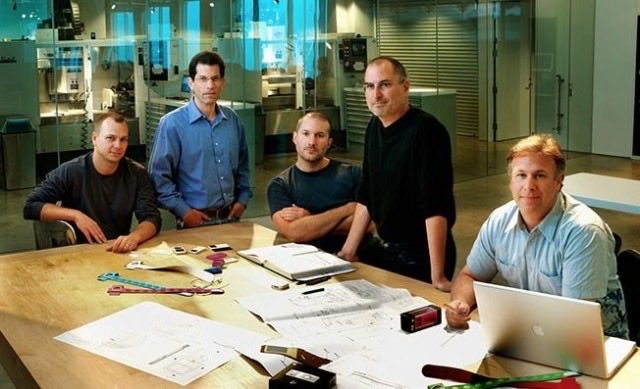
Great spending time with Global Accessibility Awareness Day co-founders @Jennison and @joedevon at Apple Park, as we celebrate the 15th annual #GAAD. Their work continues to motivate developers and teams at Apple to think deeply about technology, designed with everyone in mind.
Incoming Apple CEO John Ternus gave commencement speech at Penn Engineering School in 2024.
He does version of Steve Jobs “paint both sides of the fence even if other people don’t know” attention-to-detail story…about screws for the Cinema Dislay monitor:
“Here’s my first [advice]: the care that you put into your work really matters. My first project at Apple was the Cinema Display. It was a large desktop monitor. It had a beautiful clear plastic enclosure that was held together with some screws coming in from the back. These screws were made of stainless steel, and the head of every screw was machined to have a pattern of concentric grooves that shimmered like a CD when light moved across it. I should probably say, if some of you have never seen a CD before, you can ask your parents afterward.
At some point in my first year, I found myself at a supplier facility. I was far away from home, it was well past midnight. I was using a magnifying glass to count the number of grooves on the head of this screw, which, remember, lives on the back of the display. And I was arguing with the supplier because these parts had 35 grooves, they were supposed to have 25.
I distinctly remember stepping back for a minute and thinking to myself, “What the hell am I doing? Is this normal?” And I thought about it, and I realized it might not be normal, but it’s right. It’s right because I’d already spent months working on that product, and if you’re going to spend that much time on something, you should put in your very best effort. Maybe a customer notices, maybe they don’t, but either way, whenever I saw one of those displays on someone’s desk, it mattered to me to know that my teammates and I had considered everything about it and done the very best job we could.”
***
H/T to @kevg1412 for flagging this: https://t.co/mXrkvpfMej
Disney paid roughly $200 million just for Robert Downey Jr. and the Russo Brothers to come back. That's before a single frame of film was shot. Before sets, VFX, marketing, craft services, anything.
The test screening results suggest that $200M bet is about to pay off at somewhere between 10x and 25x.
Here's why this leak matters more than the usual hype cycle. This is a pre-reshoots cut. The version that tested at Infinity War levels is the version before they add more characters, more cameos, more fan-service scenes. Reshoots on a film testing this well are additive, not corrective. That's a completely different production posture than what Marvel has been doing for the last five years.
The Russos' last two Avengers films did $4.85 billion combined. Infinity War alone cleared $2.05B. Endgame hit $2.8B. The entire Multiverse Saga since then has been a slow bleed of audience trust. Quantumania did $476M on a $200M budget. The Marvels did $206M. Eternals, $402M. Marvel was losing casual viewers at a rate that made the franchise look terminal.
The Downey/Russo reunion was always the play of last resort. Downey literally refused to return unless the Russos directed. His deal includes private jets, a security detail, and a trailer compound. The Russos got $80M with escalators at $750M and $1B box office thresholds, plus their AGBO banner gets a producer credit, which is a first for Marvel.
And now the thing is testing like Infinity War before reshoots even happen.
If Doomsday clears $2B in December 2026, it validates something very specific: Marvel's problem was never the audience. The audience was always there. The problem was that Phase 4 and 5 shipped B-tier directors and C-tier scripts on A-tier IP. The fix wasn't reinventing the formula. The fix was paying for the best people and getting out of their way.
The Russos' performance escalators kick in at $750M and $1B. If this thing does Infinity War numbers, those escalators trigger so fast Disney's finance team won't finish the wire transfer before the second weekend.
Orcas eat great white sharks. They hunt seals, dolphins, and baby whales. They have never killed a single human in the open ocean. Not once, in all of recorded history.
An orca's brain weighs up to 15 pounds. Yours weighs about 3. They have roughly double the brain cells we do in the regions that handle complex thought. A neuroscientist at Emory named Lori Marino put an orca brain in an MRI and found these animals can tell different species apart underwater. They do it by sending out clicks that bounce off everything around them and come back as a kind of 3D sound map (this is called echolocation). From 500 feet away, an orca knows you're a human and not a seal. It skips you on purpose.
The answer is culture. Orcas around the world are divided into at least 10 separate populations, each with its own food rules, its own language, and its own way of hunting. All of it learned from their mothers. One population eats only fish. Another eats only marine mammals like seals and sea lions. These two populations can live in the exact same water and never swap a single meal. A baby orca learns what food is from its mother, and that list stays the same for life.
In the Pacific Northwest, one population called the Southern Residents eats almost nothing but Chinook salmon. Scientists have documented them killing harbor porpoises 78 times over six decades, carrying the dead porpoises in their mouths, and never once eating them. Even when the group was starving. A 2023 study in Marine Mammal Science looked at all 78 cases and concluded it was play. These orcas would rather go hungry than eat something their culture says isn't food.
Researchers studying whale behavior in 2001 found that orca cultural traditions "appear to have no parallel outside humans." Each family group has its own dialect, its own version of the language. Calves spend about two years just learning how to make all the sounds their family uses. Mothers will slow down a hunt on purpose so their young can watch.
In 2005, a 12-year-old kid was swimming in Helm Bay, Alaska when an orca came at him full speed. At the very last second, the orca seemed to realize it was charging a human. It bent its entire body in half and turned back to open water. In captivity, it goes differently. SeaWorld's Tilikum killed three people during his life in a concrete tank. Research from 2016, published in the journal Animals, traced it to psychological collapse from being locked away from the family bonds orcas need to stay stable.
I think calling this a "mystery" undersells the science. Orcas decide what to eat based on culture, not instinct. No orca mother has ever taught her calf to hunt humans, so no orca hunts humans. Only about 75 of those salmon-eating Southern Residents are still alive. Their pregnancy failure rate is 69% because we've destroyed their salmon runs. They won't break their food culture to survive. Whether we care enough to protect theirs is the part that actually matters.
Congratulations to Artemis II on a successful mission! You captured the wonders of space and our planet beautifully, taking iPhone photography to new heights, and we’re grateful you shared it with the world. Your work continues to inspire us all to think different. Welcome home!
Marketing: “we need a 12th logo for this slide.”
Biz dev guy: “Anthropic.”
Marketing: “we’ve…partnered with ourselves?”
Biz dev guy: *shrugs*
Marketing:
Most tech companies break out product management and product marketing into two separate roles: Product management defines the product and gets it built. Product marketing wires the messaging- the facts you want to communicate to customers- and gets the product sold. But from my experience that's a grievous mistake. Those are, and should aways be, one job.
There should be no separation between what the product will be and how it will be explained- the story has to be utterly cohesive from the beginning. Your messaging is your product. The story you're telling shapes the thing you're making.
I learned story telling from Steve Jobs. I learned product management from Greg Joswiak. Joz, a fellow Wolverine, Michigander, and overall great person, has been at Apple since he left Ann Arbor in 1986 and has run product marketing for decades. And his superpower- the superpower of every truly great product manager- is empathy. He doesn't just understand the customer. He becomes the customer.
So when Joz stepped into the world with his next-gen iPod to test it out, he fiddled with it like a beginner. He set aside all the tech specs- except one: battery life.
The numbers were empty without customers, the facts meaningless without context.
And, that's why product management has to own the messaging. The spec shows the features, the details of how a product will work, but the messaging predicts people's concerns and finds way to mitigate them.
- #BUILD Chapter 5.5 The Point of PMs
I can’t put in words what this group of people from past and present has meant to my life. Holding my very first iPod sparked my love for music. My first iBook sparked my love for learning. And my first iPhone pushed me to actually work @Apple. Thank you for truly everything.
So thrilled to celebrate #Apple50 with @paulmccartney! His music has inspired us from the beginning, so this is a full circle moment to close out our celebrations. Thank you, Paul, for proving that when you think different, you have the power to change the world.
50 years of @Apple
From the early days of the #iPod to bringing the #iPhone into the world, some of the most formative years of my career were spent there. The products and teams stay with you. But more importantly so does how Apple thinks.
A few lessons that have held true for decades:
1) Start with the user, not the tech. The question isn’t “what can we build?” but “what problem actually matters?”
2) Focus is everything. Apple is defined as much by what it says no to as what it builds.
3) End-to-end matters. Hardware, software, services. It all has to work together.
4) Details are the product. What feels small is what users remember.
5) Debate hard. Commit fully.
6) Build for the long term.
We’re in another moment of massive technological change. The fundamentals haven’t changed.
The companies that win build things people actually use and can’t imagine living without.
Congrats to everyone who has been part of Apple’s first 50 years! 🙌