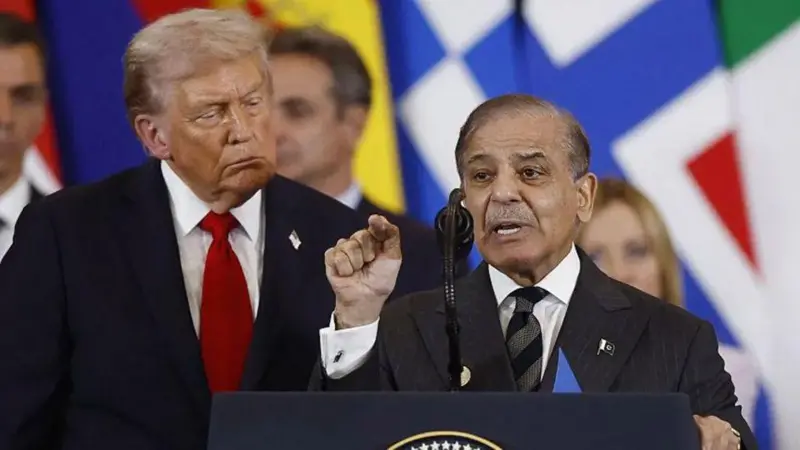
The False Promise of Pakistan's Military - my piece in Foreign Policy in Focus @FPIF today:
Washington has made this bet before, and lost.
For decades, successive U.S. administrations supported Pakistan’s military rulers to advance their geopolitical agendas, overlooking—and at times reinforcing—authoritarianism in exchange for stability and cooperation.
The Trump administration is repeating the same bargain. It has defined counterterrorism, critical minerals, and managing regional competition with China among core U.S. interests. And yet, each of these is threatened by the very institution the United States has relied on to preserve them. The Democratic-controlled Congress now has an opportunity to reverse course.
https://t.co/0U2F4hFkX2
Deeply saddened by the tragic shooting incident in Kraków, which has resulted in the loss of precious human lives and left several others injured.
On behalf of the Government and people of Pakistan, and on my own behalf, I extend our heartfelt condolences to Prime Minister Donald Tusk, the bereaved families and the people of Poland. Our thoughts and prayers are with the families of the victims during this difficult time. We also wish a speedy and full recovery to those injured.
Pakistan stands in solidarity with the people and Government of Poland in this moment of profound grief.
🚨BREAKING | Houthi attack on Riyadh; 23 Pakistani soldiers reportedly killed!
Saudi Arabia’s capital, Riyadh, has reportedly been targeted by Houthi ballistic missiles.
According to sources, 23 Pakistani soldiers were reportedly killed in the attack, while around 80 others were injured.
🚨BREAKING | Houthi attack on Riyadh; 23 Pakistani soldiers reportedly killed!
Saudi Arabia’s capital, Riyadh, has reportedly been targeted by Houthi ballistic missiles.
According to sources, 23 Pakistani soldiers were reportedly killed in the attack, while around 80 others were injured.
Pakistan turns down Saudi request to strike Houthis.
Pakistan says the Mecca Pact of mutual defense “doesn’t cover a pre-existing condition,” so it only covers wars started after the pact was signed. It also covers only state actors, not non-state actors (and perhaps preferably those within reach of Pakistani power projection).
Saudis won’t ask Turkey (the third partner in the Mecca Pact). If they did, Turks would happily deploy naval assets from their Somalia base. Turks itch to control Bab al-Mandab; a fight with the Houthis would give them an excuse. Saudis are not keen to replace Iranian occupation of Yemen and the strait with Turkey.
3/
Now the FASCINATING part.
This is not Delta’s first Afghan pipeline project. They have been here before.
In the 1990s, Saudi Arabia’s Delta Oil was one of Unocal’s main partners in the original CentGas consortium, which wanted to move Turkmen gas through Afghanistan to Pakistan.
Delta Oil, the predecessor/company lineage of today’s Saudi Delta group, was one of the original principal partners of Unocal in CentGas in the 1990s.
In 1996, Unocal and Saudi Delta were trying to build a pipeline carrying Turkmen gas across Afghanistan into Pakistan.
By 1997, the CentGas consortium included Unocal, Delta Oil, Turkmenistan, Japanese companies, Hyundai and Pakistan’s Crescent Group. Delta held about 15%.
The project collapsed amid Afghanistan’s war, political risk, financing difficulties and the international status of the first Taliban government. Unocal withdrew in 1998.
Now, almost 30 years later, the same Saudi corporate lineage has returned to Afghanistan and has literally revived the CentGas name.
2/
First, some accuracy.
This is not a $50 billion Saudi government investment in Afghanistan.
The agreement is with Delta International Energy, a privately held Saudi energy group.
And the $50 billion figure is potential long-term investment, conditional on exploration, feasibility, financing and later investment decisions.
Three things were actually agreed.
First, an exploration and production-sharing contract covering the Kushk–Tirpul area in western Afghanistan, roughly 23,317 km² across 11 blocks. Delta is expected to conduct geological surveys, seismic work, exploration drilling and reservoir evaluation.
In other words, the first task is to establish what commercially recoverable oil and gas actually exists there.
Second, Delta will finance a gas-utilisation study for Herat, looking at supplying Herat Industrial Park, Herat city, electricity generation and other industrial uses.
Third, they signed a framework to examine a roughly 700 km gas pipeline from Guzara in Herat to Spin Boldak in Kandahar, branded “CentGas — Corridor of Prosperity.”
Something potentially VERY important happened in Kabul today.
A Saudi energy company signed agreements covering Afghan gas exploration, domestic energy development and a proposed 700 km pipeline.
The headline number being reported is $50 BILLION.
But the real story is much more INTERESTING.
A thread
1/