In late June 2026, at the direction of Shaykh al-Islam Mufti Taqi Uthmani (Ḥafiẓahullah), I was honoured and privileged to be invited by the esteemed Darul Iftaa Committee of Darul Uloom Karachi to present my research on the Fiqh and Shariah analysis of crypto and digital assets. The presentation was delivered to a gathering of senior Muftis and scholars for over two hours, after which we engaged in an in-depth exchange on deep Fiqh matters.
This paper provides an overview of the principal arguments and conclusions presented during that scholarly session.
Mufti Abdullah Uthmani, the grandson of Shaykh Mufti Taqi Uthmani, writes:
This fatwa (the latest fatwa of Darul Uloom Karachi on USDT being prohibited) was initially issued in early June, and similar fatawa have also been issued on this subject in the past.
“Following the issuance of the most recent fatwa, we have been organising a series of scholarly webinars and expert discussions to further strengthen and refine our research. As part of this initiative, we recently invited Mufti Faraz Adam to deliver a detailed presentation of his research before the members of Darul Ifta, Jamia Darul Uloom Karachi. His valuable insights and rigorous scholarly analysis have made a significant contribution to the ongoing research process. We have invited other experts too before issuing this fatwa to present their research infront of Darul Ifta.
At present, the researchers at Darul Ifta are undertaking an extensive and comprehensive review of the evidences (dalāʾil) presented by scholars and experts representing different perspectives. This research is being conducted through detailed textual analysis, scholarly deliberation, and a thorough examination of the relevant proofs. We are also in ongoing communication with the Pakistan Virtual Assets Regulatory Authority (PVARA) regarding this matter. It is an encouraging development that the relevant government authorities and the Ministry are actively engaging with scholars and Darul Iftas and recognising the importance of their scholarly input in addressing this issue. Our objective is to ensure that any conclusion ultimately reached is founded upon balanced, objective, and meticulous academic research, In shāʾ Allāh.
May Allah Almighty guide us all to the truth, grant us sincerity in seeking it, and bless us with the ability to follow the path that is most pleasing to Him. Aameen”
Download the paper: https://t.co/oxMEXu90bf
Think it. Say it. Done.
The average person spends 3 hours typing + switches 1,000 tabs per day.
That ends today.
Meet Lemon: The first voice-to-action AI agent that turns your voice commands into finished tasks.
RT + Comment "Lemon" to get free access for 30 days.
(must be following so I can DM you)
Three Lessons for a Calmer Mind.
Beware of productivity culture:
Productivity culture harms mental health. We are not valuable because of how much we produce. Our worth is not measured by output.
Practice acceptance:
Try to accept life as it comes as much as possible, instead of constantly resisting or fighting reality. Acceptance reduces inner stress.
Develop ḥilm (forbearance / deep patience)
Many times we think, “I can’t take this anymore,” but that’s usually just a thought , not the truth. Human beings can tolerate far more than they believe.
Like physical endurance, patience grows through testing. When hiking or training, you think you’ve reached your limit but then you realize you can go further. The same applies emotionally and mentally.
Practices like martial arts, physical challenges, or any disciplined effort that tests both mind and body teach us that we can endure discomfort, emotions, and hardship.
Today, people often collapse over very small things (a single comment, a minor conflict) because endurance is no longer trained.
We can handle a lot, but soft modern life and our egos / nafs teach us not to want to.
Patience is like a rubber band. The more it’s stretched, the stronger and more flexible it becomes.
Dr.Francesca Bocca-Aldaqre & Shaykh Shadee Elmasry.
THE SIX VERSES OF HEALING
Abul Qasim al-Qushayri (author of Al-Risala al-Qushayriyya) said that one time his son fell really ill: "We did everything but could not find a solution, until I became completely despondent. Then I saw the Prophet ﷺ in a dream and he asked me,
The rational fear of those who dislike economic inequality is that the rich will convert their economic power into political power: that they'll tilt elections, or pay bribes for pardons, or buy up the news media to promote their views.
Relying on Mufti Taqi al-Uthmani's Qur'an Translation
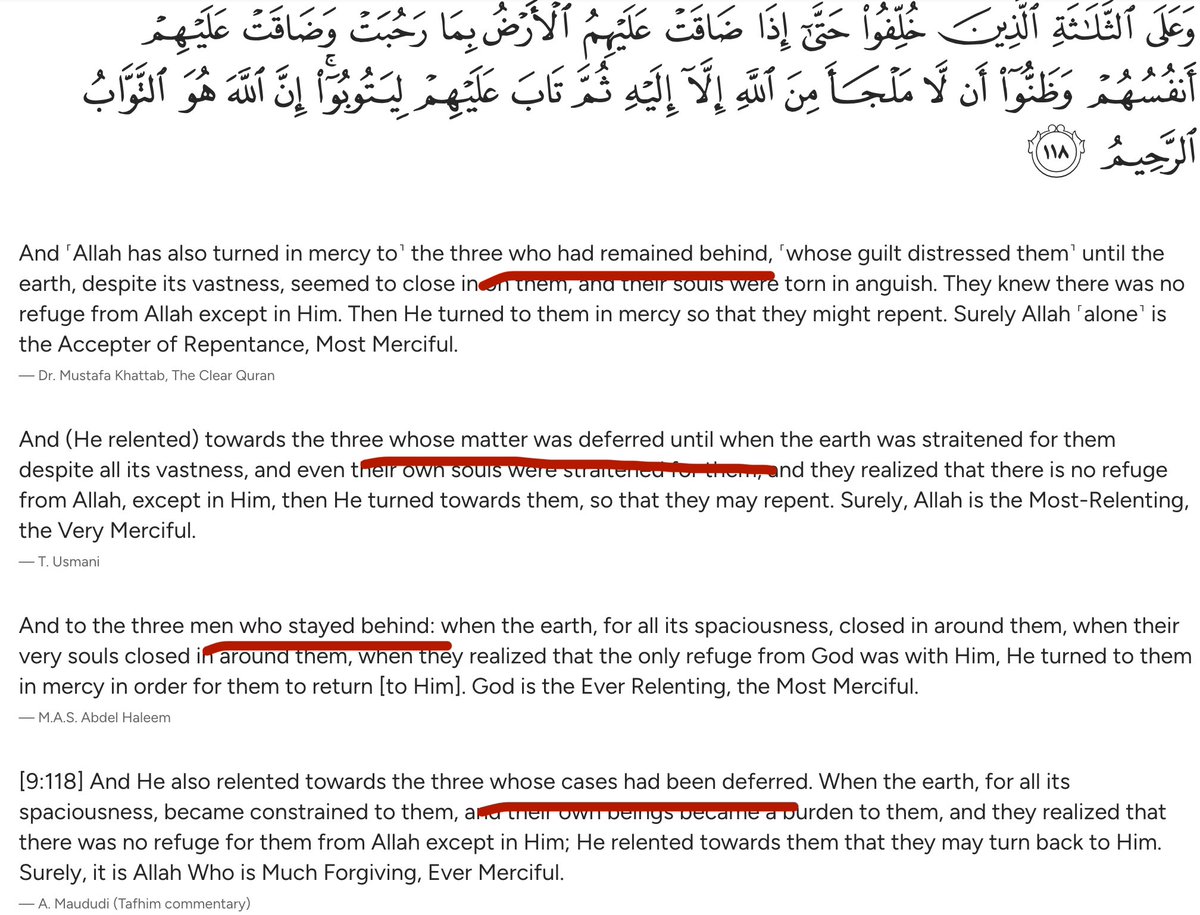
I came across an interesting translation in Dr. Mustafa al-Khattab and M.A.S. Abdel Haleem's translations of the Qur'anic ayah:
وعلى الثلاثة الذين خلفوا
These two scholars translated it as:
And Allah has also turned in mercy to the three who had remained behind.
However, the hadith in Sahih al-Bukhari (see the picture below) clearly mentions from Ka'b Ibn Malik himself that the خلفوا was not that they were left behind in the battle, but that their matter was delayed by Allah and His Messenger as to whether they will be forgiven or not.
Mufti Taqi al-Uthmani clearly being aware of this narration translates it more accurately as:
And (He relented) towards the three whose matter was deferred
Considering the idea that the person regarding whom the verse was revealed would be most aware of its context, it would mean the second translation is more accurate.
This would suggest the importance of relying upon Mufti Taqi al-Uthmani's translation of the Qur'an, primarily due to his scholarship in general.
Dua to remove anger from the heart
اللَّهُمَّ رَبَّ مُحَمَّدٍ اغْفِرْ لي ذَنْبِي و أَذْهِبْ غَيْظَ قَلْبيْ وأَجِرْنِي مِنْ مُضِلَّاتِ الفِتَن
Allahumma rabba Muhammadin ighfir li dhanbi wa adhhib ghayza qalbi wa ajirni min mudillati-l-fitan
Prophet Muhammad—upon him God’s blessing and peace—related the story of a wicked man who feared his reckoning with God so much that he ordered his sons to cremate his body, pulverize it to ash, dump half of it on land and the other half in the ocean. His hope in doing so was that God would not be able reassemble his body. But, of course, God did reassemble his body and then asked him, “Why did you do that?” When the man responded, “Out of fear of you, my Lord!” God, then, forgave him.
Sahih Muslim 2756 Sahih Al-Bukhari 7506
-قالَ رَجُلٌ لَمْ يَعْمَلْ حَسَنَةً قَطُّ، لأَهْلِهِ: إِذَا مَاتَ فَحَرِّقُوهُ، ثُمَّ اذْرُوا نِصْفَهُ في البَرِّ وَنِصْفَهُ في البَحْرِ، فَوَاللَّهِ لَئِنْ قَدَرَ اللَّهُ عليه لَيُعَذِّبَنَّهُ عَذَابًا لا يُعَذِّبُهُ أَحَدًا مِنَ العَالَمِينَ، فَلَمَّا مَاتَ الرَّجُلُ فَعَلُوا ما أَمَرَهُمْ، فأمَرَ اللَّهُ البَرَّ فَجَمع ما فِيهِ، وَأَمَرَ البَحْرَ فَجَمع ما فِيهِ، ثُمَّ قالَ: لِمَ فَعَلْتَ هذا؟ قالَ: مِن خَشْيَتِكَ، يا رَبِّ وَأَنْتَ أَعْلَمُ، فَغَفَرَ اللَّهُ له.
Interpretation:
Despite the man’s hope that God could not reassemble his body after going to such extremes, God did not treat him as one who rejects faith in the resurrection. That’s because his extreme acts—outwardly indicative of skepticism about God’s power—were yet the result of a conviction that in normal circumstances God would assuredly punish him for his moral depravity. God interpreted his actions as remorse and repentance for past misdeeds. As a result, He forgave him. This story is a clear manifestation of the divine prerogative to forgive and punish whoever He wills despite the sort of lives any of us lives.
Dear Lord! Please forgive us and show us mercy!
اللهم اغفر لنا و ارحمنا
A Review of "Bitcoin, Fiat, and Islamic Finance" (Summary) [1]
I was excited to read Harris Irfan and Allen Farrington's paper "Bitcoin, Fiat, and Islamic Finance." The authors perform a valuable service by questioning whether modern banking, including Islamic banking, truly aligns with Islamic principles. Their identification of interest-based structures, central bank moral hazard, and wealth concentration as problematic is important and well-articulated.
However, the paper's central thesis faces significant challenges. First, the authors conflate monetary medium with contractual structure, treating fiat currency as the fundamental problem when Islamic law actually prohibits riba and exploitative risk-transfer arrangements, not the monetary base itself. The claim that "fiat is haram" remains inadequately supported. Fiqh defines money functionally, not by supply characteristics. These prohibited structures can exist under any monetary system, including Bitcoin.
Second, while the authors emphasize that fiat inflation extracts wealth from currency holders, they fail to address that Bitcoin's deflationary nature creates an opposite but equally problematic wealth transfer: from debtors to creditors, from entrepreneurs to passive capital holders. Combined with any fixed obligations, hard money deflation can be even more regressive than fiat inflation, concentrating wealth with those who already possess capital rather than those creating economic value, as evidenced by historical gold standard crises.
Critically, the authors advocate for profit-sharing instruments like mudaraba and musharaka as proper Islamic alternatives. However, these very instruments create monetary claims exceeding the hard currency base. When a mudarib generates returns through productive activity, economic value grows beyond the fixed Bitcoin supply, creating the same deflationary pressure they critique in fiat systems. This reveals that the problem is not credit expansion itself, but rather the structure of risk allocation: partnership that allocate equitably versus creditor/debtor relationships that cause debt spirals.
By treating "money creation" as the disease rather than interest-based contracts as the problem, they mistake symptoms for causes. Bitcoin may change monetary tradeoffs, but it doesn't eliminate them. What matters more is not the monetary base but whether we build inherently just financial structures and market mechanisms on top of it.
As I've argued elsewhere, "Sound monetary policy stems from values and ethical framework, not the specific form of money." [2]
---------------
links below 👇👇
Of course, you would never say anything like that about orthodox Jews despite their negative views of Jesus and mistreatment of Christians in the ME. I also wonder if you feel the same about the Amish and Mormons in the state of Utah. But once again, this has become a common diversionary tactic used by pro-Zionists to change the focus from the savage treatment of Palestinians by Israelis. Be sure to bring the conversation back to where it belongs.