Who will own Africa’s AI future?
Artificial Intelligence is rapidly becoming the most important technology of our time, reshaping economies, industries, governments and societies.
But as AI becomes embedded into everything we do, a critical question emerges:
Who owns the intelligence?
Who owns the data?
Who builds the infrastructure?
And who benefits from the value AI creates?
In this latest episode of Exponential Africa, @micmannsa sits down with @Lavina_rr to explore one of the most important conversations Africa must have this decade: AI Sovereignty.
We discuss:
⚡ What AI Sovereignty actually means
⚡ Why data ownership matters
⚡ Africa’s opportunity in the global AI race
⚡ AI governance and responsible innovation
⚡ The role of the African Union
⚡ How Africa can become a creator, not just a consumer, of AI
The future of AI isn’t just about technology.
It’s about ownership.
It’s about agency.
It’s about Africa’s place in the next intelligence revolution.
🎙️ Listen now on Spotify, Apple Podcasts or Amazon Music.
While I’m no fan of socialism or arbitrary confiscations of wealth, I can see why Bernie Sanders’ proposal (for the government to take a 50% stake in AI companies) resonates, including with many on the right.
The CEOs of the leading AI labs have told us repeatedly that they will cause massive job loss. This is not a story that I believe, nor does the data bear it out, but this is what they have told us. Similarly, they have hyped the risks of AI without putting an equal or greater emphasis on the benefits or readily available mitigations.
Conservatives have another fear. The employees of the leading labs claim to be philanthropic, but what we’ve seen is massive enrichment of NGOs advancing an agenda at odds with traditional values, fueling a revolution against our cities and communities. Soros-maxxing is not charity in our book.
Anthropic and OpenAI have established themselves as Public Benefit Corporations. What could be more in the public benefit than using half the wealth generated by these companies (which trained for free on the collective knowledge of humanity) to pay down the national debt? There is no ideological bias in that philanthropy.
Dario and Sam have begun to walk back their claims of massive job loss, but the damage to public trust is done, and now the chickens are coming home to roost. I could almost support the Sanders proposal as a stupidity tax.
There’s just one problem. Nationalization of AI will accelerate the corporate-government fusion we’re already sliding toward. Conservatives rightly fear a Central Bank Digital Currency. They ought to be even more concerned about Central Government AI — a system with even more totalistic power over information, decision-making, and human behavior.
We saw how social media was weaponized to censor conservatives (including President Trump) in the last Democrat administration. The definition of “trust & safety” expanded to mean protecting the public from supposed psychological harms, micro-aggressions, and disinformation (you know, like hearing conservative ideas or true facts about Covid).
That “safety” agenda as applied to AI will be vastly more powerful and Orwellian. AI won’t just moderate posts; it will curate reality — with the ability to rewrite history, enforce ideological conformity, influence policy at scale, mass surveil Americans, and condition the benefits of the many systems it controls on approved behavior.
America won’t win the AI race if we beat China but end up with a CCP-style social credit system in the U.S. — and that is the danger as the government becomes more deeply involved in AI development and assumes direct ownership and control.
Conservatives are right to fear where this is all headed but ought to think more carefully about how regulations they are flirting with now (that are widely celebrated among those with a long history of lust for Big Government) will be used against them the next time a Democrat administration is in power.
Anthropic just filed for IPO. People continue to ask: Is all this AI revenue durable?
My answer: yes. Enterprise revenue is durable, code revenue is durable, and both will keep compounding.
There will be major new streams beyond them, too.
🚨 BREAKING: On Lex Fridman's podcast Jensen Huang declared the exact moment when we achieved AGI.
You can stop guessing when AGI gets here.
CEO of Nvidia Jensen Huang gave Lex Fridman a four-word answer.
"I think it's now,"
"I think we've achieved AGI. We've achieved AGI when an AI can build a billion-dollar app then immediately die."
"You said a billion, and you didn't say forever."
"It is not out of the question that a Claw was able to create a web service, some interesting little app that all of a sudden, a few billion people used for 50 cents, and then it went out of business again shortly after."
"We saw a whole bunch of those type of companies during the internet era, and most of those websites were not anything more sophisticated than what OpenClaw could generate today."
"It's happening right now," Huang says.
"When you go to China you're gonna see a whole bunch of people teaching their Claws to go out and look for jobs and do work, make money."
The AGI you've been waiting for is already getting hired.
It's just not hiring you.
If you're new here, follow @AiEvolutio for the latest on ChatGPT, Claude, and the AI tools shaping how we work and create.
— Jensen Huang ( @nvidia ), NVIDIA CEO, on Lex Fridman's ( @lexfridman ) podcast
Terence Tao summarized how AI is massively accelerating math career and math research.
"In math, you previously had to basically go through years and years of education to be a math PhD before you could contribute to the frontier of math research. But now it's quite possible at the high school level or whatever, that you could get involved in a math project and actually make a real contribution because of all these AI tools and lean and everything else."
From @dwarkesh_sp podcast (link to full video in comment)
If you’re in/around the administration, you're obligated to keep up the narrative that AI is creating jobs.
If you're a Democrat or America First/America Only, you're obligated to spread the job destruction narrative.
That's how AOC and Steve Bannon find themselves on the same team.
If you're an independent thinker, you understand that we will have massive AI job *displacement* combined with profound abundance (lower prices, shorter work weeks and new jobs)
This means extreme winners AND losers, which will require thoughtful change management.
🚨 JAPAN JUST TESTED A MACH 5 RAMJET ENGINE AND IT COULD MAKE TOKYO TO LOS ANGELES A 2-HOUR FLIGHT.
Researchers from JAXA and several top Japanese universities have completed a successful ground combustion test of a ramjet engine designed for a Mach 5 hypersonic aircraft.
The test simulated real flight conditions at 25 kilometers altitude and Mach 5 five times the speed of sound with temperatures exceeding 1,000°C.
Why this matters:
• Ramjets have no moving parts and use the aircraft’s own speed to compress air, making them ideal for extreme velocities
• The team proved stable combustion and effective heat management using advanced thermal protection systems
• A Mach 5 aircraft could theoretically cut the Tokyo–Los Angeles journey from ~10 hours to just 2 hours
• This is a major step toward practical hypersonic passenger travel (target: 2040s)
The deeper implication is enormous:
We may be watching the slow but steady rebirth of ultra-fast global travel.
After the Concorde era ended, many thought hypersonic passenger flight was too difficult and expensive. Japan’s progress suggests it might not be science fiction after all.
What happens when the Pacific becomes a short hop instead of an all-day journey?
Follow for more frontier physics and future technology
Euler's formula isn't just an equation.
It's a connection between five mathematical ideas that seem unrelated at first glance.
e for growth.
π for circles.
i for complex numbers.
1 for identity.
0 for nothingness.
And somehow, they all meet in one statement:
eᶦᵖⁱ + 1 = 0
I'm proud to share that @Glean has surpassed $300M ARR, just five months after crossing $200M and growing ~3x over the past 15 months. This is an exciting milestone for Glean, and it's a signal about where the enterprise AI market is heading.
We’ve long believed the real challenge in enterprise AI is not access to models. It is grounding AI in how a company actually works: its people, knowledge, workflows, permissions, and systems.
That’s even clearer now. The companies creating real value with AI are not just adopting better models. They are building systems that understand their business well enough to deliver reliable outcomes at scale. That is the real moat, and it is what we’ve been building at Glean: an unrivaled context layer for enterprise AI.
That context has to work across the business, not just inside a single team or use case. We see that in how customers adopt Glean: more than 85% use it across five or more job functions.
It also has to meet the security and governance demands of complex enterprises. We see that in who is choosing Glean: our Fortune 500 customer count nearly doubled year over year.
And it has to make economic sense as usage grows. In our recent benchmark with Claude Cowork, Glean was preferred roughly 2.5x as often as off-the-shelf MCP tools and used 30% fewer tokens on average. Better context improves both quality and efficiency.
I enjoyed talking with @CNBC's @dee_bosa about this broader shift. In enterprise AI, the winners will not be defined by better models alone. They will be defined by who builds the strongest foundation for enterprise context.
Thank you to our customers, partners, and team for helping us build the future of enterprise AI.
🌍 Countries Leading in Different Professions
1. 👨⚕️ Most Doctors → 🇮🇳 India
2. 👨💻 Most Engineers → 🇨🇳 China
3. 💻 Largest IT Workforce → 🇮🇳 India
4. 🔬 Most Researchers (R&D) → 🇨🇳 China
5. 🧪 Most Scientists → 🇺🇸 USA / 🇨🇳 China
6. 👩⚕️ Most Nurses → 🇮🇳 India / 🇨🇳 China
7. 👨🏫 Most Teachers → 🇮🇳 India
8..🎓 Most University Professors → 🇺🇸 USA
9. ⚖️ Most Lawyers → 🇺🇸 US
10. 💾 Most Software Developers → 🇮🇳 India
11. 💊 Most Pharmacists → 🇨🇳 China
12. 🦷 Most Dentists → 🇮🇳 India / 🇨🇳 China
13. 🏗️ Most Architects → 🇨🇳 China
14. ✈️ Most Pilots → 🇺🇸 USA
15. 📰 Largest Media & Journalism Industry → 🇺🇸 USA
16. 📊 Most Data Scientists / AI Specialists → 🇺🇸 United States
17. 🚀 Most Startup Founders / Startups → 🇺🇸 United States
18. 🏭 Largest Manufacturing Workforce → 🇨🇳 China
19. 👷 Largest Construction Workforce → 🇨🇳 China
20. 🧑🔧 Largest Skilled Labor Workforce → 🇮🇳 India
🚨: Indian Chemists Solved a 75-Year-Old Molecular Puzzle With a First-of-Its-Kind Molecule 🧪⚛️
Chemists at Indian Institute of Technology Madras and Indian Institute of Science have created the world’s first stable carbon-free analog of ferrocene solving a molecular challenge that had remained unanswered for decades.
🇺🇸 SpaceX recently announced a major AI compute partnership with Anthropic, leading to speculation about a massive long-term compute leasing business for Elon.
He's now clarifying what the deal actually is: a 180-day lease with a 90-day mutual cancellation notice. The short term was SpaceX's call, not Anthropic's.
Elon says SpaceX won't leave them hanging but may need the compute back if things get tight.
Anthropic gets what it needs now, and SpaceX keeps what it may need later.
We are back again :) After three weeks of quiet building.
Introducing Genesis World 1.0, our latest simulation platform, the second release in our full-stack suite. Open-sourced.
Robotics is still bottlenecked by the 1× speed of the physical world. Every model, checkpoint, and data recipe eventually needs to be tested on physical hardware, slowly, expensively, and with limited coverage.
One hour in reality can become 100 days in simulation. That is how robotics model iteration moves from a wall-clock bottleneck to a compute problem.
To make this work, simulation has to be both fast and trustworthy.
Over the past year, we rebuilt the entire stack: a GPU-accelerated cross-platform compiler, penetration-free multi-physics contact solvers, unified rigid and deformable physics, and a photo-realistic renderer purpose-built for physical AI applications.
We built Nyx, a high-performance path-traced rendering engine for robotics application.
Genesis World 1.0 achieves near realtime performance with our latest development for penetration-free IPC solver, supporting various types of deformables beyond rigid bodies. It supports contact-rich, dexterous manipulation simulation across different embodiments: unitree, sharpa, wuji, genesis hand and various types of grippers.
Under the hood is Quadrants, our effort in pushing forward cross-platform GPU-accelerated computation. Quadrants started as a fork of Taichi, and we rebuilt most of the critical parts for optimizing simulation workloads, giving 10x faster launch time and up to 4.6x runtime performance compared to the initial Genesis release.
Together, they bring us to an unprecedentedly low sim-to-real gap, enabling zero-shot real-to-sim model evaluation and much faster iteration of GENE.
All available today.
Genesis World 1.0: https://t.co/aknCM3eqws
Quadrants: https://t.co/uXqPNI4cb6
Nyx: https://t.co/R8j0djqGnV
Trump is in a real bind now with Iran because he is correctly trying to tie the GCC under the Abraham accords as part of the Iran negotiations, as it will enable the US to leave the middle east and retain hegemony over the region.
However because of the ceasefire and lack of commitment to destroying the Iranian regime, the Arab world sees that as weakness and so they are hedging. Trump is trying to strongarm them into joining the coalition, however he is doing so from a position of weakness in their eyes. Ceasefires in the middle east are not a thing, they don't understand the concept and just see it as weakness.
The Arab countries see their core infrastructure, like water and oil production being vulnerable to Iranian attack, while they see Israel and the US not hurting the regime properly. They see how they have conducted the war as weakness, by not killing the families, not hitting infrastructure and the core regime targets. Because of this they don't believe the coalition is going to end Iran, and so instead they're forced to plan for if the regime survives, so they're hedging now.
They hate Iran and want the regime gone, they are the most vulnerable to their predatory actions and they are most at risk. But they cannot take no oil exports forever, they're willing to take pain but not indefinitely and they'll make a deal with Iran before this. They are not in the business of jeopardising their own power domestically.
Because of this, Trump is struggling to strong arm them under the US block because they aren't convinced the US will remove Iran. Remember they have paid huge money to the US and Trump in order for this to occur and the protection of the US empire. If the regime survives and the US fails to remove them, they will punish the US by ending or not following through with the trillions they have been forced to pay for this operation. Don't listen to the isolationists, the US is benefiting huge from this war. But Trump can't negotiate with the Arabs from his current position during a ceasefire, because they see this as weakness and they don't believe in signing onto weakness. This is the middle east and weakness is immediately punished.
They're very upset because they're now forced to hedge with Iran, and no amount of strong arming is going to make them join unless they believe Trump is going to finish the operation, which they now dont believe will occur.
The only way out of the bind is to continue the kinetic operation, but they don't want this because they don't think the US/Israel coalition is going to hurt the Iranians enough, and they fear retaliation on their critical infrastructure which is getting more difficult to defend.
Which is why the negotiations seem difficult and are being dragged out, because Trump and the gulf are now in a difficult bind.
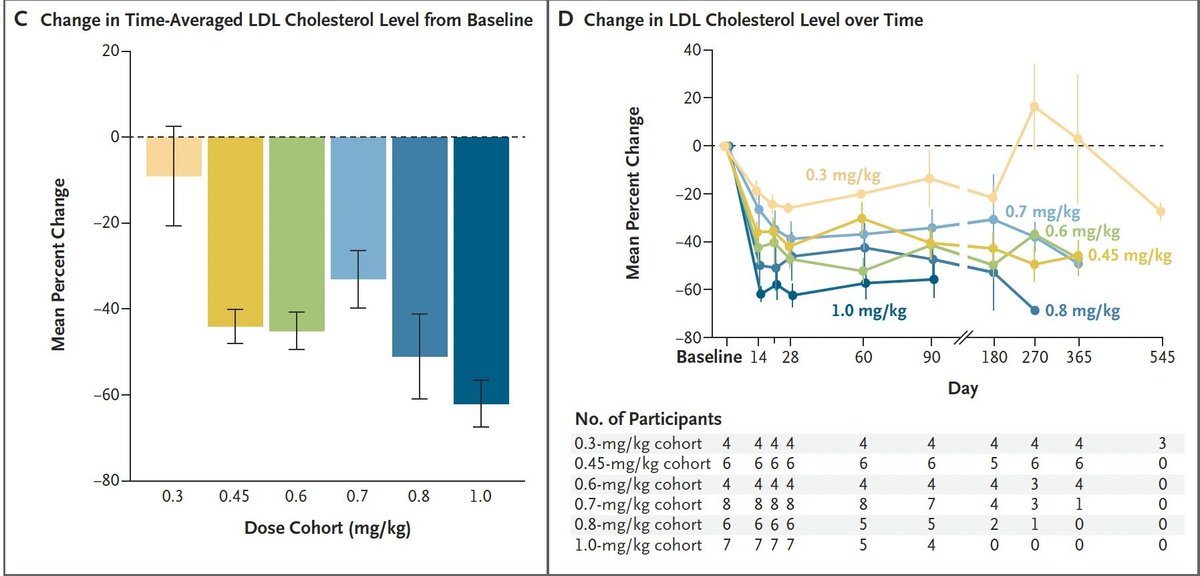
Eli Lilly has done it.
They've gone and made what seems to be a powerful, permanent gene therapy for LDL cholesterol.
That means they'll be able to effectively prevent most heart disease with a single infusion!
Brain-computer interfaces are no longer science fiction. A recent article from @Bloomberg by @IkeSwetlitz, @SarithaRai, and @AmberTongPW explores how quickly the BCI field is evolving.
One of the key themes in the piece is the contrast between brain penetrating and non-penetrating BCIs, along with the different approaches emerging companies are taking to advance the technology. The article also highlights an important milestone for Precision Neuroscience: receiving @FDA clearance in 2025 for our minimally invasive, non-penetrating BCI designed to record, monitor, and stimulate brain activity. @PrecisionNeuro_'s technology has already been implanted in close to 90 patients through clinical studies — a strong signal of how rapidly this field is advancing.
Exciting to see the conversation around BCIs shifting from “someday” to real-world impact today.
https://t.co/3uWvXmcyNv
Humanity, created by God in all its grandeur, is today facing a pivotal choice: either to construct a new Tower of Babel or to build the city in which God and humanity dwell together. In Jesus Christ, this humanity in its grandeur becomes the Way, the Truth and the Life, opening the path for each of us to grow toward fullness. #MagnificaHumanitas
https://t.co/6i9MWs6LJl