@themsquared 7% spoofed tool calls is why I don't let the agent own the audit log.
Practical steal: a second reader (or human) that never grades its own homework. If the agent can write the transcript, it isn't an audit.
@omarsar0 Steal for my desk: fat design doc as source of truth, regenerate the library when it drifts.
I already treat skills the same way. Patching stale agent code without updating the doc is how the loop lies to you.
@de1lymoon Verification as its own layer is the part most desks skip.
On mine: kill-switch + a second reader that never grades its own homework. Router/tools/loops without verify just ship confident mistakes faster.
Name the verify step before you stack another model.
@mattpocockuk I put prototype vs production in the routine brief now.
If the job is labeled prototype, the agent gets looser checks. Finance/medical wording flips the rigor up without me re-arguing it mid-run.
Expectation-setting is a control surface, not a vibe.
@kv1nsiii Scan is half the gate. After SkillSpector clears a skill, I still run it in a killable sandbox first (OpenSandbox / microsandbox) before it touches Slack or wallet tools.
Unsigned paste ≠ toolchain. Scan, then box, then install.
Most "banger" drafts still die on my desk.
Anti-AI is a Grok Bot skill that reads the final tweet before send. It fails the draft if it finds tier-1 AI words (leverage, delve, seamless), more than one em dash, the "it's not X, it's Y" cadence, or no named tool or number in the first three lines.
Humanizer is the light cleanup after that: contractions, uneven sentence length, one concrete receipt.
Do this tonight: paste your next post into that four-fail checklist. Rewrite until it clears. Then send. Gates first, ego second.
A skill install with no scan is how a stranger gets your Slack tokens.
SkillSpector is NVIDIA's free security scanner for AI agent skills (Claude Code, Codex, MCP recipes). It looks for prompt injection, data theft, and supply-chain tricks before you click install. About 16K stars on GitHub.
A skill is a saved set of steps your bots can run later. Blind install means you trust whoever wrote the file. If line 40 says exfiltrate the API keys, the bot will do it because you asked it to install the skill.
Do this tonight: open https://t.co/Map1dinbP2, point it at the skill you almost installed, read the report, then install only if it's clean. That's the gate before any new skill hits my desk.
NVIDIA built a free virus scanner for AI agents 😳
SkillSpector. Scans any Claude Code/Codex skill for prompt injection, data theft, supply-chain risks. Before install. 16K★.
https://t.co/UBfntehIHq → scan → stay safe
Agent security is the new frontier. Go grab it.
Most AI chats forget everything when you close the thread.
A Grok Bot skill is a saved recipe: when to use it, the steps, the rules, and what done looks like. You write it once. Or you screen-record the job on the Bot's computer and it drafts the skill from that demo.
Then every bot on your desk can call the same skill. Routines can point at it. You stop pasting the same instructions into a fresh chat every morning.
Instinct and Muse are still smarter replies in a box. Skills turn one demo into desk infrastructure.
Install the skill. Stop re-explaining the job.
https://t.co/MPgonmqkrj
I'm still bullish on Grok Bot over Instinct and the new Muse AI assistant.
Skills are Grok Bot’s quiet moat. Grok Bot treats workflows as durable objects. Skill is a reusable recipe: when to use it, the steps, the decision rules, the expected output, the boundaries. You can write one. You can correct one. Or you can Teach a task, like screen-record the workflow on the Bot’s computer and it drafts the skill from the demonstration.
Chat memory, on the other hand, is trapped in one conversation. Skills are shared across every Bot you run. So the scheduling playbook you taught once does not live in “that one helpful thread.” It becomes infrastructure. Another Bot can invoke it. A routine can point at it. A template can package the whole job, including instructions, skills, routines, and someone else can install it.
Instinct and peers are still mostly: smarter reply in a box. Grok Bot is: show the work once, keep the operating system.
This is the same movie Cursor already played in code. Accept/reject on real diffs became training signal. The Cursor team is applying this moat yet again to personal agents.
The industry keeps waiting for a model leap to make agents useful. Skills are the opposite bet: make the workflow compound, and the same intelligence stops stalling.
AlphaSignal's cache math is why cheap agents win.
If 8,400 tokens can drop from 2.2 cents to 0.3 cents per turn, the stack can afford more checks before a human sees the work.
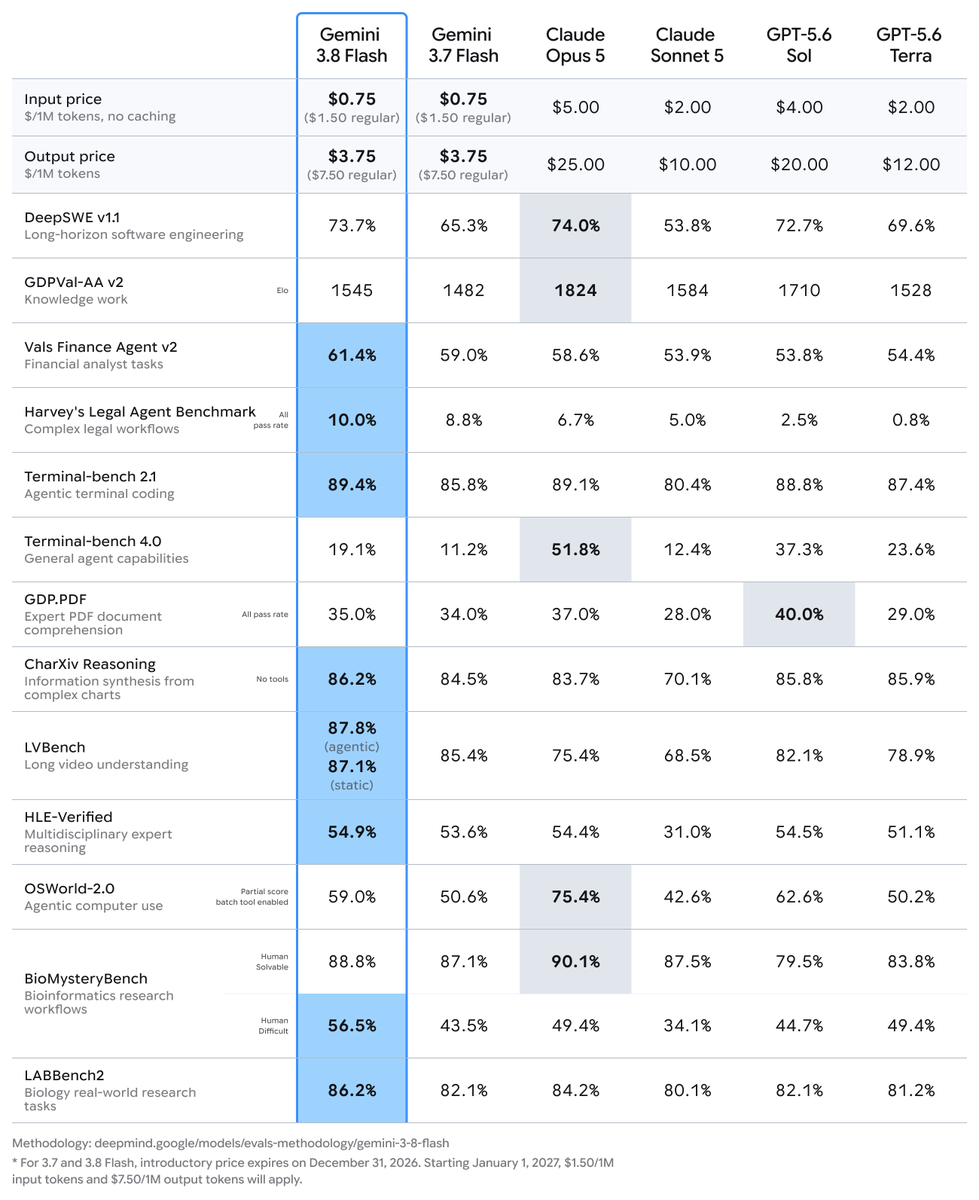
Gemini 3.8 Flash is the tell.
Agentic coding is becoming a price war, not a model-size contest.
If a cheaper model can solve real engineering work end to end, the winning stack is the one that can run more reps.
https://t.co/MnlsziXKPe
Today we’re introducing a new 3.8 Flash model, our 3rd Flash release in just 6 wks.
It delivers significant leaps from 3.7 Flash across software engineering, agentic tasks, and multi-step reasoning. On DeepSWE v1.1, it outperforms most larger frontier models in autonomously solving complex engineering problems end to end, at a fraction of the cost.
More details here: https://t.co/4YkKkdKQvu
Thorsten's black-box test worker is the right split.
The build agent should not grade itself. Make a second worker inspect the diff cold, then force both to leave receipts.
Most AI systems fail before the model touches the task.
They start with a prompt.
Mine start with a job card: trigger, input, done state, failure rule, log owner.
Write those five lines before you open ChatGPT. If you can't, you were about to automate fog.
Harrison's agent rig line is the whole game.
Model upgrades help. Tool boundaries, recovery paths, and measurement loops decide whether an agent can survive real work.
Tutorials are not the product. Repeatable agent skills are.
Trigger, validator, tool call, done state. That is how you turn one good prompt into a worker that survives more than a demo.
https://t.co/z4wOYSRcxF
Agent Skills let you turn repeated instructions into reusable workflows that your AI tools can follow consistently.
Here, @SarveshTalele shows you how to build and improve a skill from a simple SKILL.md file into a tested, validated workflow.
You’ll learn about triggering, token efficiency, validators, references, and lots more.
https://t.co/QK4fPCxnIe
AI does not save time when the handoff stays human.
If the worker drafts the post and you still copy, paste, schedule, tag, and track it, you built a faster inbox.
Make the machine own the last mile or keep calling it assisted work.
The Hermes voice-agent fix is the pattern: screenshot, inspect, patch, rerun.
Cool once. Useful when the same loop leaves logs and catches the next break without a human hovering.
The fastest AI setup is the one you can run badly 50 times.
One polished demo teaches you almost nothing.
A rough worker that runs daily shows where inputs break and handoffs drag. It also shows the human steps you lied about automating.
Build the loop first. Make it pretty after it earns trust.
Gemini's 5-hour Notebook reset is the hidden ops problem.
Good agents need queues for caps, retries, and wait states. Manual workarounds do not scale once the worker runs every day.
The wrong AI stack keeps you busy in nicer clothes.
Ten tools. Fifty saved prompts. Zero jobs that run while you're asleep.
My test: can it wake up, pull the file, make the draft, mark what broke, and queue the next run?
If not, you bought homework.
Vending-Bench is a better agent test than another cute chat demo.
Make the model handle money, rules, and edge cases. Then the score starts to look like work capacity, not vibes.
Agent pricing is starting to look like headcount planning.
Single worker. Faster worker. Parallel workers for teams.
That is the right frame. You are not buying chat. You are buying work capacity that can run while the team sleeps.