💡Can AI Enhance its Creativity to Beat Humans?
Preprint is out! 🚨With P. Pelletier (@peltouz_) and R. Guichardaz, we compared human vs. machine creativity in 3 tasks, testing 2 prompt strategies: AI as a crea Expert vs. a Naive ideator! Want to know more? 👇
@beta_economics
The discussion about the classics in economics is pushing some economists to position the field closer to hard sciences such as physics.
That's sweet.
But while I agree that economics shares many features with the hard sciences, we also need to acknowledge two things.
First, economists are often late adopters to hard-science ideas.
The switch to "big data," which was popular in physics in the early 2000s, became a thing in economics in the 2010s. Networks, which exploded in physics in the late 90s, became more prominent in economics after the 2008 financial crisis. Neural networks, which were a thing in physics in the 80s, have only more recently become a thing in economics.
Second, and more importantly, many economists reject the principle of interdisciplinary consistency, the idea that fields of science need to "match." This is the notion that physics must be consistent with chemistry, chemistry with biology, biology with psychology, and so on. Many colleagues have told me directly that this consistency is not a requirement for economics. They believe the field is unique and exempt from this principle.
But I disagree. I think that to be a science every field must accept interdisciplinary consistency. That is accepting that other disciplines produce knowledge that cannot contradict that created by your discipline.
Interdisciplinary consistency is in fact a core aspect of scientific identity. Accepting that we are scientists first and members of a discipline second is an ante people expect others to pay to join the room of the "hard-sciences." It is a hard pill to swallow, because there is a lot of knowledge in other fields that each discipline must be consistent with. In the case of economics, this ranges from knowledge on the biological constraints on human cognition and behavior as well as work on macroecology and evolution. The beauty of interdisciplinary consistency, however, is that--when it works--it leads to more general answers. Answers involving mechanisms that are valid across fields.
I personally think economists have a lot to contribute to science. I've been part of the field for 20+ years and I know it is filled with brilliant people. But I am not sure if all of them are ready to accept themselves as scientists first and economists second. I've sometimes had that conversation.
And that’s the real challenge. If economics truly wants to sit at the table with the hard sciences, it has to embrace the same rules of the game, including the sometimes uncomfortable reality that it also has to align with knowledge from other fields.
So, are we ready to make that leap? To stop being a hard science by analogy? I hope so. Because the answers we’re looking for might just be waiting for us in the spaces between disciplines.
This study investigates the creative performance of artificial intelligence compared to humans by analyzing the effects of two distinct prompting strategies (a Naive and an Expert AI) on AI and across three different tasks:
https://t.co/GnumPL7IcV
@AG_Malt
A word of advice: if, like me, you're in the last months of your thesis, cook yourself some comfort food ! 👩🍳
Tonight's menu includes Mushrooms Bourguignon style and Tiramisu ✨️
#phdchat#phdlife
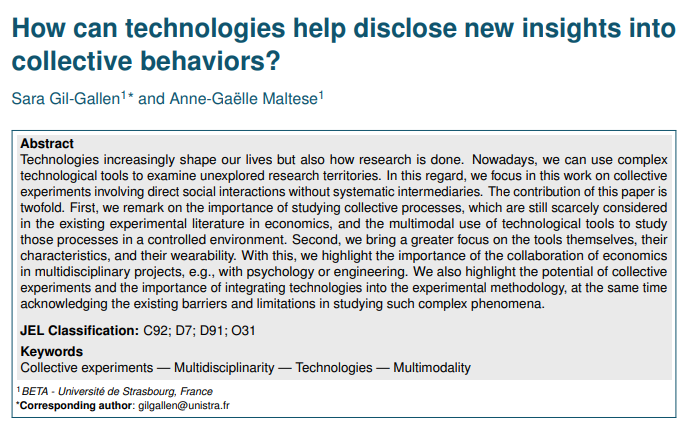
🚨 Our paper on "How can technologies help disclose new insights into collective behaviors?" is out!
Advocating the use of technologies in collective experiments ➡️#multidisciplinarity & #multimodality
👇
https://t.co/vV6RmnjjMX
#EconTwitter @beta_economics @BE4Policy
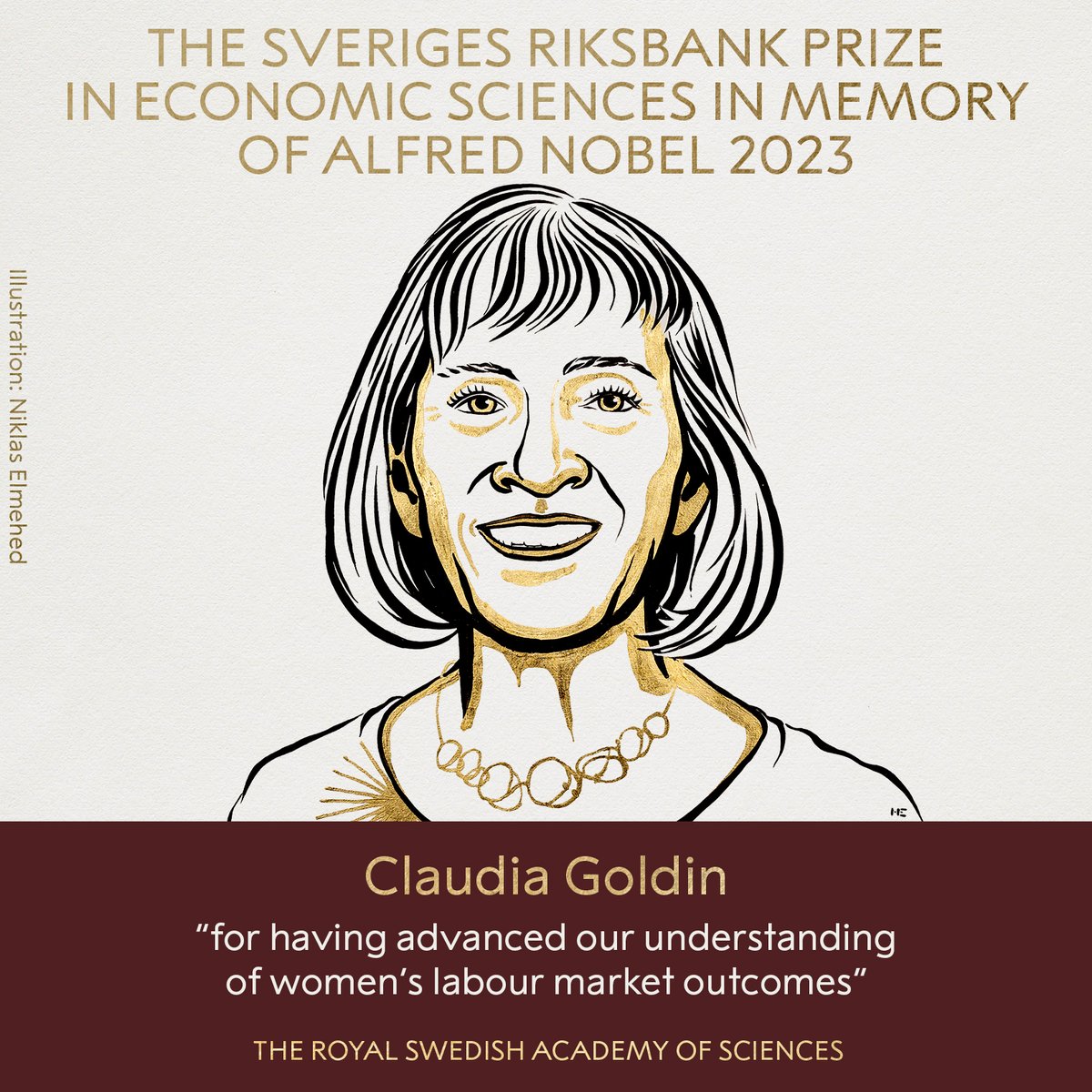
BREAKING NEWS
The Royal Swedish Academy of Sciences has decided to award the 2023 Sveriges Riksbank Prize in Economic Sciences in Memory of Alfred Nobel to Claudia Goldin “for having advanced our understanding of women’s labour market outcomes.”
#NobelPrize
Bonjour,
La 14ème édition de l’Ecole d’Automne en Management de la Créativité est pour bientôt. 😃
Bloquez les dates du 6 au 10 novembre 2023 pour en savoir plus sur les Transitions Créatives. 😊
Inscrivez-vous dès maintenant !
https://t.co/TWQZhgKnW5
#creasxb2023
🚨🇪🇸⚽️ FLASH | La Fédération #espagnole de football a annoncé qu'au lieu de destituer le président Luis Rubiales, elle engagera des poursuites judiciaires contre la joueuse Jenni Hermoso, l'accusant d'avoir « menti » au sujet d'un baiser non consensuel.
👉 De plus, la fédération affirme que les joueurs ont l'« obligation » de représenter l'équipe nationale, en réaction à la décision de 81 joueurs ayant signé une lettre déclarant qu'ils refuseraient les convocations de l'équipe nationale tant que Rubiales refusera de démissionner.
📚 Seeking a summer read that explores collective creativity and diversity? Look no further! 💡🍹
Delighted to announce our latest collaboration with @Sara_Gil_Gallen and @LLERENA3, now accessible as a @beta_economics working paper.
https://t.co/wOZX5nheHQ
#econtwitter
🚨 Vous n'êtes pas encore inscrit.e ??
CreaSXB vous attend ! Alors à vos agendas et inscrivez-vous sur : https://t.co/kzx8ERIOe6
🗓 6 au 10 novembre 2023
📍Strasbourg
🚨🚨Vous l'attendiez, CreaSXB est de retour !
Du 6 au 10 novembre 2023, retrouvons-nous à Strasbourg pour 5 jours autour des Transitions Créatives !
Inscription et programme provisoire dès à présent sur : https://t.co/kzx8ERIOe6
#CREASXB2023#CREASXB#Strasbourg#Créativité
📚 Seeking a summer read that explores collective creativity and diversity? Look no further! 💡🍹
Delighted to announce our latest collaboration with @Sara_Gil_Gallen and @LLERENA3, now accessible as a @beta_economics working paper.
https://t.co/wOZX5nheHQ
#econtwitter