At Karambi, Fort Portal City, I joined our people as preparations continue for the final resting place of His Highness King Oyo.
Forever rest in peace, Your Majesty.
NRM National Vice Chairperson – Western Region
Later, after the Kira E-Bus Xpress engagement, I proceeded to Speke Resort Munyonyo, where I met with the Parliamentary Committee on Science, Technology and Innovation.
I shared with the Committee our strategic direction as a Ministry, with discussions focusing on the STI Policy, research commercialization, data as a strategic national resource, and technological and data sovereignty.
I commend my fellow Members of Parliament for the constructive engagement, which provided an important opportunity to inform, update and guide one another as we strengthen Uganda’s science, technology and innovation agenda.
Our direction remains clear: STI must translate into national capability, economic value and greater technological sovereignty for Uganda.
Great work, Hon. Min. It is profoundly inspiring to see you in the company of PSU Secretary Emeritus, Dr. Opio. Your convergence represents a formidable confluence of intellect, vision, and institutional wisdom. The two of you are an invaluable blessing to the advancement of Science, Technology, and Innovation (STI) in Uganda and, indeed, to the global intellectual and developmental enterprise.
@EngJonard@KagutaMuseveni@mkainerugaba@STIsecretariat That’s what we call evidence-based leadership-a detailed assessment is conducted before recommending interventions to strengthen and improve the system. Kudos to you, Respected Sir, Hon. Minister!
Some words possess a resonance more profound than their echoes. To some, you are merely an ordinary person and a colleague; but to us, you embody the very essence of patriotism, altruism, and selfless service to the greater good. These words continue to reverberate within the deepest recesses of my mind, carrying a meaning that transcends their mere utterance. Thanks Respected Sir, Hon Min. @EngJonard@BobKakuru@FredShaka
*Argument for the Presidential Succession of Gen. Muhoozi Kainerugaba*
In an era where the crisis of leadership across postcolonial states continues to metastasize into systemic inertia, General Muhoozi Kainerugaba has emerged as a rare synthesis of political will, military discipline, and developmental intentionality. His brief but impactful public leadership arc invokes a profound reconsideration of the principles that ought to govern political succession and statecraft in contemporary Africa.
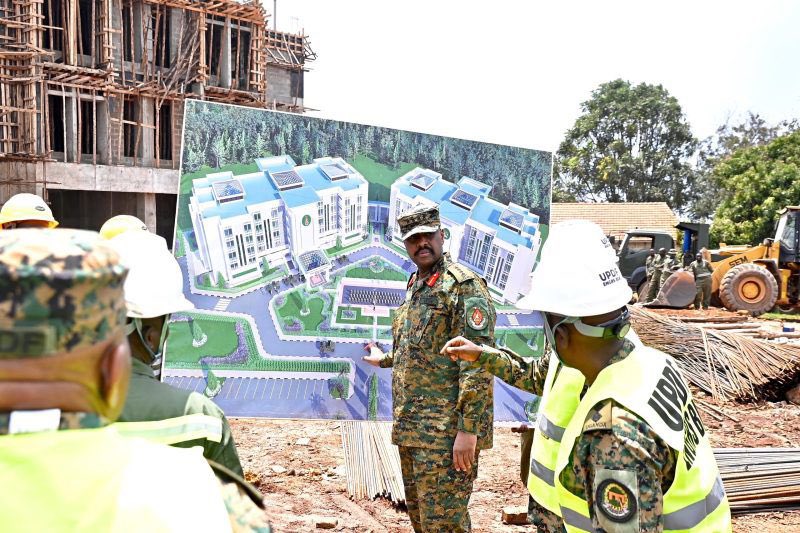
At the core of this argument lies the principle of teleological governance-the notion that leadership must be judged not merely by rhetorical promises or inherited charisma, but by the degree to which it actualizes its end: the good of the polity. Within just over a year, Gen. Muhoozi has demonstrably prioritized structural transformation over performative populism. His strategic interventions-most notably the expediting of the UPDF National Regional Hospital, the robust curtailment of endemic corruption, and his meticulous oversight of critical infrastructure like the UPDF headquarters project-signal not opportunistic governance, but a committed praxis of national stewardship.
In this light, his leadership aligns with what philosopher Max Weber termed “legitimacy through rational-legal authority”, not inherited, but earned through institutional performance. It transcends the metaphysics of lineage and enters the empirical domain of visible, quantifiable achievement. Such is the foundation of post-heroic legitimacy: not who the leader is, but what the leader does-and for whom.
Furthermore, Gen. Muhoozi’s approach may be read through the lens of pragmatic idealism-a rare political orientation in which visionary goals are not sacrificed to the altar of political expediency, but are pursued with military precision and administrative lucidity. The classical philosopher Aristotle posited that the purpose (telos) of leadership is to cultivate eudaimonia-the flourishing of the people. By aligning military efficiency with developmental vision, Muhoozi actualizes this Aristotelian imperative in real, measurable terms.
Indeed, his actions evidence a phronetic leadership-governed by practical wisdom (phronesis) rather than abstract theorizing. His developmentalism is not anchored in ideological dogma but in adaptive, situational ethics that respond to the actual exigencies of the Ugandan people-healthcare, integrity, national dignity, and institutional renewal.
Lastly, we must speak of political temporality: the idea that there are historical moments when the conditions are ripe for new paradigms of governance. Uganda, after decades of foundational leadership, now stands at the cusp of generational renewal. Gen. Muhoozi represents not merely a continuation of legacy but its evolution. His rise is not an anomaly but a dialectical necessity-a response to the historical demands of a nation yearning for both continuity and change. Long live Sir. Salute Afande#Much Respect# @mkainerugaba@nbstv@ntvuganda
Did you know the roles of a pharmacist in our society? Let's briefly dive into their roles. They include; patient counseling, dispensing medications, providing extensive drug information to patients, carrying out various clinical trials and toxicology management.
Happy Father's Day! The most fulfilling job I've ever had is being Sasha and Malia’s dad. To all those lucky enough to take on the role of being a father, I hope you enjoy your day.
Diabetic ketoacidosis - Diagnostic criteria:
Management
Main principles of management
fluid replacement
most patients with DKA are deplete around 5-8 litres
isotonic saline is used initially, even if the patient is severely acidotic
please see an example fluid regime below.
insulin
an intravenous infusion should be started at 0.1 unit/kg/hour
once blood glucose is < 14 mmol/l an infusion of 10% dextrose should be started at 125 mls/hr in addition to the 0.9% sodium chloride regime
correction of electrolyte disturbance
serum potassium is often high on admission despite total body potassium being low
this often falls quickly following treatment with insulin resulting in hypokalaemia
potassium may therefore need to be added to the replacement fluids
if the rate of potassium infusion is greater than 20 mmol/hour then cardiac monitoring may be required
long-acting insulin should be continued, short-acting insulin should be stopped