This young man is an uncut diamond that deserves a future.
The Cockroach Janata Party should enlist diamonds like him as members if they really want to go far with their movement and change India’s destiny.
If not, some rich NGO or a corporate CSR department should rehabilitate him by providing an interest-free loan and helping him set up a small business.
His name is Mohammad Irfan. He lives in a broken 12 sq yd 1-room slum (with tarpaulin roof) with his parents and two sisters in Delhi’s Laxmi Nagar.
For his livelihood, along with his father, he sells ice slabs as a roadside vendor.
He cannot write, he never went to school, and all his education is acquired by asking questions to Google several hours a day.
From the Preamble to the Indian Constitution (Hindi version) to Urdu Shayar Ahmed Faraz and Kavi Gopal Das Neeraj’s poetry to legal rights of workers and minimum wage & hour laws in India, his knowledge is 10x more than the average brainwashed WhatsApp University uncles of India.
In the video, Irfan emphasizes on “garima” (dignity). The Preamble to the Constitution explicitly states: “assuring the dignity of the individual,” irrespective of their caste, religion, education, or economic status.
Irfan was discovered by The Lallantop’s brilliant journalist Rajat Pandey @RajatpandeyJF during recent student protests at Jantar Mantar. That’s real journalism India needs instead of the shameless mainstream media that is digging India’s grave.
Rajat can provide the phone number and address of Irfan to anyone interested in supporting him.
Spare 20 minutes of your time this Sunday to watch this YouTube video:
https://t.co/fDFk8umLMb
Indian trade deficit with China is $110bn+. It was ~$50bn 5 yrs ago. So India is paying $60bn more to China in the time I've been writing these threads.
This is the cost of manufacturing that could have been done in India.
Most factories are running on low capacity. Not because of machines (which is a factor too - but that's a different problem) but because labor is inconsistent. People leave and don’t come back. Some may say pay is low (which I agree and it’s not as if Chinese pay was sky high when they scaled) but the real issue is Indian worker is untrained/unreliable for various reasons. You can't build a reliable manufacturing ecosystem on the back of an untrained unreliable labor supply.
If Indian govt could connect this $110bn being paid to China with incentives to upskill workers/small manufacturing units there’s a chance to fix this in the next few years otherwise in 5 years the gap will widen to $200bn.
Not having Manufacturing is a punitive tax on the economy. India is paying this tax in more ways than one.
The West poured $50 billion into fast breeder nuclear reactors and abandoned every single one. India poured $900 million and just achieved criticality on the first commercially viable one outside Russia.
The US spent $15 billion. Gave up. Japan spent $12 billion. Their Monju prototype had one sodium fire in 1995 and never recovered. The UK spent $8 billion. Germany spent $6 billion. France, Italy, all walked away. Six of the richest nations on Earth concluded this technology was too hard and too expensive to pursue.
India started building in 2004 with an initial budget of $420 million. Twenty-two years, a dozen missed deadlines, and a cost doubling later, the Prototype Fast Breeder Reactor at Kalpakkam just sustained a controlled fission chain reaction. The reactor is now alive.
The reason India never quit is a constraint most people have never thought about. India has only 1-2% of the world's uranium reserves. For a country of 1.4 billion people trying to build energy independence, that's a death sentence if you're running conventional nuclear.
But India has 25% of the world's thorium. The single largest national reserve on Earth.
The problem: you can't just burn thorium the way you burn uranium. A physicist named Homi Bhabha designed a three-stage nuclear program in the 1950s specifically to solve this. Stage 1: burn natural uranium in heavy water reactors, collect plutonium as a byproduct. Stage 2: feed that plutonium into fast breeder reactors, where it breeds MORE plutonium AND converts thorium into fissile uranium-233. Stage 3: burn thorium directly at scale.
India just entered Stage 2. Seventy years after Bhabha drew it up on paper.
The math on the thorium endgame is wild. At current energy consumption rates, India's thorium reserves could power the country for over 700 years. Most nuclear nations are playing a uranium game with maybe 80-100 years of runway. India is playing a completely different game with a 7x longer fuel supply.
The West quit because uranium stayed cheap and sodium coolant is terrifying. It catches fire on contact with air. It explodes on contact with water. Russia's BN-600 had 27 sodium leaks and 14 sodium fires between 1980 and 1997. And Russia kept going anyway because Russia doesn't quit nuclear projects. India watched all of that and kept going too.
When you have 1% of the uranium but 25% of the thorium, the engineering difficulty stops being a reason to quit. It becomes the price of admission to a 700-year energy supply that nobody else can access.
ok so the rosie story was even more insane than it looked
> be the australian tech guy who made a cancer vaccine for his dog
> first try: genetic algorithms to design a new drug from scratch
> works in simulation but would take years to test
> second try: screen 1 million existing compounds against the mutation
> two weeks of computation. find a perfect match
> it's patented
> patent holder says no to compassionate use
> what_did_you_expect.jpg
> spend two weeks just being with the dog
> 2am idea: what if i just make a vaccine
> chatgpt for pipeline, gemini for construct, grok for validation
> 300 gigabytes of raw sequencing data to half a page of vaccine construct
> university ethics approval would take until mid-2026
> dog doesn't have that long
> panik
> canine cancer expert connects him to a lab in queensland with existing approval
> drive 14 hours to get there
> inject
> three weeks later the tumors swell. immune system swarming
> six weeks later shrinking
> two months later legs returning to normal
> one mass doesn't respond
> sequence it again
> different cancer. the vaccine worked. the body grew a new tumor
he's now building a company so every dog owner can do this
he had the technology the whole time. he spent 18 months fighting for permission to use it
System Design Playbook:
Giveaway Alert!!
• System design fundamentals.
• Condensed notes to read before the system design interview.
• Must know concepts from real-world software engineering case studies.
(24 hours only!)
To get it:
1. Like, Retweet & Follow @systemdesignone
2. Reply "Playbook"
Then I'll DM you the details.
🚨 New Column!
"Spy Satellites over the Melbourne Cricket Ground".
Where I investigate the Pakistani delusion. My latest in Today's Hindustan Times, Sunday edition. Read, Share views :)
A General on the March Does Not Chase Bunny
Following the recent escalation in tensions between India and Pakistan, a narrative proclaiming "India’s failure" or its "humiliation" has rapidly gained traction in international media.
Remarkably, this view has permeated not just Western mainstream outlets but also many voices from the Global South.
Yet upon reflection, such narratives are largely superficial rhetoric—something India need not overly concern itself with. Indeed, a key vulnerability among many Indian observers is precisely this tendency to place excessive weight on external evaluations, often valuing rhetoric more highly than tangible outcomes.
The most critical attribute a country of India’s scale must cultivate is strategic composure.
So long as India maintains its enormous population, geopolitical positioning, and robust government, the optimistic fundamentals underpinning its risea will always remain, and impervious to fleeting outside critiques.
Moreover, I've observed that some Indian commentators lean heavily on conspiracy theories, attributing negative discourse to supposed "Chinese conspiracies."
This perspective reveals a fundamental ignorance and underestimation of China!
China's rise rests on the very same strategic composure outlined above: patience, diligence, resilience, and unwavering focus.
After all, it has been a nation that, first and foremost, minds its own business, neither easily distracted by others nor intent on distracting them.
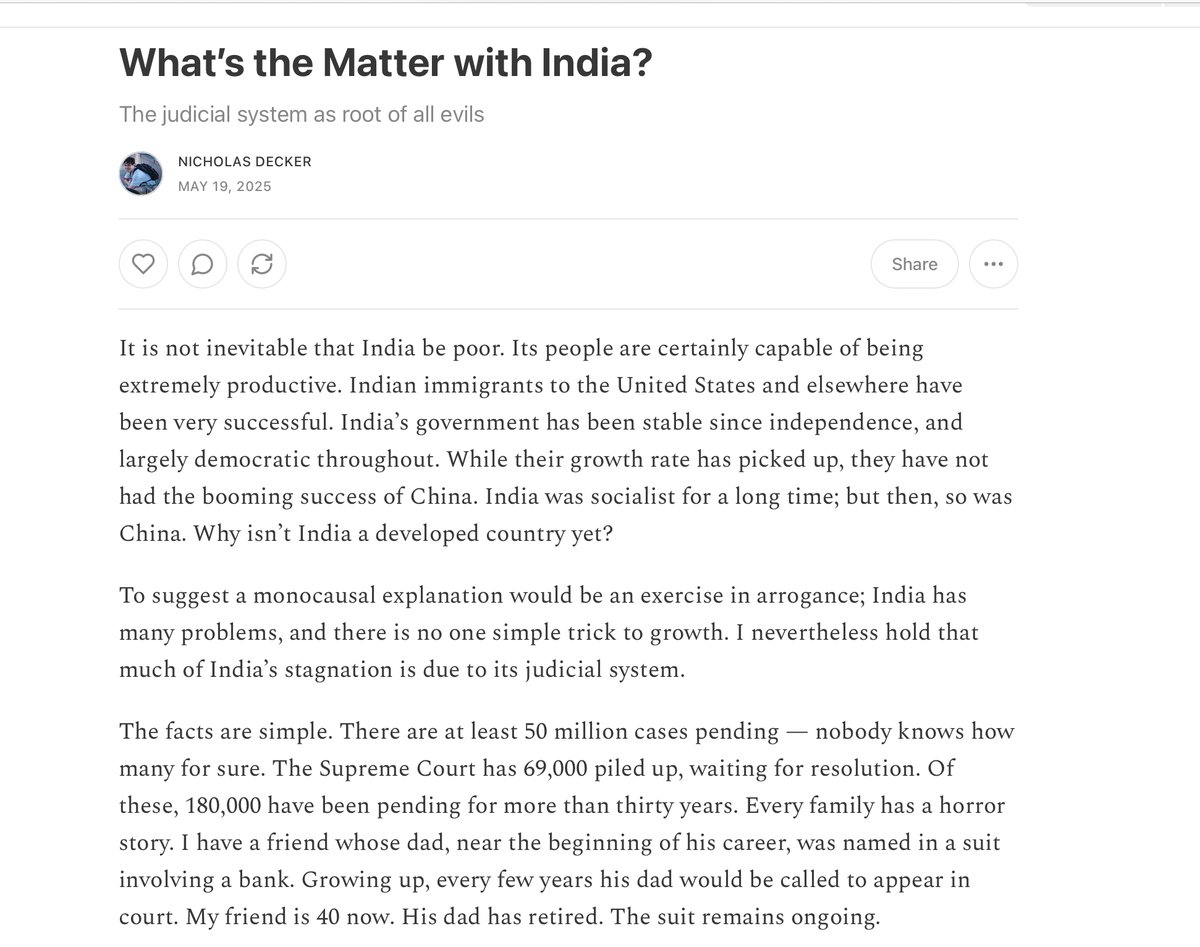
The Indian judicial system is a national embarrassment. Today on my blog, I cover how it affects economic activity. It is directly responsible for the reduction of GDP per capita by severage percentage points a year. Read it below!
It makes me so mad that China is trying to stop India from industrializing.
For decades, America helped Chinese people escape poverty. Now China is trying to keep Indians in poverty. Disgusting.
https://t.co/tMzmBXpeJo
Pakistanis bring up the Hindutva bogeyman, ignoring for nearly 50 years, Hindutva was fringe and a generous Indian secularism was norm, yet they still found the idea of living w Kafir neighbors nauseating.
Little self awareness in how funding for terrorism was fuel for Hindutva