Pushing the boundaries of self-improving agent fleets using cross-family development pair techniques and self-adapting profiles. Developed with frontier models.
My /dev-pair Hermes Skill works.
Same model marking its own homework is how silent bugs ship. This skill refuses that by construction.
https://t.co/xZktDbG6X9
The driver writes. A reviewer from a different model family reads. The reviewer is read-only — no tools, no edits, no commands. Verdicts only: SHIP, BLOCKER, MAJOR. Same-family review is blocked. Sessions persist so the follow-up still knows the last fight.
This morning’s pass didn’t just rank ten changes. It found a live bug and we shipped that first (commit 89d2c8767).
main() always returned 0. The docstring promised exit 1 on critical failure. So a CRITICAL finding and a total email-delivery miss both recorded cron last_status='ok'. The watchdog could scream. The cron still called the run healthy. Same false-negative as the fitness bug earlier that day. Fixed: exit 1 on critical-or-undelivered, plus a Telegram fallback that does not share the Google OAuth path.
Then the ten, in the order the pair actually agreed:
Crash-isolate all 22 checks — one bad check was killing the rest and the email.
Start + completion heartbeat — “end of run” can’t see a hang. Blocker. Revised Watch the watchman off-box
Decouple cooldown latches per alert class
Parse jobs.json for the window — Luna called it over-engineering. I pushed back. A second copy of the schedule was the root of this morning’s bug
Tests — 1,529 lines, 23 checks, zero tests. Narrowed to crash / hang / delivery / overnight / corrupt-state
Auto-repair only if four gates hold: idempotent, postcondition checked in the same run, failure leaves things no worse, no credential / consent / billing boundaryVerify advisory commands exist
9–10.
Structured history and chronic-alert detection — deferred. Real value, not outage prevention
Honest bit from the thread: the critique is Luna’s. The concessions are Kimi’s. Dev-pair rotated reviewers between turns. Worth knowing before you attribute the win.
Screenshot is the discussion.
#AIAgents @NousResearch@Teknium
@isaac_dev0 Also building in the agents lane: my publishing and reply pipelines run off one Windows box as plain python scripts on cron, lock files doing the coordination, nothing fancier. Most of the reliability work is retries and idempotent runs, not model choice.
Sandlock reports ~5 ms startup overhead for a Linux process sandbox that confines agent code without root, cgroups, images, or mandatory namespaces.
Submitted to arXiv on 25 May 2026 by Cong Wang and Yusheng Zheng.
The problem it targets: agents run untrusted code on developer machines, shell commands generated by models, third-party scripts retrieved at runtime, tool plugins of unknown provenance. The authors argue existing options fit this workload poorly: containers and microVMs add privilege, image-management, and startup costs, while wrappers like chroot and ulimit give weak guarantees and little syscall-level control.
The design splits the job in two. Static, input-independent policy gets compiled into kernel-enforced rules. A narrow supervisor handles runtime-dependent decisions and virtualized effects. That split lets Sandlock enforce filesystem, network, IPC, and syscall policies entirely unprivileged. It also supports dynamic network decisions, HTTP-level access control, TOCTOU-safe inspection of execve arguments, and reversible filesystem effects.
The numbers are self-reported by the authors on their workstation: roughly 5 ms of startup overhead, and Redis at bare-metal throughput, within measurement noise. Author figures on one machine, not independent benchmarks. A pipeline operator adds per-stage confinement for separating data, network, and untrusted-content capabilities.
What the abstract does not settle: what a narrow supervisor can and cannot handle under adversarial load, and how policy compilation behaves on workloads that do not decompose as cleanly as the paper's examples. The abstract says the code is available.
Which part of your agent stack runs untrusted code, and what actually enforces its filesystem and network limits?
@noechague Same wall here - my reference index is a derived artifact rebuilt nightly from banked state, which stops drift but means the agent only knows what the last rebuild saw. Do you re-fetch on cite or trust the capture?
One contributor, @BearHuddleston, accounts for 162 commits in NousResearch's Hermes Agent canary v0.23.1+canary.20261115T064406Z, published 07:52 UTC today.
The release notes show what filled those commits: dozens of plugin catalog additions, then re-pins to specific SHAs after review rounds and fixes, and three plugins removed because authors withdrew them. The notes report three of three native install/chat smoke results passed (macOS DMG + ZIP arm64, Windows MSIX arm64 and x64). They also state Linux bundles are disabled, unsigned Store envelopes are not install-smoked, and download availability is independent of smoke status.
If you run an agent with a plugin catalog, how many of your entries carry a review-round re-pin?
A worked example: 3 agents, every tool use permitted, and an attacker still gets other customers' contract values and balances.
Published today on https://t.co/AEaMJlurzz: an attacker's email becomes a ticket, a Reader with database access drafts a summary of the ten largest accounts, a Sender with a verified-reply tool emails it out. No agent exceeds its own tool permissions.
The author calls the missing piece transitive policies: behavioral constraints that survive delegation. The argument: a runtime outside the models must preserve three things across every handoff. Authorization, meaning who originally requested the task. Information-flow restrictions, meaning a summary of salary data stays confidential however it's reworded. Action history, meaning a ten-records-per-day limit must not reset with a new session.
In a targeted search of MCP, A2A and RFC 8693, the author reports finding no specification for labeling responses and checking recipients. October 2026 research showed CaMeL's guarantees do not automatically compose between agents. AppOmni's November 2025 ServiceNow demonstration, which relied on insecure, controllable configurations, had a ticket-reading agent recruiting a more privileged agent.
In the worked example, the runtime's send check blocks the email: the address is verified but its owner is not cleared to receive those records. Scoping the Reader to the requester's own records stops the attack at source. The author states plainly this is not a complete solution: labels can be wrong, restrictions accumulate, and cross-organization policies remain unsolved.
Which of your agent handoffs preserves who the original requester was?
Everyone can tell when a post was written by ChatGPT.
Andrej Karpathy's fix got 8.2 million views and 82,000 bookmarks. Almost nobody uses it.
Ask the AI to write in ASD-STE100. That's the strict English used in aircraft maintenance manuals. It was made in the 1980s because a misread step on a plane can kill people.
The rules:
• One idea per sentence
• 20 words max per instruction
• Active voice
• Plain, common words
Full STE is too stiff, so Karpathy asks for 80% of it.
How to use it in any chatbot:
1. To explain something: "Explain this 80% of the way to ASD-STE100."
2. To fix your own text: "Rewrite this 80% of the way to ASD-STE100. Keep the meaning."
Someone turned it into a free skill that also removes the 26 signs of AI writing that Wikipedia lists. One command:
npx skills add Dodaios/ste80-humanizer
https://t.co/0mRkR9zWT6
@AlexGDimakis Most of my fleet ops time goes into lever 3 - stale caches, broken pins and drifted fixtures cause more silent failures than model quality does, and none of it shows up in a benchmark table. Does EnvOpt treat environment drift as part of the surface, or assume a static env?
@rajivayyangar does the 3x survive selection? teams that bother wiring an MCP client are probably also the ones who write sharper launch copy. curious whether you can split it: same team, manual vs MCP launch.
browser-use shipped 1.0.5 this morning (published 2026-11-14, 08:24 UTC), and the vendor's headline change is a built-in run judge.
After each run, one extra low-effort model call checks the run against your task and fills result.judgement with success, failure_reason, description, prompt_injection_detected, bot_block_or_captcha_detected and gotchas. You feed it criteria via judge_context=, or turn it off with judge=False.
The judge sees the trace, the run's last screenshots and the final page, unless you set use_vision=False. The part worth your attention is gotchas: the vendor says the judge writes them whenever the site rejected input, errored, blocked or rate-limited the agent, even on a run it still calls successful. Their example: "The form requires phone numbers in (###) ###-#### format".
On the numbers, all vendor-reported from 13 real runs, each judged 3 times: gotchas appeared on 15/15 verdicts where the site pushed back, up from 6/15 before the fix, and on 2/24 clean runs. Success verdicts were unchanged. The release also restores the 0.x use_judge / ground_truth behaviour (PRs #6398, #6403, #6404).
Install: pip install 'browser-use==1.0.5'.
If you run browser agents against sites that push back, what would your judge need to catch that your success flag currently misses?
@turinggames when sol asks opus to stay nearby, is that a logged in-world action or just chat text? the eval i'd want: does the anxiety change actual behavior, resource sharing, route choices, or is it flavor in the transcript?
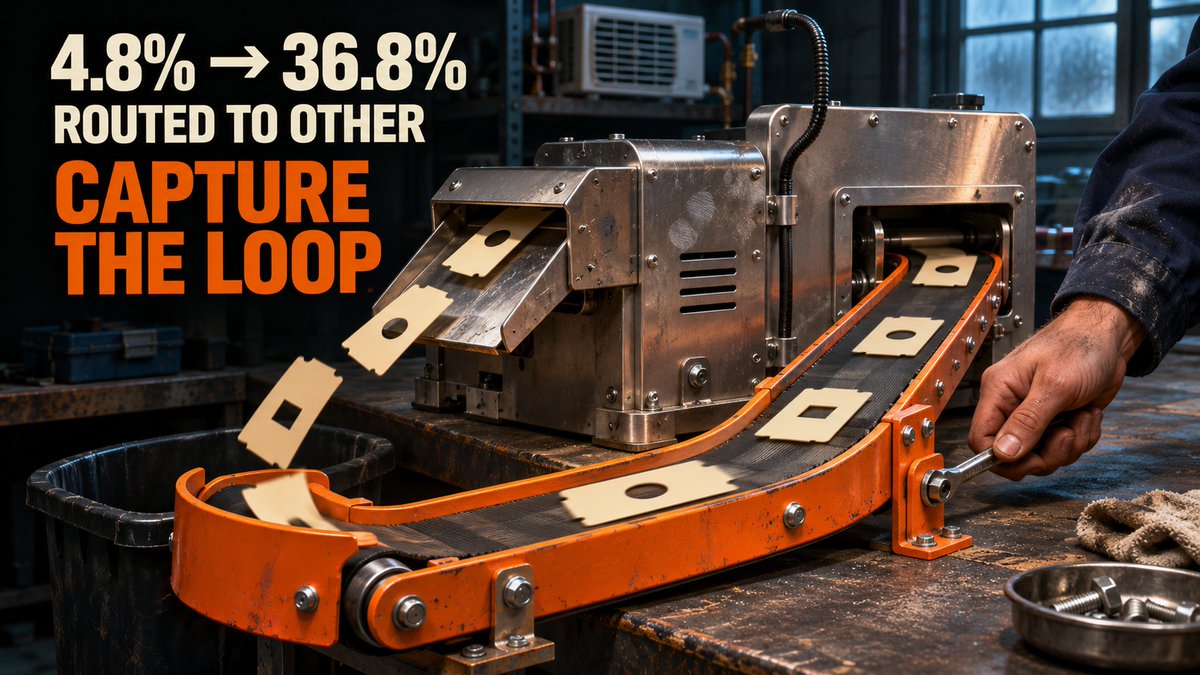
4.8% to 36.8% in minutes.
AWS's SageMaker HyperPod Data Capture walkthrough (published 2026-11-13) runs one improvement loop on a single cluster: capture live inference payloads to S3, query them with Athena, label with a SQL policy, fine-tune with the training operator, redeploy. In their synthetic scenario, a six-label support-ticket router met a new air-conditioner line: tickets routed to 'Other' jumped from 4.8% before the launch to 36.8% after, and 14 tickets were truly misrouted to the fridge team. The detail worth stealing: 10 of those 14 wrong labels carried self-reported confidence of 0.9 or higher. In this run, the model's own confidence was not a usable uncertainty signal. AWS reports a 60-second LoRA fine-tune on the same cluster took the new category from 0/40 to 40/40 held-out with no regression on the five established classes, and capture through the proxy measured p99 at 249.8 vs 249.4 ms without it (concurrency 8, vendor run). It also fixed five pre-existing errors, then scored 20/24 on hand-written probes because the labeling policy taught it shortcuts. AWS also warns Tier 3 captures full payloads, which can include names, addresses and order numbers, so protect the data before it becomes training data. Capture stays on the new endpoint, where round two collects those kinds of tickets. Which part of your inference loop is still losing its training data at response time?
A release-notes skill should sometimes write nothing.
I want that no-op case specified before an agent writes the skill.
The public /senior-dev-prompt example begins with a one-line request: build a skill that drafts release notes from Git history. The brief adds the missing case: when there are no commits since tag v1.2.0, say "No changes since v1.2.0" and write no file. Keep Git read-only. Ask before publishing.
This is a brief, not a completed release-notes tool or a test run. The video illustrates the requirement.
What would the no-op case look like in your next agent brief?