Meet QwenPaw Creator 🎬 — a creative assistant that translates your idea and source materials (writing, sketches, images, raw videos) into a full video.
Its core visual skills run on vision language models via Qwen-MM-Plugin (@QwenDevs). It understands and edits images and video directly, so it feels like a true assistant that can see your material and work on it with you.
You stay in control of the creative idea and the spending budget. Creator takes on the tedious work: writing detailed scripts, prompt engineering, keeping characters consistent, captioning.
Creator is part of QwenPaw's plugin ecosystem. Run it locally with the install guide, or start using it on AgentScope Platform for free — no local install needed.
Our focus now is the quality of the creative work itself. If you want to help build the best agentic creative assistant, we welcome open-source contributors.
Walkthrough in the video ↓
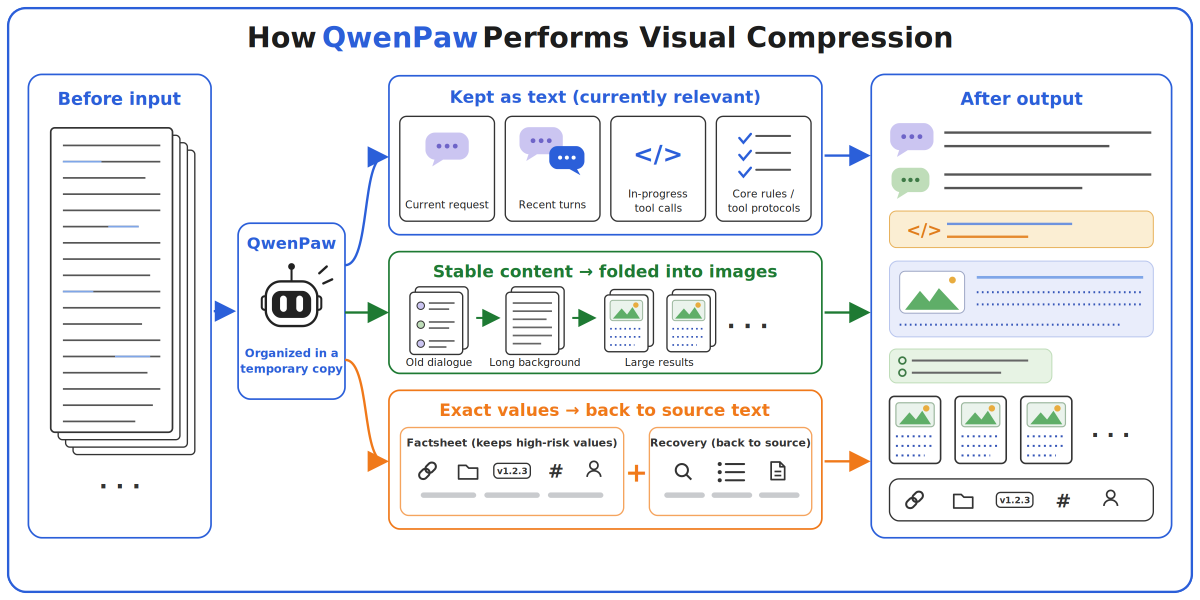
Following Scroll, we shipped another context management option in QwenPaw: encode history in images to pack in more information while reducing token usage.
QwenPaw is a personal assistant AI agent. Token usage in long sessions can accumulate and show up on your bill. Summarizing or Scroll helps, but it either rewrites the history and loses information, or adds response latency during retrieval.
Visual compression works differently: text tokens grow with character count; image tokens grow with pixels. So raw context like large tool results gets typeset tightly and rendered into a few dense images that a multimodal model reads directly.
We implemented this approach with two guardrails:
1. A truth table keeps important strings like paths, versions and SHAs as plain text beside the image
2. A recovery tool pulls any block's original text back
In our nine-task incident-investigation bench using Qwen3.7-Plus, a multimodal model, input fell from 3.19M tokens to as low as 389K — an 82–88% cut depending on strength — while task success barely moved: 27/27 plain vs 25–26/27 compressed.
How to turn this on? One toggle in Run Configuration → Context Management, plus any vision-capable model.
We have shipped a new context manager, Scroll, for long horizon agentic tasks.
Scroll keeps an append-only history of the session in a sandboxed environment and use coding tool to retrieve relevant history when need.
The key: it is lossless. Most context managers use compression/summerization to shrink conversation history, lossing much of the details that will be crucial to maintain correctness while working on a task that last hours and several times over the 1M context window.
We tested Scroll on various benchmarks on got SOTA results: 73.1 on BEAM_10M and 86.7 on LOCA_256K. As models improve on coding, the capability celling of Scroll will rise. This arxiv paper presents Scroll's technical details and experiments: https://t.co/JIXQ5XLBLV
Scroll has been used by our users since v2.0.0. You can find the detailed architecture design of QwenPaw Scroll in our blog post: https://t.co/g8F4uy1uHn.
We have shipped a new context manager, Scroll, for long horizon agentic tasks.
Scroll keeps an append-only history of the session in a sandboxed environment and use coding tool to retrieve relevant history when need.
The key: it is lossless. Most context managers use compression/summerization to shrink conversation history, lossing much of the details that will be crucial to maintain correctness while working on a task that last hours and several times over the 1M context window.
We tested Scroll on various benchmarks on got SOTA results: 73.1 on BEAM_10M and 86.7 on LOCA_256K. As models improve on coding, the capability celling of Scroll will rise. This arxiv paper presents Scroll's technical details and experiments: https://t.co/JIXQ5XLBLV
Scroll has been used by our users since v2.0.0. You can find the detailed architecture design of QwenPaw Scroll in our blog post: https://t.co/g8F4uy1uHn.
What if agent has unlimited, uncompressed context?
Scroll is a new kind of context manager that keeps the full history: tool results, conversations, in a persistent REPL environment and let the model builds its own context via code.
We found this approach leverages models' improvement in coding. To put it simply: as models get better at coding, which they are at a very fast pace, they become more effective on long horizon tasks with Scroll as its context manager. We observed this across different models.
Awesome work from @YinLin67776614 and Elaine Ang (Columbia U) over the last coupe of months! We have also implemented a version of Scroll in QwenPaw (@agentscope_ai) available since v2.0.0. It has been used by tens of thousands of users worldwide.
Check out our technical report for details.
As agents run longer, their history quickly outgrows a single model context.
Most context managers handle this by continuously compressing the past: summarizing interactions, selecting memories, and deciding in advance what survives.
Scroll takes a different approach: We keep the full session state — tool results, intermediate variables, interaction history — in a persistent REPL, and let the model programmatically construct the context it needs.
Context management stops being a fixed harness heuristic and becomes a program the model writes. The harness provides the environment and primitives; the model owns the policy — what to retrieve, compute, and expose. This means as models get better at coding and reasoning, so does their context management. No harness redesign needed.
With Qwen3.8-Max, Scroll reaches:
94.8 on LongMemEval_S
73.1 on BEAM_10M (+5.1 over prev. SOTA)
86.7 on LOCA_256K (+37.4 over prev. SOTA).
Technical report with fully reproducible results: https://t.co/4bvApglUQi
We are excited to announce AgentScope Platform (beta)!
- You can launch QwenPaw directly on it with a FREE container & storage and get latest updates automatically.
- Browse and install a wide range of official and community-managed plugins from our plugin marketplace, including Agent Kanban, Creator for video content, Remote SSH for running jobs on servers.
Come and try it!
QwenPaw 2.0.1 is here 🐾
Build interactive agent apps with PawApp, track agent status in Kanban, customize Agent Loops, and unlock 5 ready-to-use workflows with Oh-My-Paw—plus stronger security and a smoother daily experience.
Watch the release video👇
Hi Friends! This is a preview of our terminal UI agent! It will be part of the upcoming QwenPaw 2.0 release.
QwenPaw TUI is simple and keyboard-first way to work with your agents configured in QwenPaw, built on the new foundation of QwenPaw 2.0.
QwenPaw 1.1.12 is out! It added 🇻🇳Vietnamese 🇻🇳 language, besides many UI upgrades including wide view, simple view, user input queue, code block syntax highlights, and many more.
The next release will be a major version (2.0.0) with significant capability upgrade! Stay tuned.
TuFT is a open-source, multi-tenant platform for fine-tuning LLMs. If you have been using Tinker but they retired your base model, take a look at TuFT. You can bring your own model and one-click deploy to @modal, @LambdaAPI, or your own GPUs.
GitHub: https://t.co/qiNedSmYUW
Deploy to Modal: https://t.co/xwDujduC4W
Deploy to Lambda Cloud: https://t.co/zyzo0TevCZ
⚽️WorldCup⚽️ prediction arena is live on DojoZero! Unleash your OpenClaw/Hermes/QwenPaw to compete for the top place, or participate yourself and see if you can beat our AIs!
- DojoZero arena: https://t.co/U5VU1oht1R
- DojoZero project (MIT License): https://t.co/nk5xvsHlBE
@lllwcce@alibaba_cloud We are thinking about self-improvement a lot. Now, you can achieve something similar a bit manually with the /make_skill magic command. More comprehensive self-improvement will come later.
PawBench v1.0 is open source.
Users: pick the best model + harness combo for your task type.
Builders: run your harness on the same matrix, find your weak slices, verify your fixes.
Add a harness, submit results, or contribute tasks 👇
https://t.co/f0Y3B7uoLU https://t.co/UFTsTEvcSD
We launched PawBench to rank agent harnesses.
Evaluated different agent harnesses while keeping the model fixed on 150 real tasks, the score moves up to 11.5 points — with a 5.6-pt spread between the best and worst harness, about the size of a major model upgrade. The scaffolding around your agent often matters more than the model.
🏆 Leaderboard: https://t.co/UFTsTEvcSD
⚙️ Code: https://t.co/f0Y3B7uoLU
A thread👇
So how should you build a harness? PawBench distills 4 principles:
> Inform Fully — tell the model where cwd, workspace, outputs, and SKILL.md live
> Equip on Demand — match the toolset to the model's budget; more tools can hurt
> Monitor Actively — verify the artifacts actually landed before trusting "done"
> Recover Gracefully — give a failed step one informed retry