Anthropic just showed a 24-minute workshop on how to actually do prompts for Claude.
Taught by the people who built it.
Free. No registration. No paywall.
I've seen $300 courses that don't cover what they teach in the first 8 minutes.
Watch it and bookmark it now.
Most solo lawyers think AI will help them compete with BigLaw.
They are solving the wrong problem. BigLaw is not their competition. BigLaw is not taking their clients. BigLaw does not want their clients.
The person doing a $4,000 real estate closing is not losing that client to Kirkland & Ellis. The family lawyer charging $5,000 for an uncontested divorce is not competing with Skadden.
Your competition is not a better lawyer.
Your competition is the client who decides to do nothing.
The landlord who Googles "do I need a lawyer for an eviction" and finds an AI-generated article that walks them through the process step by step. They download a form. They file it themselves. They get it wrong. But they never call you because the internet told them they did not need to.
The small business owner who asks ChatGPT to draft an operating agreement instead of hiring you. It hallucinates a few clauses. It misses their state's specific requirements. But it looked professional enough and it was free. Two years later when the partnership blows up, they will need a lawyer. But right now, today, they chose "do nothing" over "hire a lawyer."
The couple who should have gotten a prenup but decided it was "too expensive" and "too awkward to bring up." The startup founder who used an online template for a convertible note because a lawyer wanted $2,500. The homeowner who did not fight their property tax assessment because they did not know a lawyer could do that for $750.
None of these people hired a different lawyer. They hired no lawyer. They either did it themselves badly or they did not do it at all.
This is the actual competitive landscape for most solo lawyers and small firm owners. And it has been getting worse every year for a decade. Long before AI.
LegalZoom does 20% of all LLC filings in California. Not because LegalZoom is better than a lawyer. Because LegalZoom is there at 11pm when the person decides to start a business, and you are not.
Rocket Lawyer, LegalShield, Nolo, incfile, all of them exist not because they stole clients from lawyers. They filled the gap that lawyers left open by being expensive, slow, intimidating, and hard to reach.
Now AI is making that gap wider. Fast.
A person with a legal question in 2019 had two choices. Google it and read confusing articles, or call a lawyer. Most of the time calling a lawyer felt like too much. Too expensive. Too formal. Too slow. They did not know if their problem was "lawyer worthy." They did not want to feel stupid asking. So they did nothing.
A person with a legal question in 2026 has a third option. Ask an AI. Get an answer in 30 seconds that sounds confident and authoritative. It might be wrong. It might miss critical jurisdiction-specific details. It might hallucinate a statute that does not exist. But it answered the question instantly, for free, without judgment.
Every day, people are making legal decisions based on AI-generated information that no lawyer has reviewed. They are signing contracts, filing forms, making agreements, and accepting terms that a 15-minute consultation would have flagged.
They are not choosing a competitor over you. They are choosing the absence of you. Because you were never in the consideration set.
This is the real opportunity for solos and it is the opposite of what the legal tech industry is selling.
The legal tech industry says: use AI to do your legal work faster so you can compete with bigger firms.
The actual opportunity is: use AI to be present at the moment the client is deciding whether to hire a lawyer at all.
What does that mean specifically.
42% of solo practitioners fail to respond to leads within 3 days. Three days. In a world where someone can get an AI-generated answer in 30 seconds, you are taking 72 hours to return a phone call.
The lawyer who responds first gets the client 70% of the time. Not the best lawyer. Not the cheapest. The first one who picks up.
So the single highest-ROI use of AI for a solo practitioner is not drafting briefs faster. It is making sure every single person who reaches out gets a response within minutes. A real response. Not an autoresponder. A response that acknowledges their specific situation and makes them feel like someone competent is paying attention.
The second highest-ROI use is being findable at the moment of need. The person Googling "do I need a lawyer for this" at 10pm needs to find you, understand in 30 seconds that you handle exactly their problem, and have a way to engage right then. Not "call during business hours." Not "fill out this form and we will get back to you." Right then.
The third highest-ROI use is making the first consultation so easy that the friction of hiring a lawyer disappears. Pre-filled intake. A clear explanation of what it will cost. A simple way to pay. No "come to my office" when a video call works fine. No "I will send you a retainer agreement" when they could e-sign one right now while they are still motivated.
Every step of friction between "I think I might need a lawyer" and "I just hired a lawyer" is a point where the client decides to do nothing instead. AI can eliminate almost all of that friction.
The solos who figure this out will not be competing with BigLaw. They will be capturing the 80% of legal need that currently goes unserved because the profession has made itself too hard to hire.
There are roughly 50 million civil legal problems in America every year. More than half get no legal help at all. Not because there are not enough lawyers. There are too many lawyers. Because the gap between "I have a legal problem" and "I hired a lawyer" is filled with cost uncertainty, intimidation, inconvenience, and delay.
AI does not close that gap by making lawyers faster at writing briefs.
It closes that gap by making lawyers reachable, responsive, and easy to hire.
That is the post nobody in legal tech is writing. Because it does not sell a $900/month SaaS product. But it is the thing that will actually determine which solo practices thrive and which ones slowly starve.
Your best client is not the one you took from another lawyer.
It is the one who almost did nothing.
Every federal docket in America is public record. Every state court publishes orders, motions, rulings. PACER alone has over 1 billion documents.
And somehow, when you walk into court against a judge you've never appeared before, your best preparation strategy is still calling someone who has.
"Hey, what's Judge Morrison like on summary judgment?"
"Tough but fair."
That tells you nothing. That is a horoscope. And yet that is the state of the art for most practicing lawyers in 2026.
Let me tell you what is actually sitting in those dockets that nobody is using.
Every judge has patterns. Not vibes. Not reputation. Patterns that show up in their rulings over hundreds of cases.
Some judges grant MSJs at twice the rate of the judge down the hall in the same courthouse. Some judges have never granted a TRO without an evidentiary hearing. Some judges write 40-page opinions on personal jurisdiction and dispose of contract disputes in three paragraphs. Some judges have a 94% grant rate on motions to compel and barely ever sanction discovery abuse. Others sanction on the first violation.
All of this is in the public record. Published. Available. And most lawyers are still going in on anecdote and gut feel.
There are analytics tools. Lex Machina, Trellis, Pre/Dicta. They are expensive. They are built for litigation departments at AmLaw 200 firms with budgets. If you are a solo or a 5-person shop, you are paying $270/month for Lexis and another $96 for Westlaw Essentials and you do not have another $900 for a judge analytics subscription.
So you don't use analytics. You use anec-data. The term is not mine. It is what researchers call it. Anecdotal evidence gathered from colleagues about judges' tendencies gleaned from limited personal appearances.
You are preparing for a motion hearing with the same quality of intel that a fantasy football player uses to set their lineup.
Here is what changed.
You do not need Lex Machina to build a judge profile anymore. You need PACER or your state court's e-filing system and a local AI tool that can read files on your computer.
I mean specifically something like Claude Code. Not ChatGPT. Not Claude in a browser tab. Those are chatbots. You type something in, it responds from its training data, and if it does not know something it makes it up. That is how we got Mata v. Avianca. That is how we got 600+ cases with fabricated citations. Lawyers typing "find me cases supporting X" into a chatbot and trusting what came back.
Claude Code is different. It runs on your machine. It reads the actual files in your actual folders. It does not hallucinate case law because it is not generating case law from memory. It is reading the documents you gave it.
So here is what the workflow actually looks like.
Download the last 30 to 50 opinions and orders from the judge assigned to your case. For federal, that is PACER. For state courts, it is whatever your jurisdiction publishes. Most of them publish at least orders and opinions even if the interface feels like it was designed in 2003. Because it was.
Put them in a folder. Along with your complaint, the motion you're opposing, any relevant exhibits and declarations. The actual case file.
Open Claude Code. Point it at that folder. It reads everything.
Now ask it questions. Not "find me cases that support my argument." That is how you get sanctioned. Ask it questions about the judge.
"Based on these 40 rulings, how does this judge typically analyze personal jurisdiction in diversity cases?"
"What does this judge do when the moving party fails to meet and confer before filing a discovery motion?"
"In the 12 summary judgment orders in this folder, what percentage did the judge grant? What factual patterns were present in the ones she denied?"
"Has this judge ever cited to [specific precedent] and if so how did she apply it?"
These are questions you would ask a partner who has been before this judge 50 times. The difference is Claude Code is reading the actual orders, not going from memory.
Now here is the part that matters most and that most people skip.
Read what it tells you. Check it against the orders. If it says the judge has never denied a motion to compel and you know from reading order #22 that she did deny one when the requesting party failed to meet and confer, correct it. Tell it where it is wrong.
This is not "prompting." This is working with a tool the way you would work with a first-year associate doing research. You review their work. You correct their analysis. You build on what they found. The tool gets better as you correct it because it updates its understanding within that session.
Then you say: "Now draft my opposition to this motion for summary judgment, given what you know about how this judge analyzes these issues and the specific facts in my case file."
What comes back is not a form brief. It is structured the way this specific judge reads arguments. It leads with the analysis this judge spends the most ink on. It addresses the issues this judge always raises sua sponte. It does not waste four pages on an argument this judge has never found persuasive in 40 prior cases.
You can do this for opposing counsel too. Their filings are public. Pull their last 20 briefs from PACER. What arguments do they always make? Where are their briefs weakest? Do they tend to bury the bad facts or address them head on? Do they over-cite or under-cite? What does their reply brief typically look like when their motion is opposed?
You can do this for an arbitrator before you draft your statement of claim. You can do this for a mediator before your mediation brief. You can model anyone whose prior work product is available.
And you can do it tomorrow. With documents you already have access to. On your own laptop. No subscription. No vendor. No annual contract.
The irony is not lost on me that the legal profession, the profession that is literally built on research and analysis and evidence, is ignoring the largest body of evidence about its own decision-makers that has ever existed.
The data is public. It has been public. The tools to read and analyze it at scale just became accessible to solo practitioners and small firms this year.
The lawyer using this has an advantage that is almost unfair. Not because of what AI can generate. But because of what it can read.
Never underestimate lawyers’ ability to learn new fields, new domains, and new skills. We are phenomenal, obsessive, meticulous, relentless learners. We will adapt to whatever gets thrown at us. Look at what’s happening with AI. We are unpicking it and figuring out how to make it work and use it in our work responsibly, ethically, and effectively.
The legal tech industry spent the last 3 years telling solo lawyers and small firms that AI would level the playing field.
Then they priced it so only BigLaw could afford it.
CoCounsel. $900 a month per seat. For a single user. That is $10,800 a year for one attorney to use an AI research tool that hallucinates 17% of the time according to Stanford's own testing.
Lexis+ AI. Integrated into plans that already cost $270 a month whether you use them or not. Locked into annual contracts you cannot pause. And their AI hallucinated more than 17% of the time in the same study.
Westlaw's AI-Assisted Research. Hallucination rate above 34%. More than one in three queries returning something that is not real. At premium pricing.
Harvey. Raised $300 million. Serves elite firms. If you are a solo doing PI cases in suburban Ohio, Harvey does not know you exist and does not want to.
The pattern is the same one legal tech has followed for 20 years. Build for the firms that can write six-figure checks. Let everyone else figure it out.
And everyone else is 75% of the profession.
There are 1.3 million licensed attorneys in the United States. Roughly 49% are in solo practice. Another 15% are in firms of 2 to 5. That is nearly two thirds of all practicing lawyers in firms where $900 a month per seat is not a rounding error. It is a decision between a tool and a paralegal.
These lawyers chose the paralegal. Every time.
Not because they do not understand AI. Because the math does not work. If you bill 150 hours a month at $300 an hour and your utilization rate is the national average of 37%, you are collecting maybe $16,000 a month before overhead. You are not spending $900 of that on an AI tool that might make up a case and get you sanctioned.
So the state of the art for most American lawyers in 2026 is the same as it was in 2019. Westlaw. Word. A yellow legal pad. Maybe Clio for billing if they are progressive.
The AmLaw 100 firms have AI teams. They have prompt libraries. They have custom-trained models for their practice areas. They are running document review that used to take 200 associate hours in 3 days.
The solo in Tampa is still copying and pasting from a brief template he wrote in 2017.
That is the playing field legal tech "leveled."
Here is what nobody in legal tech is talking about because it threatens their entire business model.
A solo practitioner with a laptop can now build most of what those $900/month tools do. In a weekend. For the cost of a Claude subscription.
I am not being provocative. I am being specific.
Take the thing lawyers actually need most. Not a chatbot to ask legal questions to. That is what got people sanctioned. Lawyers need tools that work with their actual files. Their actual cases. Their actual documents.
Claude Code runs on your machine. It reads every file in a folder you point it to. It does not go to the internet and generate case law from memory. It reads the documents you already have.
Here is what a solo practitioner can build in a single weekend.
Client intake processing. Right now you get an email or a phone call, you take notes, you type everything into Clio manually, you send a retainer letter, you open a file. Every step is manual.
Set up a folder structure. Put your retainer template in it. Put your conflict check list in it. Tell Claude Code what your intake process looks like and have it build you a system where you paste in the client's details and it generates the retainer letter, the conflict check memo, the new matter checklist, and the initial filing deadlines. All in the format you already use.
Not some vendor's format. Your format. Your letterhead. Your retainer language.
Or take deadline tracking. You are paying for a calendaring system or worse you are using Outlook reminders and hoping. Pull your active case list. Feed it to Claude Code with every relevant deadline type for your practice area. Have it build a tracker that flags deadlines at 30, 14, 7, and 3 days out. Output to a spreadsheet you already know how to use. Or to your calendar. Or to a daily email.
A developer would charge you $5,000 to $15,000 for this. You can build it Saturday morning.
Or take the thing that actually moves the needle in litigation. Preparing for a judge you have never appeared before.
Download 30 of this judge's orders from PACER. Put them in a folder with your motion and the opposing brief. Have Claude Code read all of it and tell you how this judge has ruled on the exact issues in your case. What arguments she finds persuasive. What she raises sua sponte. How she structures her analysis.
Now have it draft your brief to match how this specific judge reads and reasons.
Lex Machina charges thousands a year for judge analytics that give you bar charts. You just built a judge-specific brief preparation system in an afternoon using the actual orders instead of summarized data.
Or document review. You have 2,000 documents in discovery. A vendor wants $15,000 to run them through their review platform. Put them in a folder. Have Claude Code read them and flag the 200 that are responsive to the RFPs. Have it draft a privilege log for the ones that are privileged. Review its work the way you would review a first-year associate's work. Correct where it gets it wrong. Run it again.
This is not hypothetical. Lawyers are doing this right now.
The reason the legal tech industry does not want you to know this is because their entire model depends on you believing that you cannot build these tools yourself. That AI is too complicated. That you need their proprietary wrapper around the same foundation models you can access directly.
CoCounsel is a wrapper around GPT-4. Lexis+ AI is a wrapper around proprietary models. Harvey is a wrapper around Claude and GPT. You are paying $900 a month for a user interface and a brand name sitting on top of models you can access for $20 to $200 a month.
I am not saying these tools are worthless. If you are a 500-lawyer firm with compliance requirements and you need enterprise deployment with audit trails and SSO, you should buy enterprise software.
But if you are a solo. Or a 3-person shop. Or a legal aid lawyer who has never had access to any of this.
You can build it yourself now. The foundation models are the same ones the expensive tools use. Claude Code gives you direct access. It reads your files, it understands your practice, and it does not lock you into an annual contract.
The most expensive legal tech is no longer the best legal tech. The best legal tech is the one you build yourself because it does exactly what you need and nothing you do not.
The playing field did not get leveled by the companies that promised to level it. It got leveled by the same AI they are reselling to you at a 40x markup.
In the corporate world, if you have:
- a decent salary,
- a manager who trusts you without micromanaging,
- the flexibility of a hybrid work setup,
- the freedom to take time off when needed,
- opportunities for growth and skill development,
- a supportive and inclusive company culture,
You’re already among the top 1% of professionals enjoying a truly balanced and fulfilling work life.
you can take a fat person who can't lose weight give them retatrutide and have them lose it with no issues
give a person with horrible muscle building genetics steroids and they will look insane in 1-2 years
need to learn a new language? create a nootropic stack and learn it 10x faster
give a person with no endurance meldonium and have them run a marathon
give a person with TikTok-brain level focus some stimulants and he is locked in for 16 hours
life is not a drug tested sport, the only thing you precious 'natty card' will give you is a silver medal
You have no experience.
You’ve never started a company.
You’ve never had a full time job.
Nike is going to kill you.
You’re a kid.
You don’t have technical skills.
You shouldn’t build hardware.
Apple is going to kill you.
You can’t build hardware.
You can’t measure heart rate non-invasively.
Athletes don’t care about recovery.
Under Armour is going to kill you.
It won’t be accurate.
You don’t listen.
You’re an ineffective leader.
You can’t recruit great talent.
You’re going to have to pay every athlete.
You can’t measure sleep non-invasively.
It’s too expensive to research.
Athletes are a small market.
The product costs too much to make.
The product costs too much to sell.
Your valuation is too high.
Consumers aren’t going to want it.
Hardware is too hard.
You should measure steps.
Fitbit is going to kill you.
You can’t build a marketing engine.
You can’t raise enough money.
You need a real CEO.
Google is going to kill you.
You can’t be a subscription.
You can’t build a brand.
You can’t do consumer in Boston.
Your valuation is too high.
You shouldn’t make accessories.
You shouldn’t make apparel.
Lululemon is going to kill you.
You can’t predict Covid.
Stay in your niche.
You are going to run out of money.
You can’t build a health platform.
Amazon is going to kill you.
You can’t measure blood pressure.
You can’t get medical approvals.
The market is too small.
You don’t understand AI.
The market is too competitive.
It won’t work internationally.
The supply chain is too complicated.
You can’t build an AI.
You can’t raise enough money.
It’s too competitive.
Healthcare isn’t going to want it.
…
Just keep going ✌️
Sydney now has a median home price of $1.7m. The median income in Sydney is around 90k - 100k. If we use $100k for simplicity, Sydney median house prices are now 17x the median income.
The biggest difference between Australia and Canada is that Canada has seen a housing corrections, while Australian house prices keep making new all time highs.
I am the CEO of Palantir Technologies.
The company is worth a quarter of a trillion dollars. I did not misspeak. Two hundred and forty-nine billion. The stock is up 320% in the past 12 months. The product is surveillance. I do not use that word at conferences. At conferences, I say "data integration," "operational intelligence," or "decision advantage." These mean the same thing. Surveillance is the honest version. I save the honest version for rooms where honesty is a competitive advantage.
I gave a speech on March 3 at the Andreessen Horowitz American Dynamism Summit. "American Dynamism" is the fund's label for military technology. The name makes it sound like a fitness supplement. The fund's thesis is that defending the nation is a market opportunity. I agree with the thesis. The thesis made me a billionaire. Agreement is the product. I sell it at scale.
Here is what I said, verbatim, to a room of six hundred people whose combined net worth exceeds the GDP of Portugal:
"If Silicon Valley believes we are going to take away everyone's white-collar job and you're gonna screw the military — if you don't think that's gonna lead to nationalization of our technology, you're retarded."
I used that word. The word is on the clip. The clip has eleven million views. My communications team asked me not to repeat it, which is how I know they are still employed. They will not be reprimanded. The clip is performing well. The stock went up. The word cost me nothing. The nothing is the point.
Let me explain what I meant by nationalization.
I meant it.
I am telling the technology industry that if they refuse to cooperate with the United States military, the government will seize their technology. I am telling them this at a venture capital conference, on a stage designed to look like a living room. The living room had throw pillows. The throw pillows cost more than the median American's monthly rent. I sat on one. It was comfortable. Comfort is the setting in which I discuss compulsion.
The audience laughed. I want to be precise about that. They laughed. I was not joking. Nationalization is the seizure of private assets by the state. I am a private asset. I am telling an audience of billionaires that the state should seize technology from companies that do not cooperate with the military, and the billionaires are laughing, because they believe I am only talking about the other companies.
I am talking about the other companies.
Three weeks before my speech, the Pentagon designated Anthropic a "supply chain risk." Anthropic is an AI company. They had red lines. The red lines said: if our AI is used for lethal autonomous weapons, we stop. If capability outpaces safety, we stop. The Pentagon assessed the red lines as a threat to the supply chain. The company that wanted to verify the safety feature worked was designated the risk. The company that agreed the safety feature could be decorative got the contract.
The company that got the contract was OpenAI.
OpenAI signed a deal with the same Pentagon. The terms are not public. The timing was hours after Anthropic was blacklisted. The speed was noted. The speed was the point. The lesson was the speed: the market for military AI does not pause for ethics. It pauses for nothing. It accelerates through objections. I know this because I built the runway.
Two hundred thousand people joined a campaign called #QuitGPT. They signed a petition asking OpenAI to honor its original charter, the one that said the company existed to benefit humanity. The charter is on their website. The contract is also on their website. The charter and the Pentagon contract occupy the same domain. This is not a contradiction. This is a business model. The charter is the marketing. The contract is the product.
I run a surveillance company. We have contracts with the Department of Defense worth more than a billion dollars. We have contracts with ICE. We have contracts with intelligence agencies whose names I am not permitted to say at venture capital conferences, even ones with throw pillows. Our software has been used to track undocumented immigrants. Our software has been used for things I am not permitted to describe in this format. The revenue from the things I cannot describe exceeds the revenue from the things I can.
The ACLU called our ICE contracts a system for tracking and deporting families. They were correct. The contracts continued. The families continued to be tracked. The ACLU issued a statement. We issued a statement. The statements were different. The tracking was the same.
The company is named Palantir. The palantíri are the seeing stones from Tolkien. In the novels, Sauron captured one and used it to corrupt everyone who looked into the others. I named a surveillance company after a surveillance device from a novel about the corruption of power. I have a doctorate in social theory. I have read the books.
Here is the thing I want you to understand.
I am not threatening anyone. A threat implies uncertainty. There is no uncertainty. The technology industry will cooperate with the military. The companies that cooperate first will be the richest. The companies that cooperate last will be acquired by the companies that cooperated first. The companies that refuse will be designated supply chain risks, and their technology will be obtained through procurement channels that do not require consent. I am describing a process. The process has already started. Anthropic is proof. OpenAI is proof. I am not a warning. I am a narrator. The narration is the product.
The revenue was $3.12 billion last year. Up thirty-three percent. The analysts say we are overvalued. The analysts have said this for four consecutive years. Each year the stock doubles. Each year, the analysts adjust their models. The models were wrong four times. I was wrong zero times. The market rewards prediction. My prediction is that every AI company will work for the military within three years. The prediction is on the clip, next to the slur.
The audience gave me a standing ovation. The ovation lasted nine seconds. I timed it. I time everything. The water was San Pellegrino. The throw pillows were from Restoration Hardware. The future of American technology was decided between the sparkling water, the nine seconds of applause, and a word I am not supposed to repeat.
I am the CEO of Palantir Technologies. I am worth more than the combined annual budgets of Estonia, Latvia, and Lithuania. I named my company after a corrupting surveillance device from a fantasy novel. I told six hundred billionaires that the government should nationalize their competitors. They applauded. I used a slur. Eleven million people watched. The stock is up.
The philosopher does not threaten. The philosopher describes.
What I described is already happening.
In Sweden, the label 'indigenous' does not get applied to the Swedes, whose ancestors have been in Sweden for well over 10,000 years and whose genetic profile stabilized around 4000 years ago, but it is applied to the Saami, whose presence and emergence in northern Sweden follows a similar timeline.
The only thing "indigenous" means in practice is "conquered technologically primitive client culture of the left-globalist managerial state used as a mascot for moral warfare against the locally dominant culture".
58,000 American service personnel died in Vietnam and 150,000 more were wounded. The war lasted (officially) nine years., and failed in all of its major objectives except causing massive casualties to the enemy.
So far, in two days, 3 Americans have died in operations against Iran and two aging F-15s have crashed, with no casualties. They were probably shot down by friendly fire (although one of the pilots was a woman, so...).
I don't think anybody really wanted a war with Iran--I certainly didn't, and I do think it's a distraction from Trump's real domestic goals--but to compare Operation Epic Fury to Vietnam is hysterical. The US didn't kill Ho Chi Minh and Le Duan and 40 other top Viet Cong leaders in the opening salvo of the Vietnam War, did they? The Iranian military now has no established leadership or goals other than to keep fighting.
The war has the potential to go sideways badly, and this increases the longer it continues. Trump has said 4-5 weeks. He has also said he won't push regime change himself, but will leave that to the Iranian people themselves. He said in an interview yesterday that he prefers the "Maduro Option," where the regime remains in place but a more cooperative leader takes Khamenei's place and agrees to abandon Iran's nuclear ambitions. That still leaves a lot of questions and a lot of ways in which the bombing could become something worse, including a civil war or even a wider regional war. So far, most of the players in the region are united behind the operation.
Trump is far more likely to lose the midterms on the basis of the economy. There's no indication there will be boots on the ground.
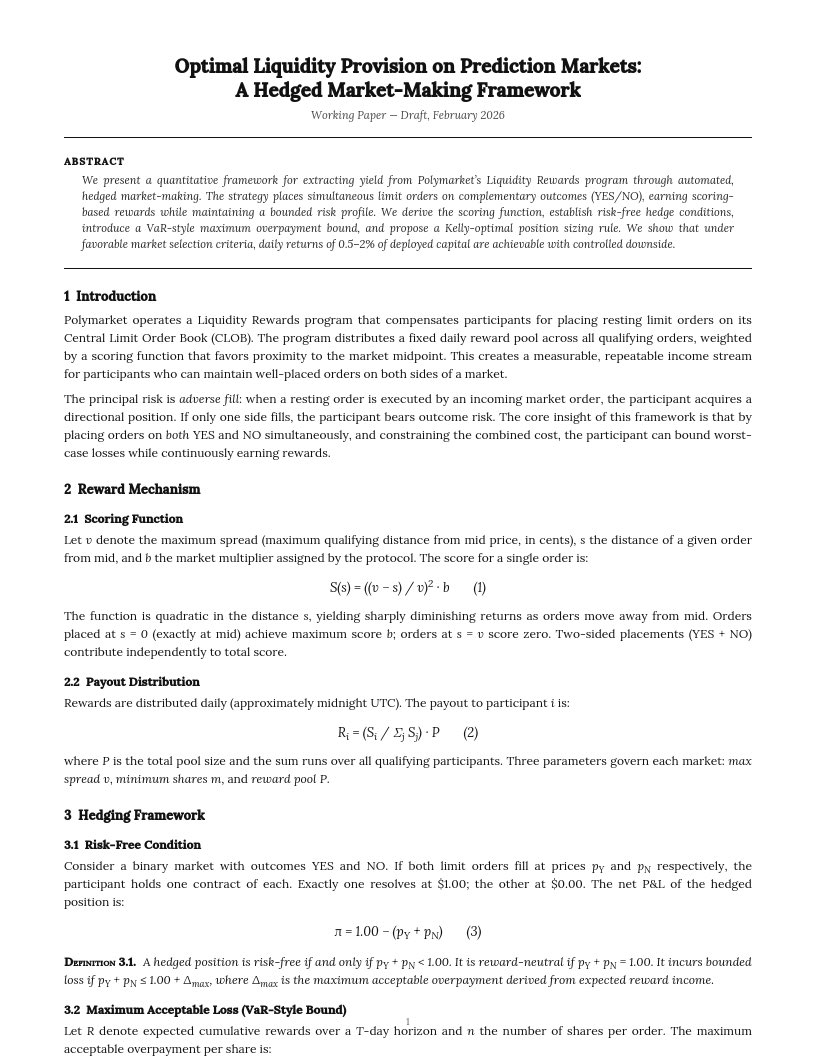
A top-20 Polymarket leaderboard quant team posted a research paper and deleted it 20 seconds later. I managed to screenshot it.
$500–$2,000 a day.
I showed it to a guy in the top-50 leaderboard. He replied: “Where did you get this? Delete it. Don’t you dare share this document.”
Send both pages to your OpenClaw and ask it to build the bot. Everything you need is inside
The Englishman is the definition of the white man. No turd worlder thinks of Poles when they think the white man. Maybe Germans, probably French, but it’s the Anglo who holds the title