I believe everyone should have access to superintelligence, and I wrote a long piece about Meta's philosophy and values for building a positive future for everyone. https://t.co/2ZoNZXZ39T
The U.S. has 2,441 proposed data-center projects scheduled to break ground between 2026 and 2028, representing as much as $2.48 trillion in planned investment. That pipeline is roughly 5 times the cost of building the original Interstate Highway System (inflation-adjusted) —except this infrastructure doesn’t move cars; it moves intelligence.
In stark contrast to what Deng did in China, up to a million North Koreans starved to death in the 1990s because their government had already banned private farming and lived off Soviet handouts.
The Soviet collapse in 1991 cut the free fuel and fertilizer that had kept the whole system afloat for decades, and energy imports dropped 75% almost overnight.
North Korea had fully collectivized its farms since the 1950s, so farmers held almost no private plots and had zero reason to grow more than the state’s quota.
When the free inputs vanished the system had no slack left. Floods in 1995 finished off what crops remained, and the Public Distribution System that nearly the entire population relied on for food simply collapsed in large parts of the country.
City rations fell from 585 grams of grain a day in 1987 to 30 grams by 1997.
The regime called it the “Arduous March”.
And even after Kim Il Sung died the year the famine began, his son kept the exact same centrally planned system running for the next 17 years while hundreds of thousands starved.
And that is the body count of full collectivization under communism.
🕐Announcement: https://t.co/jfxkwfEDb6 is now live!
A year ago, I went looking for something like a Great Replacement Tracker — a site that aggregated all the demographic data for the West and could tell me how bad things really were. To my surprise, I couldn't find one. So six months ago, I started building it myself.
Today, I'm announcing the first live version of the Great Replacement Clock. It tracks the European-descended share of the world's population and of 45 historically White countries. It consolidates historical figures and modeled projections into a single interactive timeline — sourced, auditable, and methodologically transparent.
Accurate ethnic demographic data for Western countries is uniquely difficult to access. No country directly tracks the share of its population that is of European descent. Several nations prohibit or restrict its collection outright; France's ban on ethnic statistics is the most prominent but not the only case. In other countries, official statistics obscure long-term trends through inconsistent census categories and aggregation methods that flatten meaningful distinctions. They miss and misclassify people in predictable ways: bundling Middle Eastern and North African populations into "White," absorbing later-generation immigrants into "native," or recording European immigrants to other European countries as merely "foreign." The US illustrates this: up through 2020, federal standards classified Middle Eastern and North African populations as White.
The result is a landscape in which some of the most consequential facts about the trajectory of Western societies are among the hardest to establish with precision.
This project exists to close that gap. It draws on the best available demographic evidence to reconstruct the European-descended share of each population across time, using a consistent definition across countries and eras. The sources, assumptions, and adjustments behind every figure are open to inspection.
This is a v1. If you spot a questionable figure, please flag it for review. I welcome feedback and contributions. This tool will only get better with time.
Demographic composition is a matter of public interest, not a protected secret. We deserve to know what time it is.
Every single individual who has entered the West illegally should be deported. Every person who has entered legally and who is loyal to an ideology that is antithetical to the West’s foundational values should also be deported. This is a battle for the soul of humanity. Wake up. Grow a pair.
For the first time in recorded history, a civilization has decided that the most enlightened virtue is to surrender its culture, heritage, women, and children without putting up any defence. Suicidal empathy shall prove to be the demise of the West.
Legally migrating to North America or Western Europe can easily cost 5 to 6 figures if you're a law-abiding, productive entrepreneur. And you don't get any free stuff.
Or... you can just show up on a boat or run over a land border, and get more free stuff than citizens do.
The EU has mastered one trick:
When it wins, it calls it free trade.
When China wins, it calls it overdependence.
For decades, European cars, appliances, luxury goods, chemicals, machinery, and high-end consumer products entered the Chinese market. China did not cry that Europe was “distorting” its market or creating “dependency.”
China competed.
China learned.
China upgraded.
But the moment Chinese industries became competitive, Europe suddenly discovered “strategic risk.”
Solar panels?
Europe blocked and punished Chinese solar for years with tariffs and trade barriers. Did that revive Europe’s own solar industry? No. It only made Europe’s energy transition more expensive until it eventually had to reopen the door.
Huawei and ZTE?
Europe followed Washington’s pressure campaign, ripped out Chinese telecom infrastructure it had already deployed, spent more money, delayed its own networks, and called that “security.”
Energy?
Europe chose geopolitical obedience, cut itself off from cheap Russian energy, raised its own industrial costs, became more dependent on the U.S., and then watched its companies move across the Atlantic under American subsidies and tariffs.
But somehow the problem is still China.
Please.
Europe’s crisis was not created by Chinese overcapacity.
It was created by European complacency, American dependency, ideological industrial policy, expensive energy, and decades of mistaking moral lectures for competitiveness.
Now Chinese industries are faster, cheaper, more integrated, and more efficient — from EVs to batteries, solar, electronics, ports, logistics, and manufacturing ecosystems.
So Europe invents new language:
“Diversification.”
“De-risking.”
“Overdependence.”
“Fair competition.”
But strip away the diplomatic costume, and it is just protectionism with Brussels paperwork.
China did not force Europe to deindustrialize itself.
Europe made its choices.
It followed Washington.
It sanctioned its own energy base.
It taxed its own consumers.
It slowed its own innovation.
It lectured China while China built.
And now it wants China to pay for Europe’s failure to compete.
No.
China-EU trade is not a charity program for declining European industries.
If Europe wants competitiveness, it should build it.
Not rename protectionism as “diversification” and expect China to applaud.
Por fin he probado Codex y Antigravity. Con las membresias de 8€/mes y Free respectivamente. Ambos me han durado unos 15 minutos aproximadamente. Me parece alucinante lo que pueden hacer pero estamos llegando a ese punto en el que deja de ser accesible para todos.
I think the main thing AI has taught me, through all the time savings it brings, is that I’m not a very interesting person
Faced with a surplus of free time, I realize I don’t really have hobbies besides content consumption
I’m forced to conclude that I don’t have very deep friendships, and am not a core member of any particular community
I’m not very cultured, I’m finding, and don’t have abiding interests in art or literature or history or much that isn’t directly related to my work
I have a work-centric life, in other words. AI pulls back the curtain on just how impoverished such an existence is, by disabusing me of its necessity
Given the freedom I’ve always said I wanted, I’m at a loss as to what to do with it, except plow myself even harder into work, thus exacerbating the lesson
There’s nothing more confronting to humans than freedom
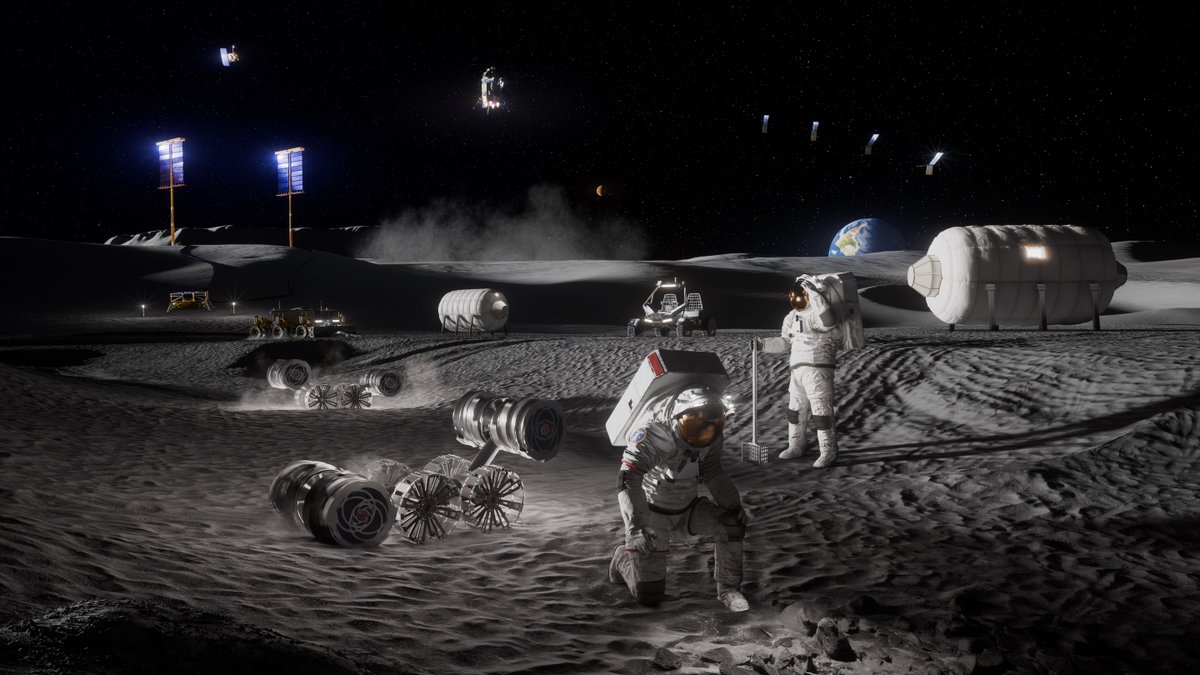
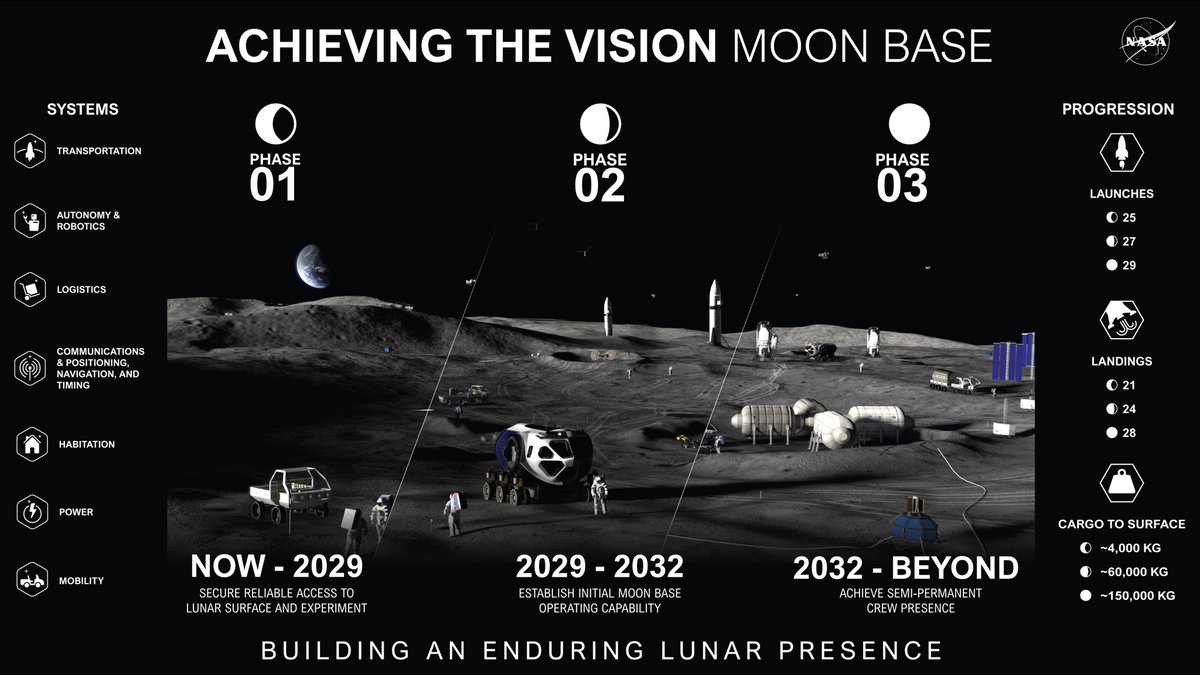
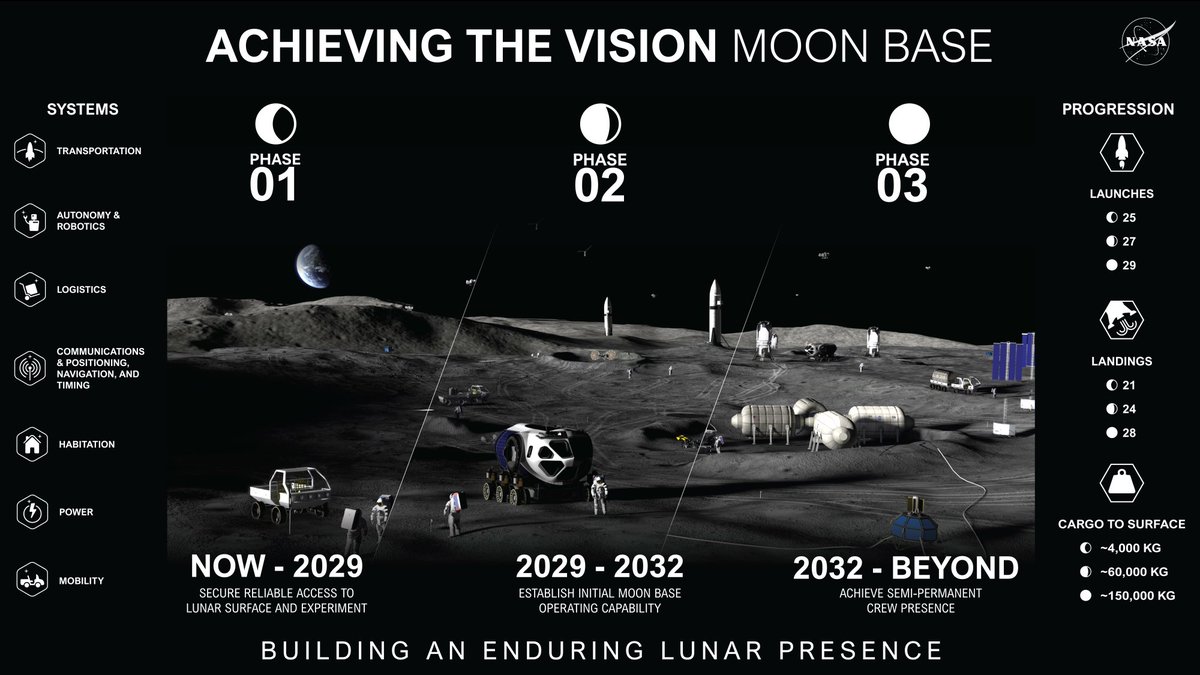
NASA just officially unveiled their master plan for a permanent Moon Base at the lunar South Pole
This is not just about flags and footprints. NASA is moving to establish an enduring, sustained human presence, and they are heavily relying on commercial innovators to build it
The roadmap is highly aggressive:
• Phase 1: Heavy robotic missions and commercial payload deliveries
• Phase 2: Semi-permanent infrastructure, including fission surface power and lunar drones
• Phase 3: A sustained, permanent human outpost
The most important takeaway is NASA explicitly stated this base is the ultimate proving ground to prepare humanity for missions to Mars
While legacy aerospace companies are still struggling to reliably get a small capsule to the ISS, NASA is setting the stage for massive lunar infrastructure....which is exactly the kind of heavy-lift planetary deployment SpaceX’s Starship was designed for
The multi-planetary economy is officially kicking off
NASA has just launched a new website for its Moon Base missions, which aims to build a permanent $20 billion U.S. base on the Moon. @SpaceX's Starship rocket will play a big role in these missions.
"The Moon Base is a home away from Earth for Artemis astronauts who will live and work at humanity’s first lunar outpost. NASA is leading global teams of innovators across international space agencies, industry, and academia to build the Moon Base and establish an enduring human presence near the lunar South Pole for the benefit of all.
Phase One (Now–2029): Experiment and Learn
NASA will begin with a rapid series of robotic missions to scout the lunar South Pole region, test technologies, and prepare for surface operations ahead of future astronaut missions.:
• A major increase in lunar activity, with up to 25 missions, including 21 landings.
• Crewed and autonomous rovers for mobility demonstrations and surface preparation, along with four drones known as MoonFall and communications relay and observation satellites.
• Early demonstrations of power, navigation, communications, and nuclear radioisotope heater unit technologies designed to endure the long lunar night.
• Scientific payload opportunities integrated across landers and rovers.
• The first tangible footprint of Moon Base effort, with four tons of payload delivered to test what works on the lunar surface.
Phase Two (2029–2032): Early Habitation
By 2029, NASA will transition to assembling semi-permanent infrastructure and initiating early habitation and logistics operations:
• Deployment of expanded solar power systems and initial nuclear surface power capabilities, potentially including fission reactors and radioisotope power systems.
• Upgraded rovers, potential advanced MoonFall drones, and early habitation elements.
• Enhanced surface-to-orbit communications networks to provide reliable connectivity across the lunar South Pole region.
• Delivery of up to 60 tons of cargo through as many as 24 landings using low-, medium-, and heavy-class cargo landers.
Phase Three (2032 and Beyond): Sustained Human Presence
This phase will scale operations to achieve a true enduring presence, with routine crew rotations and continuous surface activity. This is when living and working on the Moon becomes a reality:
• Semi-permanent habitation modules with spacious interior for crew living and operations.
• Operational fission surface power systems capable of delivering steady, reliable energy through the long lunar nights, leveraging in situ resource manufacturing.
• Advanced logistics networks supported by crewed and autonomous rovers to keep the base supplied and functioning year-round.
• Delivery of up to 38 tons of cargo annually to sustain habitats, power systems, logistics operations, and major science outposts, enabled by low-cost reusable heavy-lift capabilities."
Moon base website: https://t.co/nefXl3J2FR
I’m excited to announce that Figure has signed a commercial agreement with Catalyst Brands, the operator of JCPenney, Aéropostale, and Brooks Brothers
We’ll work to deploy humanoid robots at scale, starting with initial deployment in Reno, NV
Major areas where the financial system still needs an update:
1. Tokenization of real-world assets - Real estate, stocks, bonds, funds, etc. onchain for instant settlement, fractional ownership & massive distribution.
2. 24/7 Global trading - Pooled global liquidity, every asset, every person, with great leverage and capital efficiency.
3. Next-gen payments - Near-instant, low-cost global transfers using stablecoins, including for Agentic payments.
4. AI-powered risk, credit, compliance, and advice - Better decisions, less fraud, and broader access to capital. Everyone gets access to a great financial advisor.
5. Innovation friendly regulation - Move from one-size-fits-all to risk-based rules that encourage innovation and competition instead of stifling it.
6. Expanded access - Open protocols that reduce middlemen and self-custodial wallets to expand access to everyone with a smartphone.
7. Capital formation - Low cost and turnkey for anyone to raise money for a good idea, increasing the number of startups.
8. Sound money - A refuge from inflation, when discipline is lost in fiat money.
Jobs not done until we get these working for all.
Will require lots of tech innovation and policy work to get there.
Turkish riot police fired tear gas and forced their way into the main opposition party's headquarters to evict its ousted leadership, deepening a crisis at the heart of Turkey's democracy https://t.co/Riv9nLhYiG