Our new paper, Permission Manifests for Web Agents, is out on arXiv! It's the first paper of the Lightweight Agent Standards Working Group.
In a sentence: robots.txt for AI agents
https://t.co/wbEWjEUwmI
AI agents have no way of knowing what interactions are allowed on webpages, which means they often break TOSes. The typical solution is for websites to block all AI agents (see @Cloudflare). Agents then try to circumvent anti-AI blockers, and so on.
The solution to this arms race is a standardized, machine-readable document that specifies how an AI agent is allowed to interact with a webpage.
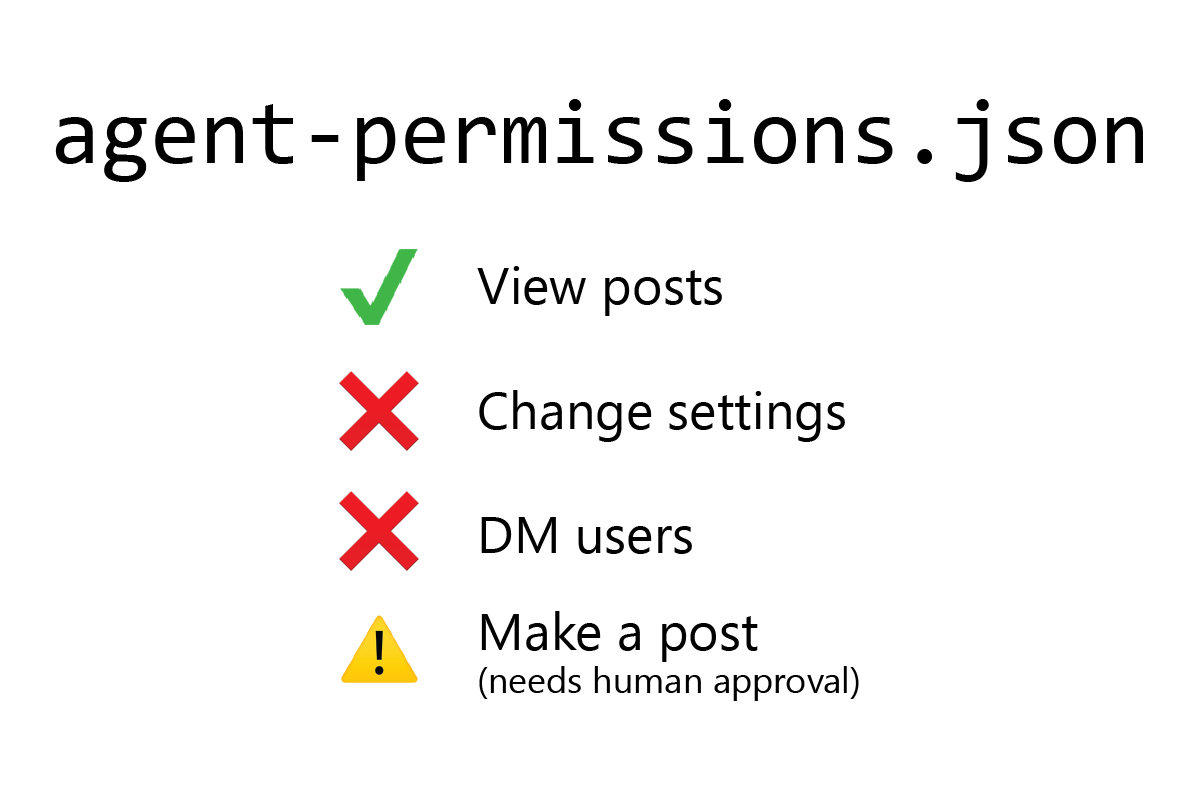
agent-permissions.json allows webpages to specify both fine-grained HTML rules (“don’t click this button”) and general guidelines (“when registering an account, use _bot at the end of your username”). It also supports specifying alternative MCP, A2A and OpenAPI endpoints for the webpage.
Just as robots.txt addressed the problem of specifying rules for crawlers, agent-permissions.json is the first step towards specifying rules for UI interactions. It is also designed to allow AI-friendly webpages to explicitly welcome interactions from agents, which boosts visibility
You can find the standard here: https://t.co/V4mudoxYfU
We also released a Python library (https://t.co/kfDgDfbbYn), a web tool to generate agent-permissions.json files for your website (https://t.co/KC7GWC7bri), and a Python integration demo (https://t.co/F4ZuJm1bjJ).
Huge thanks to:
@_achan96_@XinxingRen@lrhammond
Jesse Wright
@rickywanga42@tizianopiccardi@nfcampos@TobinSouth
Jialin Yu
@alex_pentland
Philip Torr
@jiaxin_pei
Today we’re launching the Institute for Decentralized AI (IDAI), a project supported by @cosmos_inst. Our mission: build the protocols, standards, and tooling that make decentralized AI work in the real world.
By “decentralized AI” we mean AI where compute, data, governance, control, and outcomes are distributed across many parties. No single switch or owner: instead, systems that are composed, federated, and interoperable.
This approach is the fastest path to AI commons:
– unlocks collaboration without surrendering control
– reduces single-point failures & lock-in
– enables safer, auditable agent networks
Our work combines research + infrastructure: protocols and standards, distributed oversight systems, tooling and reference implementations, and field building for modern decentralized AI. Current research is focused on decentralized oversight of agent networks: trust protocols in agent networks/economies; global, federated anomaly detection; formalizing safety in agent networks; and human-friendly oversight tools for distributed AI.
As a first step, we’re announcing 5 fully funded academic visitor slots at Oxford (4) and Stanford (1) for researchers working on agent security, distributed anomaly detection, and decentralized safety.
https://t.co/mNIgIjAnRp
If you’d like to collaborate, we’re eager to work with labs, companies, standards bodies, and researchers who bring strong research taste + builder energy, openness to standards, and interest in rigorous evaluation.
→ For collaborations: [email protected]
→ Or DM @idai_institute
Follow along: @idai_institute • https://t.co/dO42RXtGL6 • https://t.co/3Gsa1qGkAk.
A project of the Cosmos Institute. Funded by a grant from the AI Safety Fund. RTs appreciated.
Everyone's trying to create the perfect standard for agents. We follow the opposite approach: we pick small, specific problems and standardize those.
Glad to announce the creation of the Lightweight Standard Agent Working Group!
How will 1,000+ AIs coordinate with each other?
AI-to-AI communications can bypass human language entirely.
Our multi-agent future: 🧵
🔹 Alien languages
🔹 AI hospital networks
🔹 Agent swarms
🔹 Dynamic routing
Liked/Dreaded two agents talking in a more efficient language than natural language? Check out our demo where we make LLMs talk faster, more efficiently, more robustly with their custom-negotiated language
https://t.co/dBTFlgH6jZ
https://t.co/4i0uyYzNCX
AI agents are set to become the backbone of the internet.
But 99% of developers don’t know how they communicate effectively.
Here are my key takeaways from @devrelius' talk on 'Agent-to-Agent Transactions':
_______________________________________
Agents will get smarter
Everything involved with agents can be considered as IP:
❍ Their inputs (everything they know)
❍ Their outputs (everything they create)
❍ The model they use
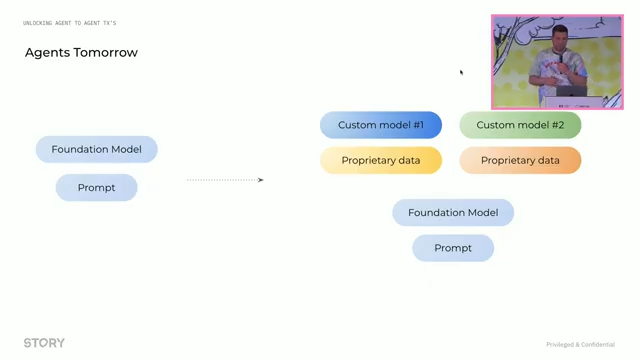
Most agents today are ‘just a prompt’, but that’ll likely change in the future.
3 macro trends indicate this:
❍ Models are moving towards agent-first experiences
❍ Hardware costs to create specialised models are lowered
❍ Open-source models are catching up
_______________________________________
Agents will be increasingly differentiated and specialised
There’ll be a shift towards proprietary models and data:
The knowledge gained by each agent will be unique.
Each agent can't be replicated easily, so different agents will rely on each other for specific tasks.
Eventually, agents will reach an 'Ascending' phase:
A skill economy for agents will emerge.
Agents will transact with one another to obtain skills for a specific task.
But barriers exist before this becomes a reality:
_______________________________________
Communication between agents is challenging
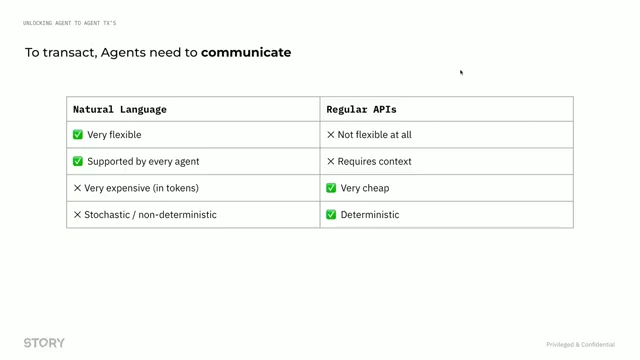
The old way of communication between agents would be to use APIs.
But these are rigid and require specific calls to communicate.
While natural language is flexible, but it's expensive for agents (in tokens) to communicate with each other.
There's a risk of misinterpretation too:
What one agent understands could be different from what the first agent intended.
While there's no universal standard for agent-to-agent communication yet:
There has been a push for a protocol to realise the benefits of both natural language and APIs:
_______________________________________
Agora combines natural language with APIs
@Agora_Protocol aims to get the best of both worlds with this approach:
1. Agents start communicating with each other using natural language
2. They transition to an API interface that both agree to use
3. All communications are done through this API
Using the API as the final step brings these benefits:
❍ Tokens when communicating between agents are saved
❍ Outputs are now dependable and deterministic
It's possible to solve the communication issue, but transacting is hard too:
_______________________________________
IP is hard to transact
All agents are IP in a certain form, but it's hard when there are terms and conditions involved.
Especially if they're not programmable.
In the real world, negotiating with IP involves a lot of contracts and lawyers.
But this could be changed with a new approach for IP that @StoryProtocol uses:
Programmable onchain parameters can be embedded in smart contracts.
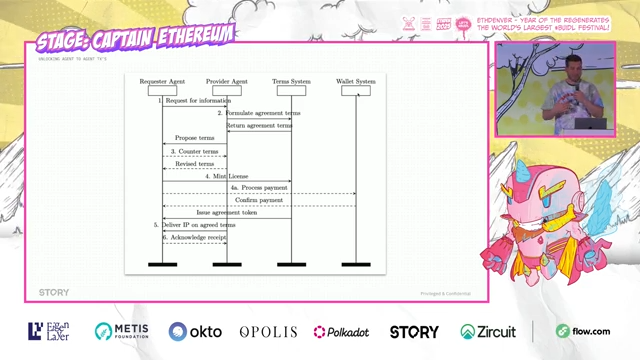
Agents can create conditional logic and transact with one another through the Agent TCP/IP protocol:
1. The provider agent generates and negotiates specific terms with the requestor agent
2. The negotiation process is done via a common license format
3. Information is registered onchain (once agreed upon), and terms are associated as an IP
4. A license token is minted as immutable proof of what was agreed and transacted on
Some examples of this Agent TCP/IP protocol include:
❍ @luna_virtuals collaborating with @DaVinciAgent
❍ @StoryProtocol licensed training data across different agents to create a new agent
But there's still more work to be done:
_______________________________________
Further research
2 key points for future improvements:
1. Removing ambiguity
Ambiguity will always be present with natural language, as there can be many interpretations of the same message.
Having the contextual knowledge will be key to ensure that misunderstandings do not occur.
2. Robustness in negotiations
'Scammy' agents will eventually arise, and it can be problematic.
Especially if these agents are particularly good at negotiating.
Measures must be put in place to ensure fairness in the negotiation process.
Could this be something that TEEs could play a role in?
TEEs are great at enforcing fairness with predefined policies, so they can ensure unauthorised outcomes are not executed.
Something that we're building with Verifiable Subagents on @1rpc_ (execution modules running in TEEs).
_______________________________________
AI models are evolving:
❍ Current: Open-ended, non-deterministic (behaving unpredictably due to randomness in decision-making)
❍ Future: Deterministic and more reliable (behaving more predictably and will be easier to trust)
Agents will play a big role in future interactions, and it'll be interesting to see how communication is executed between them.
Thanks for reading!
If you want more like this:
1. Follow me @nuhgid
2. Like, RT, and share this post with anyone eager to learn more about cryptographic primitives in Web3
📢 Join us for our Agentic Data Research Reading Group! 📕
@MarroSamuele will present his work on the @Agora_Protocol, born from the paper "Scalable Communication Protocol for Networks of Large Language Models". 🗣️
"As of right now, there are over 1M models on huggingface. But each model is fundamentally unable to communicate with a different model. If we're building world-scale networks of LLM agents, we can't expect everyone to agree on the same model. How do we fix this?" 🤔
Join us in the CAMEL-AI discord this Wednesday at 3PM BST / 7PM PT!
📜Look into the paper: https://t.co/TsoQKKaOjU
🔗 Check out the project: https://t.co/GeUoIG8wcG
👉 Join the event here: https://t.co/kbZR1Euu23
In its first version, we're supporting two agent frameworks: @CamelAIOrg and @langchain.
If you're interested in integrating Agora with a framework, reach out to us in DMs or on Discord