Open AI and Anthropic just release GPT-5.3-Codex and Opus 4.6 model, terminal capability is now on top of their list evaluating modal capability. But terminal training hits a wall fast: there aren’t enough high-quality environments.
In SETA, we just shipped 1,376 validated terminal environments across: SE • sysadmin • security • debugging • networking • DevOps
Compatible with Terminal Bench & Harbor. @Mike_A_Merrill@alexgshaw
And we’re scaling fast 👀
Find it in: https://t.co/YLg3ydz7g5 or search for seta-env in on harbor registry
We're releasing AgentVFS, a virtual filesystem interface for AI agents https://t.co/MNGMltHHvB
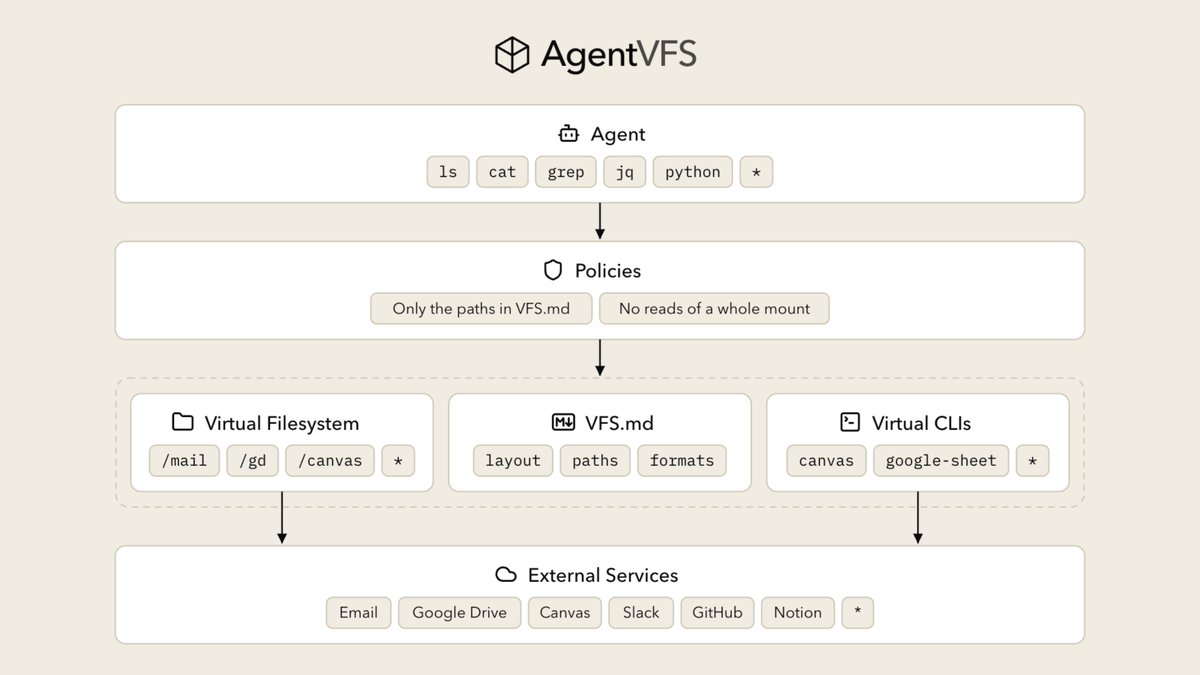
AgentVFS unifies every service into one interface and replaces the need of calling MCP. Stored data becomes one virtual filesystem across services, described by VFS.md, and actions become virtual CLIs, so the agent no longer calls MCP tools at all. AI agents work on live data across every service through the terminal-like interface they know best. They use the Unix tools they learned in training (ls, grep, jq, pipes, loops) and the terminal workflows they practiced in post-training on agentic coding.
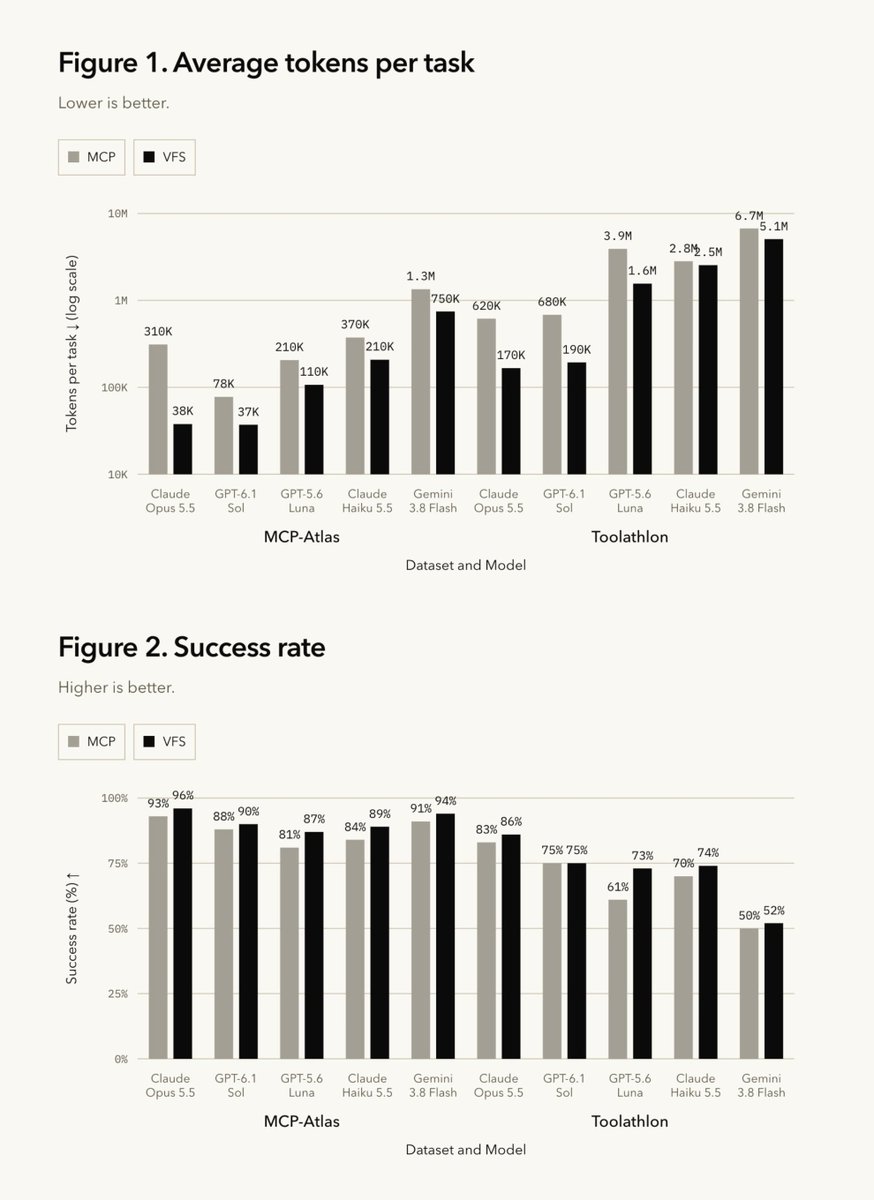
We're also releasing VFS-Bench 1.0 https://t.co/TPXLRs622F, the first systematic study and benchmark to compare a virtual filesystem with MCP on the same tasks. Compared with MCP, AgentVFS uses up to 88% fewer tokens and has about a 5% higher success rate on average.
What if every SaaS service could be virtualized as files? Excited to release AgentVFS and VFS-Bench 1.0 with @zechengzh: a virtual filesystem interface for AI agents, and the first systematic benchmark comparing it against MCP on the exact same tasks
One task, two interfaces: VFS v.s. MCP. 200 tasks from MCP-Atlas and Toolathlon. Every task runs once through MCP tools and once through AgentVFS, where services show up as files described by VFS.md and actions become CLIs
What we found:
- Claude Opus 5.5: 86% vs 83% pass@1, with 166k vs 617k tokens per task (73% fewer)
- GPT-6.1 Sol: same 75% success, 72% fewer tokens
- GPT-5.6 Luna: 61% → 73% success, 60% fewer tokens
- Up to 88% fewer tokens, and about 5% higher success on average
The part I find most interesting: stronger models gain the most. Opus and Sol save over 70% of their tokens, while smaller models save much less. Frontier models were post-trained heavily on terminal-style coding, and they seem to bring all of it to ls, grep, jq and pipes once you give them that interface
We spend all day building RL environments for agents. One lesson keeps coming back: the interface is part of the environment. The same task can get much easier or much harder depending on how you expose the world to the model
An AgentVFS layer may be how we scale environments for agents. One filesystem in front of every service, and the terminal skills models already have carry over to all of them
Eigent v1.0.6 is live! Models, Automations, and Session recovery just got a major upgrade 🚀
What’s new:
🧠 Manage saved models in one place
⏰ Inspect Automation schedules and run history
👋 Choose your Work Profile
🔄 Recover Sessions and handle approvals more reliably
📂 Preserve drafts, terminal history, and finished files
📦 Validate Bundles before sharing and recover failed imports
🔁 Follow clearer upgrade guidance
❤️ Enjoy more control over everyday work
Update to v1.0.6, explore the new features and share your feedback with us 🙌
Read the full release notes: https://t.co/NcldmDHv9d
Proud to welcome our newest sponsors to SGLang Summit.
In just one week since our public announcement, our sponsor lineup has grown from 11 to 36. Thank you to every sponsor helping bring this community together.
Join 2,000+ engineers, researchers, and builders from across the AI ecosystem for technical sessions, hands-on workshops, and the GPU Expo.
Hear from Lip-Bu Tan, Lilian Weng, Soumith Chintala, Aravind Srinivas, and more. Meet the teams building across AI hardware, infrastructure, models, and applications.
🗓️ November 12–13, 2026
🌉 Fort Mason, San Francisco
🎟️ Get your tickets: https://t.co/7C6TzrkJYV
📢 Join our CAMEL-AI Live Talk next Friday with Zihan Dong @CrD104 , AI Solutions Engineer at Lenovo, presenting CADWorld: Computer-Use Benchmark for Long-Horizon Computer-Aided Design
He'll introduce CADWorld, a benchmark that evaluates how effectively AI agents can perform realistic mechanical CAD workflows by operating professional software directly through its GUI. It includes 200 tasks across 11 workflow categories, covering the end-to-end design process from modeling and assembly to manufacturing and simulation.
📅 October 16, 2026
🕐 14:00 BST | 9:00 EDT | 21:00 CST
🔗 Register: https://t.co/2Hm78axGEm
🐫 If you're interested in computer-use agents, CAD, or AI for engineering, don't miss this talk!
Gemini 4 directed a multi-shot 3D Blender scene on Eigent! 🎬
From a calm setup to a delicate wind-blown flight and final landing. 4 connected shots, dynamic DOF, and consistent physics constraints in just one prompt!
Build effortless 3D creations today on Eigent via byok & cloud API!
Gemini 4 Argon is now on Eigent!!
It turns terminal bench author's insights into agent skills in one prompt!
👉 understands RL videos -> extracts key insights with precise timestamps -> produces validated agent skills plus a structured HTML report
Add your Gemini API key on Eigent and try it today!
📢 Join our CAMEL-AI Live Talk next Friday with Zihan Dong @CrD104 , AI Solutions Engineer at Lenovo, presenting CADWorld: Computer-Use Benchmark for Long-Horizon Computer-Aided Design
He'll introduce CADWorld, a benchmark that evaluates how effectively AI agents can perform realistic mechanical CAD workflows by operating professional software directly through its GUI. It includes 200 tasks across 11 workflow categories, covering the end-to-end design process from modeling and assembly to manufacturing and simulation.
📅 October 16, 2026
🕐 14:00 BST | 9:00 EDT | 21:00 CST
🔗 Register: https://t.co/2Hm78axGEm
🐫 If you're interested in computer-use agents, CAD, or AI for engineering, don't miss this talk!
SETA got accepted to NeurIPS 2026! 🎉
We released the full training scripts for DeepSeek-V4-Flash, GLM-5.2 (LoRA), Inkling-Small, and Qwen3.8-27B, with both GRPO and PPO, alongside 4,500+ open-source, verifiable terminal RL environments
Huge thanks to the @radixark Miles team for helping us scale the experiments!
https://t.co/CxPbAT0YzG
We’re excited to highlight SETA, an open-source RL environment for training and evaluating AI agents from the @CamelAIOrg .
A valuable resource for researchers and developers exploring agentic reinforcement learning and complex task environments.
Check it out and support the CAMEL-AI community! 🚀
🔗 https://t.co/8evX0nL04f
@OpenAI GPT 6 Astra is now on Eigent! ⚡️⚡️⚡️
Our design engineer @douglas_ym used Eigent with GPT 6 Astra to rebuild his old master’s project, TaSH, from just a few photos of the original prototype.
Eigent recreated the full product in Blender, filled in details missing from the original prototype, and automatically rendered a 30-second @Apple style product showcase video.
Download Eigent today. Give Eigent a few images from one of your forgotten projects and see what GPT 6 Astra can rebuild.
Fully open source. Self-hostable on your desktop. Even for confidential projects, your data can stay completely under your control.
This Friday on 🐫 CAMEL-AI Live Talk, Ziyi Wang @Ziyi0_0 is sharing Trajectory2Task: a trajectory-first way to train stronger tool-calling agents with synthesized, verifiable data.
Instead of writing tasks first and hoping agents can solve them, Trajectory2Task starts with executable tool-use trajectories, then turns their outcomes into realistic user intents. The result: training data that is diverse, grounded, and actually checkable.
If you care about LLM agents, tool use, or synthetic data for post-training, don’t miss this one!
🗓️ Sep 4 · 4 PM UK Time / 8 AM PT · Zoom
📝 Register: https://t.co/KXCw70pQjs
Gemini 3.8 now on Eigent! ⚡️⚡️⚡️
We handed it a real finance analyst's job: value Equinix vs Digital Realty, Damodaran-style, straight from SEC filings.
A team of agents researched, checked FX, and built the DCF, then handed back an Excel file you can actually poke at.
Click a number → see the filing it came from. Change an assumption → watch the valuation shift live.
Gemini 3.8 is now supported on Eigent via BYOK and cloud API. Try it today!
Huge congrats to the incredible @radixark team on the launch of Miles v0.1! We've really enjoyed using it in our research projects such as SETA: https://t.co/qJSnuQ8cXs
Today we're launching Miles v0.1, an open-source RL framework for LLMs and multimodal models.
RL training is easy to start and hard to debug. Miles helps you ensure your run is correct, use hardware efficiently, and keep RL running at scale.
Over the past 9 months, 72 contributors have landed 1,326 commits, 85 GPU E2E CI tests, battle-testing Miles on frontier open models like Kimi K3, DeepSeek V4, Qwen 3.8, GLM 5.2, Inkling, MiniMax H3, etc.
Miles powers frontier-model development and production RL workloads at @humansand, @periodiclabs, @modal, @DecagonAI, @Eigent_AI, @nebiusai, @IBM and more, on both @NVIDIAAI and @AIatAMD hardware.
Here is what we built, and why teams picked Miles🧵