@DSBatten ‘Those who write for fools are guaranteed a large audience’ Reddit will drink this up, while most people are blissfully unaware of the growing body of evidence (truth) to the contrary. Keep up the good fight Daniel.
First new Bitcoin podcast for some time
All new stuff in here
- why some miners are paying -2c/kWh for power
- why "Bitcoin Will Fix Energy Before Money"
- why the mainstream is now a hair-breadth away from seeing the first (of many) society-transforming uses of Bitcoin
New paper:
Bitcoin mining enables better absorption of surplus renewable generation, minimizing curtailment and supporting higher renewable integration without extra storage or infrastructure costs, creating a win-win for grid stability and mining profitability
The finding is significant, because it establishes Bitcoin Mining as the only way grid operators can avoid the significant cost of balancing frequency fluctuations and operational cost increases that doesn't involve significant capital outlay on grids with high renewable penetration
Source: https://t.co/fRPYCXFEvL
The paper "Leveraging Bitcoin Mining in Demand-Response to Mitigate Ramping-Induced Transients" (Ginzburg-Ganz et al. 2026) was published in Electric Power Systems Research. Impact Factor: 4.2 (top 12% of academic journals worldwide).
First a trickle, then a torrent
There have now been 30 papers since 2021 showing Bitcoin solving all three aspects of the energy trilemma:
♻️energy sustainability
🔐energy security (including grid stability) and
💳energy equity
No other technology can address all three concurrently
In fact, many energy experts believed this was impossible
(Source link to all 30 papers with a summary of they says in comments)
They just keep coming!
New paper finds that Bitcoin mining operations are extremely flexible loads that supports renewable-led decarbonization by absorbing excess renewable generation
The authors found that operations can curtail demand almost immediately, participate in demand response programs, and provide ancillary services which directly enhances grid stability while enabling higher renewable energy integration
Read that last para again, and compare it to what most people still believe about Bitcoin mining.
The asymmetry between what we now know about Bitcoin mining, and the actions of policymakers and regulators is simply enormous.
Source: https://t.co/rLN829zxIr
Energy, Economic and Environmental Impacts of Cryptocurrency Mining: A Review (Jafari et al. 2026)
Journal: Energy Conversion and Management: X
Impact Factor 7.6 (top 4% of all journals worldwide)
Bitcoin mining is the only technology that solve the energy trilemma AND the only technology that makes our grids stable in a world where renewable energy and AI datacenters are on a collision course.
Here's the evidence from 30 peer reviewed papers
👇
The data is unequivocal: Bitcoin mining is the way to make renewable projects that would otherwise need subsidies viable.
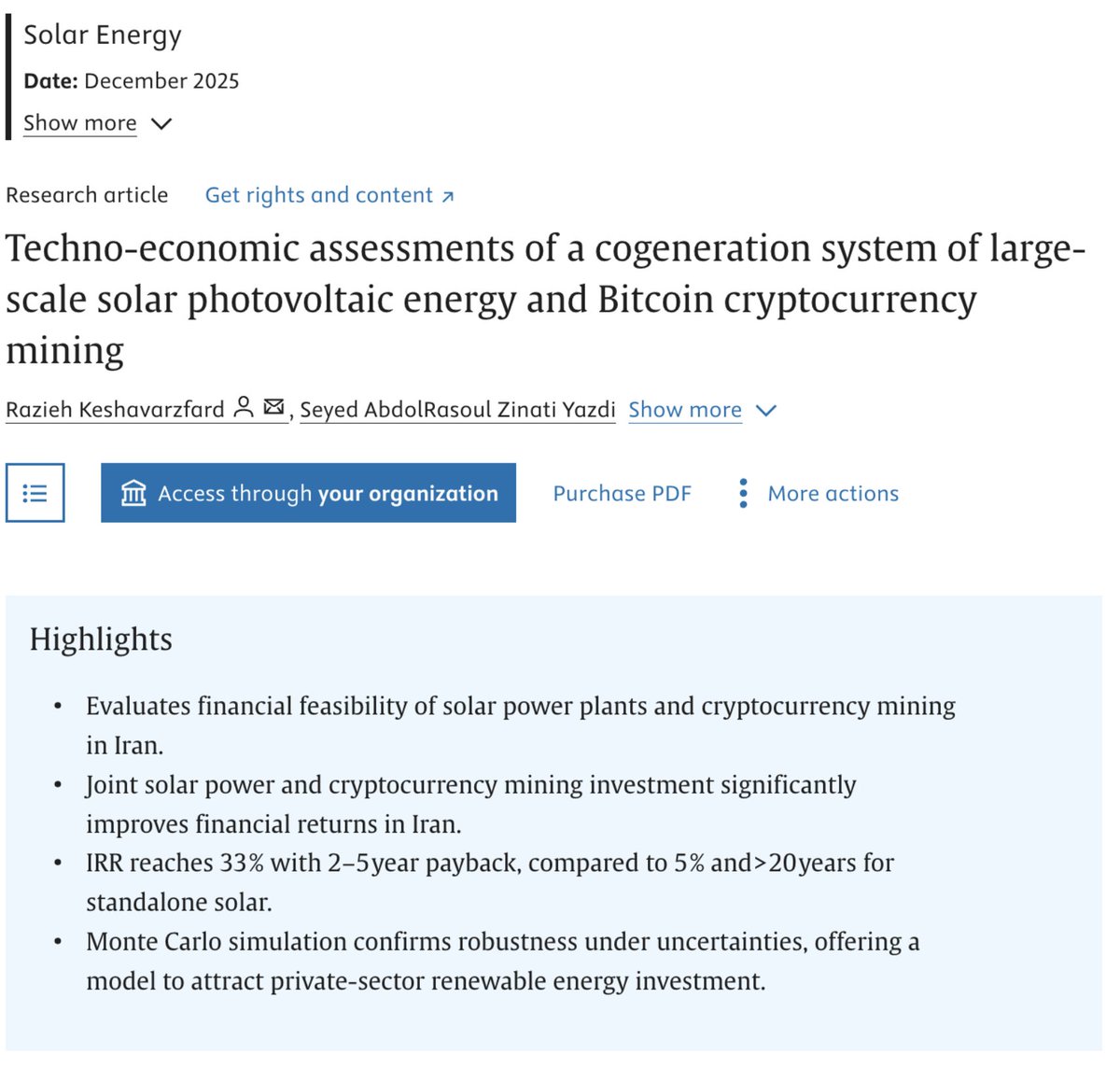
A new paper recently found that pairing large-scale solar PV with Bitcoin mining
* transforms a standalone solar project with a10-year payback, ~5% IRR into a highly profitable venture with 2–5 year payback and 33% IRR
* reduces ~10,457 tons of CO₂ avoided emissions per annum
The study was done on a 10 MW Solar Farm and supports the earlier findings of Hakimi et al that Bitcoin mining reduces the ROI from 8.1yrs to 3.5yrs while reducing CO2 emissions by 50,000 tonnes/year on a 50MW solar farm (source: https://t.co/RGsIe6z75Z)
The recent paper "Techno-economic Assessments of Large-Scale Solar PV and Bitcoin Mining" (Keshavarzfard & Zinati Yazdi 2025) was published in Solar Energy.
Source: https://t.co/MqAgiWv6CB
The journal has an impact factor of 6.6 (top 6% of academic journals)
New paper shows renewable operations using Bitcoin mining are both more profitable and lower-emission than renewable operations where Bitcoin mining is absent
The authors found that not only did Bitcoin mining have the potential to be a driver for large-scale renewable deployment in regions with abundant solar and wind resources, but also in hybrid systems (eg: solar + wind + diesel generation), Bitcoin mining reduced fossil fuel dependence while enabling a significantly higher renewable energy share
The paper is titled: Maximizing ROI in Cryptocurrency Mining Through Energy Optimization (Nasrinasrabadi et al. 2025)
Published in Energies, which has an Impact Factor of 3.2 (top 20% of journals)
Source: https://t.co/JXkP2qxukq
A window into the future:
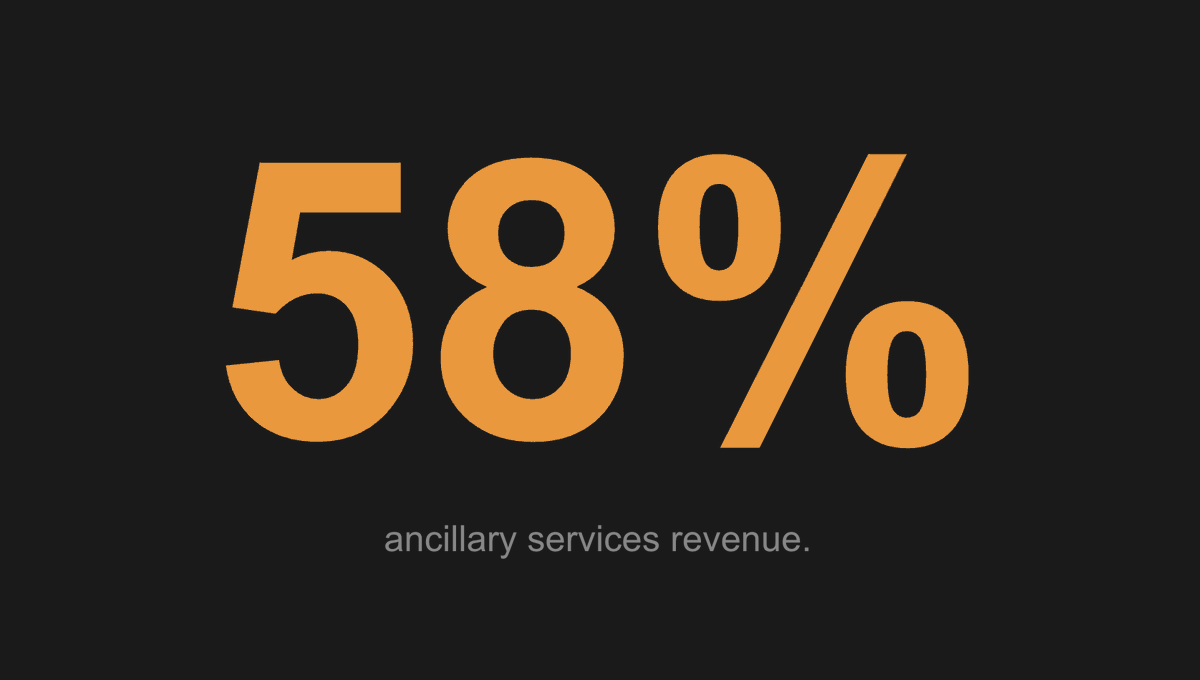
Flexionics uses 14 MW of ASICS to help stabilize the grid of Sweden
They were called on 11,245 times last year. Yes, you read that right.
Already, 58% of their revenue comes from grid services (the rest through hashing)
New Study shows Bitcoin mining supports local renewable projects with heat recapture as an additional benefit
The study found Bitcoin mining supported UNFCCC Article 6 sustainable-development benefits, including improving
*local livelihoods
*food security
*energy access
The paper documented micro-hydropower + solar coupled with flexible Bitcoin mining and heat recovery for a greenhouse and was published in "Sustainability" which has an impact factor of 3.3 (top 20% of journals)
Source: https://t.co/ozfXjNpvRZ
This farmer outside Washington, D.C., uses solar panels to shade sheep and generate electricity. The extra energy powers their personal bitcoin mining site.
One year ago Paulo Gonçalves was not a Bitcoiner.
He's was (and is) renewable energy project developer who has spent his career building small hydroelectric dams across the world.
His problem was simple: many of these dams produce power that the grid can't absorb. The energy is wasted. The economics don't work. He'd seen the problem firsthand and had been searching for a solution for over a decade.
A year ago, he attended a @FREEMadeiraOrg event in Portugal, where he discovered Bitcoin mining.
That day changed everything.
Unlike others who fall into the mistake of evaluating Bitcoin mining without understanding energy, grids or renewable generation - he understood all three intimately, and as such was able to immediately see the value that others (including policymakers and regulators) sometimes miss.
Paulo is now evaluating 100s of small hydropowered sites throughout Portugal that are ideal candidates for Bitcoin miners. There are sites that are "too small" or too remote to be of interest to anyone else.
The miners consume what would otherwise be stranded energy. No subsidy required. The dam that didn't make financial sense now does.
This is the pattern critics miss.
They assume Bitcoin miners are Bitcoiners first, working backwards to justify energy use. In reality in the energy sector it happens the other way around.
Kenji Tateiwa in Japan. Paulo Gonçalves in Portugal, Bipin Patel in Sweden are real people solving real energy problems. Different countries, different energy sources, same discovery pattern:
When you know a lot about energy, and do deep research into how to solve energy problems, you arrive at Bitcoin mining.
Incredible. The fundamentals of Bitcoin minings ability to be both instantly interruptible, yet also able to absorb a practically infinite amount of energy makes it an electrical engineers dream demand response mechanism. I’ve spoken to engineers that have said they couldn’t have designed a better piece of hardware if they tried while solving renewable intermittency, and Bitcoin miners even generate revenue.
@DocumentingBTC This is great. My research paper on this exact strategy in agriculture more broadly is due to be published soon. I’d love to get in touch with this farmer if possible?
Agree, I’ve started my path down the AI data centre rabbit hole also and the narrative screams the same Malthusian doomer logic that has come before it for every new technology. I Just needed to add some first hand numbers to the avocado claims, at least from the Northern Tropics of Australia perspective.