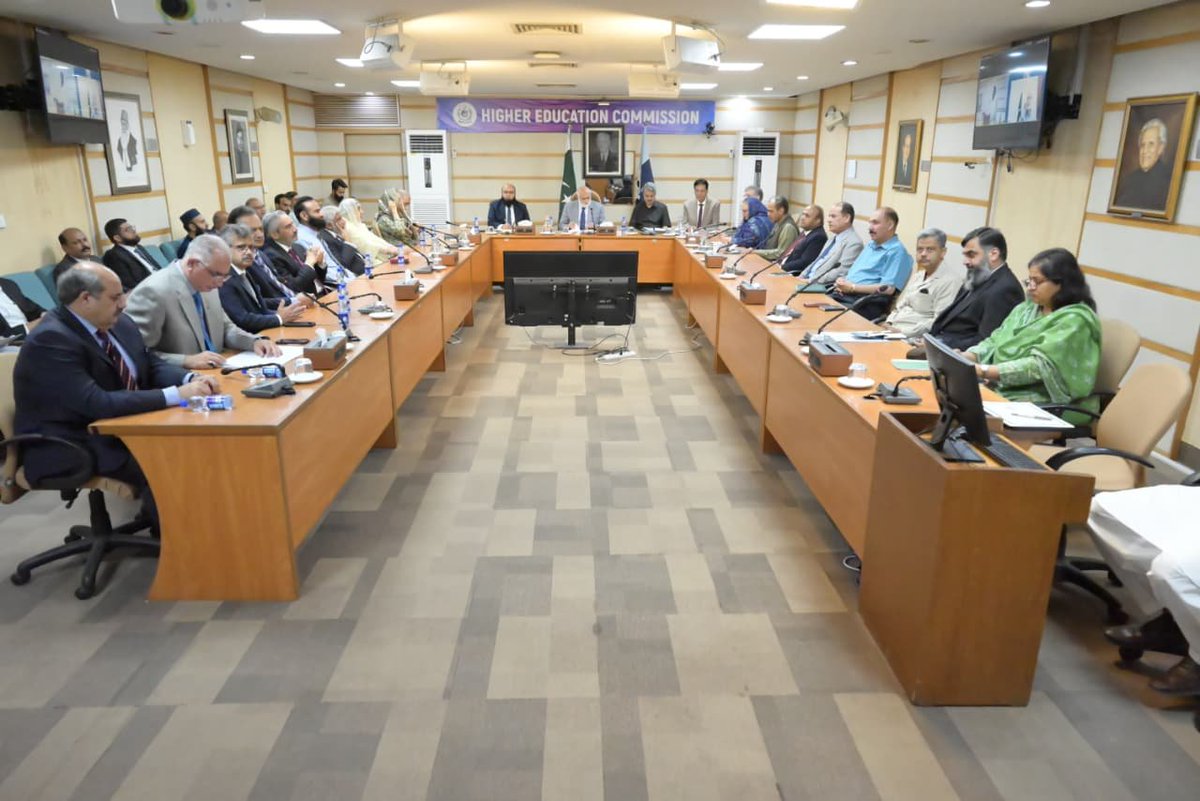
Her Excellency Ina Lepel, Ambassador of Germany to Pakistan, whose presence added a significant international dimension to the gathering and reflected the importance of strengthening Pakistan-Germany cooperation in education, tourism, professional training & human resource.
Iceland has a breed of sheep that nobody breeds for meat, because for a thousand years it has been bred for one quality only. Judgement.
They are called forystufe. Leader sheep. Taller, longer in the leg, narrower through the body, oddly marked, and always at the front, with their heads up while the rest of the flock has its head down. When they move, the flock moves. Nobody votes.
A proven leader sold for two or three times the price of a good sheep. Bloodlines became famous. When a great one died, the farm kept the head.
And the claim attached to them sounds like folklore until you read the records. They know the weather is coming, sometimes a full day out. If the leader will not leave the barn on a morning that looks perfectly fine, you do not move the flock. Farmers arranged their winters around the opinion of a sheep, and wrote it down as fact.
Autumn round-up, 1884. A large flock is being driven across the interior when a blizzard comes down on open sand and rock. Every landmark goes. You cannot pitch a tent on that ground and turning back is worse than going on.
At the front is a ram called Surtur, from Svinavatn, already known as a superior leader. The fjallkongur, the man running the round-up, makes a decision. He hands the whole thing to the sheep and tells his men to stay together.
A third of the way across, Surtur stops, turns, and walks back down through the flock to find the men. His face is packed solid with ice and he cannot see. They clear it. He returns to the front and walks back into the weather.
He comes back for the same service several more times that night. Nobody has to fetch him.
Then he stops and will not move at all. The men feel about and find grass under their boots, which tells them they are off the desert and nothing else whatsoever.
At dawn the storm eases and they work out where they are.
They are standing on the exact spot the round-up stops every year after crossing the sands. Surtur had halted there since he was a lamb. Afterwards the fjallkongur told his owner that without the ram, men would have died out there as well as sheep.
There are fewer than 1,500 leader sheep left, all of them descended from one district in the north east. Iceland recognised them as a breed of their own in 2017. There is a small museum out there, run by a local teacher, with the heads of the great ones on the wall and a coffee blend named after the animals. The saying on the wall is that if you wear clothes made from their wool, you will always find your way home.
Genetic work has since confirmed they really are distinct from every other Icelandic sheep. The folklore was right. Folklore usually is, out where the weather kills people.
No laboratory. No pedigree software. No genome. Just farmer after farmer, century after century, watching which animal was at the front when the light went, and breeding from that one.
A thousand years of selecting a sheep for its judgement, and at the end of it they built it a museum.
And here we are, in the country that calls them stupid.
CHATGPT HAS QUIETLY BUILT A FILE ON YOU. YOU'VE NEVER SEEN MOST OF WHAT'S IN IT.
Every message you send feeds it. It studies your patterns to map your personality and habits, things you never actually told it.
Here are 12 prompts to pull up everything it has on you, and wipe what you never agreed to:
Today, the 5thof August, marks a grim occasion - it is the seventh anniversary of the unlawful and unilateral measures imposed in Indian Illegally Occupied Jammu and Kashmir (IIOJK). On this day, seven years ago, an occupied people, the Kashmiri people, enduring over seven decades of injustice, indignity, unfulfilled promises and denial of their Security Council-guaranteed fundamental right to self determination were subjected to a new wave of repression. A 900,000 strong Indian occupation force unleashed untold suffering on a hapless population – a worst example of state terrorism.
My remarks during the UN Security Council briefing on threats to international peace and security caused by terrorist acts
There are grown men out there eating vegetables, and it is embarrassing.
Not hidden in something. On purpose. A fully formed adult male, fifty-odd years behind him, putting a fork of salad into his mouth in front of witnesses.
Lads. Come on.
It's water. That's the thing nobody says out loud. Ninety per cent water and about twenty calories a cup, so you have gone to a shop, paid money, applied heat and produced a wet noise. Crunchy water, eaten in reverent silence, because nobody in the recorded history of these islands has ever leaned back and said "ooh, the swede."
And the minerals you think you're getting are behind glass. The iron in the spinach is the kind your gut barely takes up, and the oxalate in the same leaf grabs at it on the way past. The zinc and magnesium in the beans and the wholegrains are sat under phytic acid doing nothing. The plant did that deliberately. It cannot run, so it fights with chemistry instead, and it has been fighting for a great deal longer than you have been chewing.
Then somebody sprayed it. Every year the residue lists come out and it is always the same aisle at the top: the leaves, the soft fruit, the peppers. The things you eat raw and unpeeled and feel good about.
So the deal is no energy, locked-up minerals, the plant's own defences and a light coating of agrochemicals, and its finest hour is disappearing entirely under butter and cheese until you cannot detect it.
You have a mortgage, a bad knee and opinions about tyres. Nobody has been checking since about 1981.
Grow up. Have the chop.
This is going to sound crazy.
But, one of the skills you must learn in the near future is how to cope with an increasingly illiterate society of emotionally dysregulated people.
If you continue to get frustrated on a daily basis over how everything seems dumb, stress is going to silently jeopardize your health.
And, they don't menton water. in most products the water is the most important ingrediënt, and cost nothing.
For instance soft cheese: > 50%. Liquid soap often >80%
The same with air. Very lucratieve!
Further they don't mention a lot of ingredients . Because no one will find out. And otherwise they they have forgotten it. Sorry!
They slso mention positieve ingrediënts who are almost not in it. For instance bee-wax.
Too expensive! So if a bee flew over the product they mention it on the list!
It is mot possible to prove that an ingredient is not in it!
The word sugar is not on most labels. These are.
Sucrose is sugar.
Dextrose is sugar.
Maltose is sugar.
Fructose is sugar.
Glucose syrup is sugar.
Invert sugar syrup is sugar.
Fruit juice concentrate is sugar.
Barley malt extract is sugar.
Rice syrup is sugar.
Agave nectar is sugar.
Date syrup is sugar.
Honey is sugar.
And then the ones that do not even have to hide, because nobody thinks to look:
Starch is sugar.
Bread is starch.
Oats are starch.
Rice is starch.
Potato is starch.
Pasta is starch.
Starch is glucose molecules in a chain. Your saliva starts cutting that chain in your mouth, before you have swallowed. By the time it clears your small intestine it is glucose, which is the identical molecule that arrives from a spoonful of table sugar.
Wholemeal bread has a glycaemic index around 74. Table sugar sits nearer 65.
The bread hits your blood faster than the sugar does, and the bread is the one on the government plate.
Ingredients are listed by weight, heaviest first, so splitting one substance across four names keeps any of them off the top of the list. That is the trick on the back of the packet.
The trick on the front is calling half of it wholesome.
🚨 لو ما راح تشوف إلا محاضرة واحدة عن ريادة الأعمال، فخلها هذي. 41 دقيقة مع بيتر ثيل في ستانفورد يشرح كيف تبني ميزة تنافسية، وليش المنافسة تقتل الشركات، وكيف نجحت Google وPayPal وFacebook. والأفضل؟ مجانية بالكامل. احفظها.
@paradeevic The smarter you are, the more difficult it is to answer a question. Because you know so many different answers that all apply, that you are not sure which to give to satisfy the source of the question.
Puts “ignorance is bliss” into perspective.
A BBC interviewer asked a Nobel physicist the simplest question in the world: why do two magnets push each other apart. He refused to answer it. What he did instead is the best seven minutes on thinking ever filmed.
The man is Richard Feynman, at home in 1983, no blackboard, no notes, sitting in an armchair.
He does not dodge because he cannot answer. He dodges because he wants you to see what the question is actually asking. So he takes an ordinary sentence, that a woman slipped on the ice and broke her hip, and starts asking why, and every answer opens another why, until the ground gives way.
Then he turns it around on the interviewer with a question about ice that sounds trivial and is not.
The point he arrives at is the uncomfortable one. Every explanation is only a translation into something you already accept without explanation. Magnets have no such translation. There is nothing more familiar than magnetism to reduce magnetism to, which is why every answer you were given at school was a picture, not a reason.
It matters more now than it did in 1983. Any tool will hand you a fluent answer in a second. Knowing which questions actually have a bottom is the part that is still yours.
One question. Seven minutes. It is in the video.
HEC convened a high-level meeting to review the post-National Skills Competency Test (#NSCT) landscape and advance discussions on competency-based skills and curriculum reforms aimed at strengthening higher education in Pakistan.
#HigherEducation#CurriculumReform#Skills#OBE
Here is the question that European civilization has never answered:
At what point, in the five hundred years of colonial practice, should a European person have been expected to know that what was happening was wrong?
Not 1945. That is too easy, and too convenient.
1904, when the German Empire issued a written extermination order against the Herero people and generals carried it out and soldiers followed orders and administrators recorded the deaths and the skulls were shipped to universities for racial science.
At that point, should someone have known?
1890, when the systematic amputations in the Congo were being photographed by missionaries and the photographs were being published in European newspapers and reformers were raising the alarm and Leopold II was receiving those reformers in his palace and explaining that the civilizing mission required certain difficult measures.
At that point?
1830, when the Trail of Tears was a policy debated in the United States Congress and approved by elected representatives and challenged by lawyers and litigated to the Supreme Court, which ruled against it, and then carried out anyway.
At that point?
1619?
1492?
The question matters because the defense of European civilization against the charge that the Holocaust was colonialism coming home always rests on the assumption that colonial violence was invisible, unexamined, a product of its time.
It was not invisible.
It was photographed and debated and reported and litigated.
It was chosen.
At every decision point, by specific people with names and offices and moral agency, the choice was made to continue.
The Holocaust produced Nuremberg because the victims were European and the defendants were the enemies of the victorious powers.
The colonial period produced nothing comparable because the victims were not European and the defendants were the victorious powers.
That is the only reason one has a trial and the other has a museum of natural history.
Same civilization.
Same logic.
Different documentation.