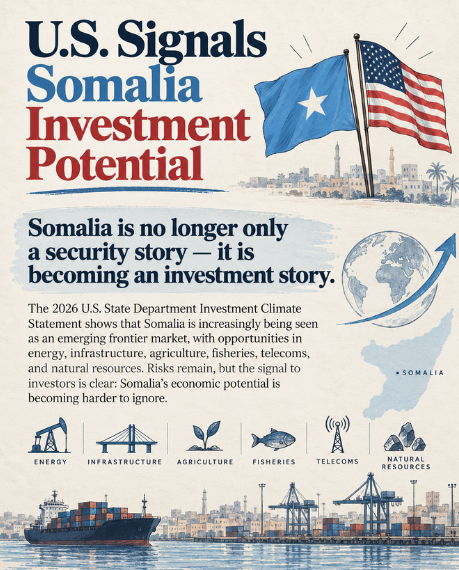
The U.S. is sending a clear signal on Somalia: the country is increasingly being viewed as an emerging investment market, not only through the lens of conflict and aid.
The 2026 State Department Investment Climate Statement highlights real opportunities in energy, infrastructure, agriculture, fisheries, telecoms and natural resources.
Somalia is still high-risk, but its investment potential is becoming harder for the world to ignore.
2026 Somalia Investment Climate Statement
701264_2026-Somalia-Investment-Climate-Statement
Deni’s letter to the UN raises a fundamental question: Who gave him the mandate to speak in the name of all Puntland and threaten Somalia’s territorial integrity? Political grievances are legitimate; manufacturing a mandate for separation is not. https://t.co/0ZzYLzGMXM
The world will remember them for begging genocidal Zionists for recognition while the entire global community is actively severing ties with Israel.
They are desperate to tie their political survival to an occupying pariah entity. Nobody will ever recognise them. They will end up sharing the same isolation as the oppressors they have chosen to side with. They will spend the rest of their days being publicly confronted and shamed wherever they go on the world stage.
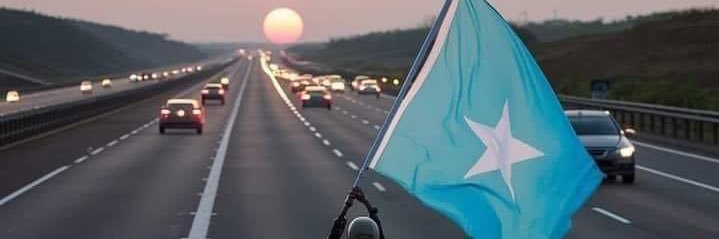
This is how the President of the Federal Republic of Somalia, H.E. @HassanSMohamud, arrived in New York to attend the 81st Session of the United Nations General Assembly.
Now, the world is waiting to hear him deliver Somalia’s message from the floor. 🇸🇴🇺🇳
🇸🇴🇺🇸 #UN's leaving #Somalia signals not only less US interest (and power) in the Horn region, but also an increasingly self-sufficient #Mogadishu backed up by ever more influential allies and partners like Türkiye.
https://t.co/ZDKL0o2XTt
Recent events in the Red Sea have been a reminder of a simple truth: without a trained ground force, neither air support nor foreign aid will get you results. That is exactly why the military training and capacity-building Türkiye has patiently carried out in Somalia for years is so critical. Ankara isn't giving Somalia weapons; it's giving Somalia an army that can stand on its own feet. This is an investment in a country's next 30 to 40 years.
🚨 Something major is taking shape in northern Somalia 🇸🇴
Las Qoray is emerging at the center of new discussions over Somalia’s military and maritime security presence along the Gulf of Aden.
This thread explains why it matters. 👇⚓
On Irro’s Washington Visit — and Where We All Go From Here
For days, Somaliland-related social media have been dissecting @Abdirahmanirro’s Washington visit, billed as something close to the mother of all recognition-seeking journeys.
His itinerary included the @HudsonInstitute, where Joshua Meservey, a longtime supporter of Somaliland’s recognition, hosted his forum. Irro struggled with some fairly straightforward questions, while his abundant laughter became a story of its own.
Irro has always been prone to laughter. Whether he overdid it is hardly the story. The real story is the gulf between the expectations that carried him to Washington and the reality he encountered there.
Some supporters were even suggesting that U.S. recognition was imminent. Instead of Trump meeting him, on 14 September — the very day Irro appeared at Hudson — the White House sent Devin Kennington’s nomination as U.S. Ambassador to the Federal Republic of Somalia to the Senate.
Thus, the much-maligned qosol may well have been a full-blown qosolgariir — involuntary laughter induced by shock and embarrassment.
Which brings me to the more serious question: where does the Somaliland question go from here?
Let us be honest. Recognition of Somaliland — or the dismemberment of Somalia, as that ultimately entails — was always a tall order. Africa and practically the rest of the world have shown little appetite for altering Somalia’s internationally recognised borders. It does not benefit them, and doing so would open a Pandora’s box few countries want opened.
Some hyper-secessionists argued Israel’s recognition was the catalyst that would change that equation. So far, the hoped-for cascade has produced the opposite.
Irro’s cardinal mistake, in my view, was throwing in his lot with Netanyahu when Somaliland’s case rested so heavily on claims of historical injustice — precisely at a time Gaza’s devastation was shaking consciences around the world.
Rather than unlocking wider recognition, that adventure polarized the Somaliland people, generated international opposition and rallied support around Somalia’s territorial integrity.
Yet perhaps there is a silver lining in Irro’s miscalculations, unproductive U.S. trip and the overall gloomy prospects for a unilaterally midwifed independent Somaliland state.
This, rather than the laughter, deserves some thought.
If Washington delivered a harsh dose of reality for secessionists, perhaps the overall state of affairs regarding separation and unity can help all of us rethink where we go from here.
For secessionists, more than three decades of foreign lobbying have not produced the breakthrough they desperately sought. For the rest of us, three decades of disunity have left Somalia weak and vulnerable.
Collectively, we have normalized a dangerous and unproductive stalemate. How much longer can we sustain this no-unity, no-recognition, no-progress status quo? That is the real question.
Political elites and other beneficiaries can afford to play hardball. Ordinary Somalis, however, have been paying the price — dearly and for decades.
Young people need jobs. Mothers need healthcare for their children. Fathers want the dignity of providing for their families. Businesspeople want to sell their fish and produce. And citizens want to benefit from the resources beneath their soil and seas.
So the question is not for Somaliland alone.
Those who insist on Somali unity must also ask: if unity is the objective, what sacrifices are we prepared to make to make unity meaningful to those yearning for separation?
Some sober reflection on where the Somalia our forefathers created stands, and where we want it to go, is a conversation we have spent too long avoiding.
There is no shortcut. Talks between northern and southern Somalis should be restarted.
And here Wiilwaal’s timeless wisdom seems particularly fitting:
“Rag walaalow wuxuu ku dhaamo la waa.”
Between rivals, nothing achieves what respect and goodwill can.
🇦🇪💥🇸🇴 Abu Dhabi’s #RSF playbook just landed in #Somalia!
#Mogadishu cuts every deal with the UAE after years of ports, bases, airspace abuse and #Somaliland games. So what does Israel's top "Muslim" asset in the Gulf, #MBZ, do? He flies in #Puntland and #Jubaland presidents plus opposition figures for a parallel, pro-Zionist foreign policy.
Same gameplan as #Sudan: Starve the center, buy the periphery, keep the country weak, divisible and useful for the Greater Israel project. Divide and conquer.
Fifteen years of Somali state-building vs. one #Gulf checkbook and a few regional strongmen. That’s not partnership, folks. That’s the same fragmentation factory that helped turn #Yemen and Sudan into abattoirs.
A “Muslim” petro-state that treats other Muslim nations as real estate for proxies, Israel recognition side-quests and anti-unity ops should not be lecturing anyone about the Ummah. We hope that brotherly Somalis from all corners of the country will help kick this model out of the Horn before it's too late.
MUST READ article from #RedSeaAxis for some related insights:
https://t.co/EvNPA2KuJn
NOW: Somaliland President @Abdirahmanirro delivers a keynote speech and sits down with @JMeservey to discuss the strategic importance of pro-Western Somaliland.
@Presidencysl_
https://t.co/Aeg4vOPkqA