In this machine I can scan 1000s pages a day and never destroy a book.
No guillotine spines, no ripped the bindings..
just a normal book ready to be treasured for centuries.
Any large AI company can afford this both financially and ethically.
@samhogan Looks impressive @samhogan but how do you convince Infosec and Data Protection and audit that this isn't risky? Asking for advice, not criticism
"How do people learn to use Claude Code like Boris?"
Claude Code creator Boris Cherny (@bcherny ) was asked by Diana Hu ( @sdianahu ) at Startup School 2026.
Boris Cherny: "Maybe don’t listen to the LinkedIn influencers.
The thing about the model is that everyone is looking for one weird trick to make it work, but that simply doesn’t exist. There is nothing like that.
You have to approach the model empirically. Give it a task that is too hard. Give it the tools to verify its work, just as you would use those tools yourself if you were doing the task.
See where it struggles, and then fix the problem with better prompting, a skill, or if the model is missing context, an MCP connection that allows it to retrieve the context it needs.
That is basically it.
It sounds very simple. I think people tend to overthink and overengineer it because, in many ways, that is how we had to build systems in the past."
----
From "Y Combinator" YouTube channel, (full video link in comment)
Turns out GPT-5.6 Sol and friends are absolutely amazing at performance and efficiency improvements. Good time to brush up on using OpenAI models if you haven’t switched already.
Excited to be able to share more soon. Pretty wild.
@ForwardEditor@XFreeze This is why the cursor acquisition made sense... How powerful the apps could be through this method...to be seen. Got to admit I think @SpaceXAI is a stalking horse now...
Google Deepmind argues that LLMs can never make real scientific discoveries.
They published a paper breaking down Albert Einstein’s private view of scientific discovery.
In a famous letter to his friend Maurice Solovine, Einstein drew a diagram of how science actually happens.
It is a cyclical loop.
First, you experience raw sensory data. Then, through a mysterious, non-logical act of intuition, you make an intuitive "jump" to abstract axioms. Finally, you use strict logical deduction to derive consequences from those axioms.
Generative AI has completely mastered two-thirds of this loop.
• Induction: Statistical pattern matching across billions of tokens.
• Deduction: Formal proof generation, like AlphaProof solving complex math Olympiads.
AI can crunch data and it can prove theorems.
But it cannot make the jump.
The paper argues that AI completely lacks Abduction, the generation of novel explanatory hypotheses when observational data is scarce.
The prevailing tech myth says that "creativity is just data compression." That if you feed an LLM enough text, scientific breakthroughs will naturally pop out.
Einstein’s formulation of General Relativity proves that is a delusion.
When Einstein formulated relativity, the observational data didn't demand a new physics framework; classical mechanics was still massively successful. The breakthrough required a conceptual rupture. An intuitive leap from physical reality to a brand-new set of foundational axioms.
An LLM can execute the math once the axioms are given. But it is structurally incapable of formulating those premises on its own.
It can interpolate inside existing human thought, but it cannot transcend it.
The translation of physical reality into formal axioms remains the absolute, hard bottleneck of artificial scientific invention.
We can build models with trillions of parameters. We can scale compute into the stratosphere.
We can make the calculator infinitely fast.
But until we solve grounding, the machine can process all the data in the universe.
It still can't make the jump.
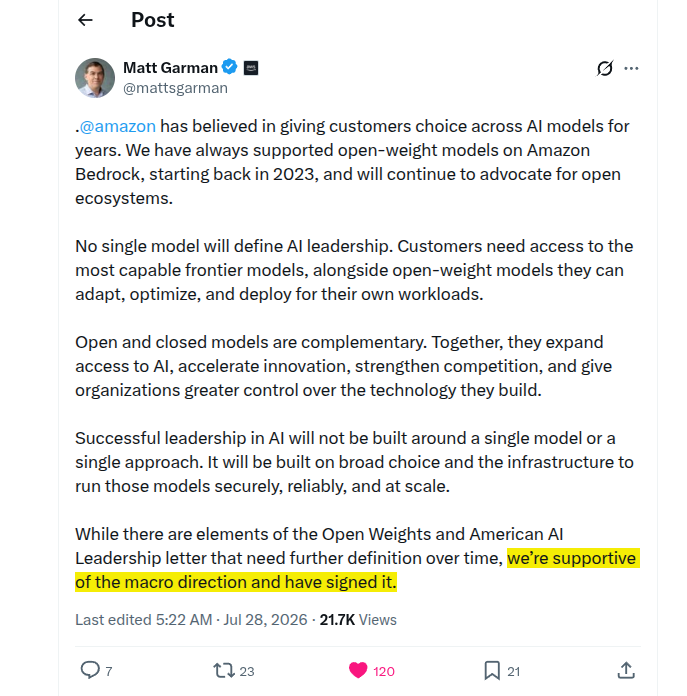
Amazon signed too.
Really interesting to note, Amazon has invested $13 B in cash so far in Anthropic, and likely owns an economic interest of roughly 19% of Anthropic.
Control a robot from your screen and make it do something wild right now.Physical AI just stopped being a demo and became something you can actually play with.Every other robotics launch just shows you a shiny video of a robot looking cool.
Here you get to grab the controls yourself telling a real robot arm what to paint what to mix what to mess around with next and watching it happen live.We got
ChatGPT for words.
We got the image and video toys.
Now the real world just got its own playground.
@ForwardEditor To be fair Brian I 💯 agree 5.6 Been using it and codex and just normal chat and it is Seamless, nice tone, sure it messes up every now and again but so do us humans... I've no inclination to use fable or sonnet. I'm actually using it in conjunction with local models via ollama
Figure robots now have visitor passes!
They have full access to every door on campus. Soon there will be hundreds of them walking around campus, just coming and going