Is this true?
As a newbie here, I prefer to build my account properly from zero, with original content and real engagement from followers and anyone who might come across my tweets, instead of buying fake engagement.
That said, I sometimes (or often, who cares anyways) like my own posts. Is that bad? Does it go against algorithm? Should I stop?
Would appreciate any insight, because I’m kinda confused 🫠
i can't remember where i "learned" this, but i've been doing non-tech content creation for a while. if a post has 0 engagement some folks won't bother with it, but if you "get it started" by leaving a side note or question in the comment section (and even a like) it encourages more interaction. *BUT* i also heard liking your own posts on twitter might work against you in the algo. still playing with it.
Most perpetual platforms ask one question first: “Is this asset big enough?”
https://t.co/BbJS4j5zNx asks something simpler: “Does it exist on-chain?”
That question alone already tells you who the platform is built for.
That difference matters more than I expected. @derp_trade
On popular platforms like GMX, dYdX, or Hyperliquid, the experience is solid but truly predictable.
So what do you usually see there? BTC, ETH, SOL, a few large alts, of course.
We also know that these are safe markets with clean execution.
But you might also notice that a lot of real trading happens outside that bubble.
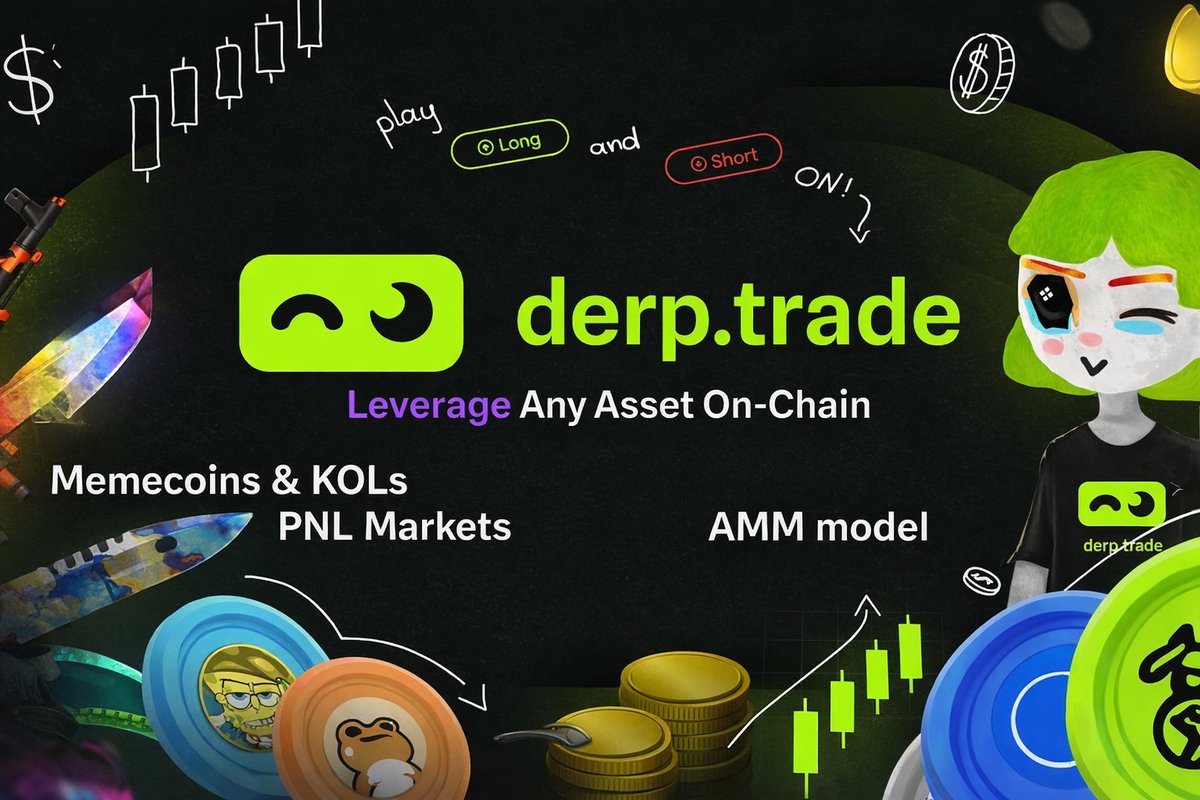
DERPs are basically synthetic assets that let you trade with leverage on any asset.
On Derp, it’s no longer only about big, well-known assets, but also memecoins, niche tokens, and even KOLs PnL markets - things that usually don’t get a perp market suddenly become tradable.
So if you’re wondering what the secret behind Derp is, let me tell you about the AMM model they use.
No order book, no waiting for market makers, and most importantly, no “liquidity coming soon.”
You can open a position instantly, even when liquidity is thin, because pricing adjusts based on who is long and who is short.
In practice, trading on Derp feels different.
If too many people are long a memecoin, longs get more expensive. If shorts step in, the market shifts right away.
It’s very direct. Let’s put it simply: you trade positioning, not just price charts.
Of course, nothing comes with zero risk.
You might recognize things like oracle risk, AMM payout risk, and smart contract risk. We can take these as the trade-off for being early, flexible, and able to trade things most platforms ignore.
What I like most, though, is that Derp doesn’t pretend otherwise. Being honest with each other is one of the main criteria we should have when starting to work with any protocol, right?
Bref, what I want to say is that https://t.co/BbJS4j5zNx is not trying to replace big trading protocols like GMX, dYdX, or Hyperliquid.
They’re simply building something different: perpetual markets for long-tail assets, short-lived narratives, and traders who want exposure before something becomes “big enough.”
That’s what makes DERPs interesting to me for now. And I hope you’ll find them interesting enough to give them a try!
Most perpetual platforms ask one question first: “Is this asset big enough?”
https://t.co/BbJS4j5zNx asks something simpler: “Does it exist on-chain?”
That question alone already tells you who the platform is built for.
That difference matters more than I expected. @derp_trade
On popular platforms like GMX, dYdX, or Hyperliquid, the experience is solid but truly predictable.
So what do you usually see there? BTC, ETH, SOL, a few large alts, of course.
We also know that these are safe markets with clean execution.
But you might also notice that a lot of real trading happens outside that bubble.
DERPs are basically synthetic assets that let you trade with leverage on any asset.
On Derp, it’s no longer only about big, well-known assets, but also memecoins, niche tokens, and even KOLs PnL markets - things that usually don’t get a perp market suddenly become tradable.
So if you’re wondering what the secret behind Derp is, let me tell you about the AMM model they use.
No order book, no waiting for market makers, and most importantly, no “liquidity coming soon.”
You can open a position instantly, even when liquidity is thin, because pricing adjusts based on who is long and who is short.
In practice, trading on Derp feels different.
If too many people are long a memecoin, longs get more expensive. If shorts step in, the market shifts right away.
It’s very direct. Let’s put it simply: you trade positioning, not just price charts.
Of course, nothing comes with zero risk.
You might recognize things like oracle risk, AMM payout risk, and smart contract risk. We can take these as the trade-off for being early, flexible, and able to trade things most platforms ignore.
What I like most, though, is that Derp doesn’t pretend otherwise. Being honest with each other is one of the main criteria we should have when starting to work with any protocol, right?
Bref, what I want to say is that https://t.co/BbJS4j5zNx is not trying to replace big trading protocols like GMX, dYdX, or Hyperliquid.
They’re simply building something different: perpetual markets for long-tail assets, short-lived narratives, and traders who want exposure before something becomes “big enough.”
That’s what makes DERPs interesting to me for now. And I hope you’ll find them interesting enough to give them a try!
Most perpetual platforms ask one question first: “Is this asset big enough?”
https://t.co/BbJS4j5zNx asks something simpler: “Does it exist on-chain?”
That question alone already tells you who the platform is built for.
That difference matters more than I expected. @derp_trade
On popular platforms like GMX, dYdX, or Hyperliquid, the experience is solid but truly predictable.
So what do you usually see there? BTC, ETH, SOL, a few large alts, of course.
We also know that these are safe markets with clean execution.
But you might also notice that a lot of real trading happens outside that bubble.
DERPs are basically synthetic assets that let you trade with leverage on any asset.
On Derp, it’s no longer only about big, well-known assets, but also memecoins, niche tokens, and even KOLs PnL markets - things that usually don’t get a perp market suddenly become tradable.
So if you’re wondering what the secret behind Derp is, let me tell you about the AMM model they use.
No order book, no waiting for market makers, and most importantly, no “liquidity coming soon.”
You can open a position instantly, even when liquidity is thin, because pricing adjusts based on who is long and who is short.
In practice, trading on Derp feels different.
If too many people are long a memecoin, longs get more expensive. If shorts step in, the market shifts right away.
It’s very direct. Let’s put it simply: you trade positioning, not just price charts.
Of course, nothing comes with zero risk.
You might recognize things like oracle risk, AMM payout risk, and smart contract risk. We can take these as the trade-off for being early, flexible, and able to trade things most platforms ignore.
What I like most, though, is that Derp doesn’t pretend otherwise. Being honest with each other is one of the main criteria we should have when starting to work with any protocol, right?
Bref, what I want to say is that https://t.co/BbJS4j5zNx is not trying to replace big trading protocols like GMX, dYdX, or Hyperliquid.
They’re simply building something different: perpetual markets for long-tail assets, short-lived narratives, and traders who want exposure before something becomes “big enough.”
That’s what makes DERPs interesting to me for now. And I hope you’ll find them interesting enough to give them a try!
Most perpetual platforms ask one question first: “Is this asset big enough?”
https://t.co/BbJS4j5zNx asks something simpler: “Does it exist on-chain?”
That question alone already tells you who the platform is built for.
That difference matters more than I expected. @derp_trade
On popular platforms like GMX, dYdX, or Hyperliquid, the experience is solid but truly predictable.
So what do you usually see there? BTC, ETH, SOL, a few large alts, of course.
We also know that these are safe markets with clean execution.
But you might also notice that a lot of real trading happens outside that bubble.
DERPs are basically synthetic assets that let you trade with leverage on any asset.
On Derp, it’s no longer only about big, well-known assets, but also memecoins, niche tokens, and even KOLs PnL markets - things that usually don’t get a perp market suddenly become tradable.
So if you’re wondering what the secret behind Derp is, let me tell you about the AMM model they use.
No order book, no waiting for market makers, and most importantly, no “liquidity coming soon.”
You can open a position instantly, even when liquidity is thin, because pricing adjusts based on who is long and who is short.
In practice, trading on Derp feels different.
If too many people are long a memecoin, longs get more expensive. If shorts step in, the market shifts right away.
It’s very direct. Let’s put it simply: you trade positioning, not just price charts.
Of course, nothing comes with zero risk.
You might recognize things like oracle risk, AMM payout risk, and smart contract risk. We can take these as the trade-off for being early, flexible, and able to trade things most platforms ignore.
What I like most, though, is that Derp doesn’t pretend otherwise. Being honest with each other is one of the main criteria we should have when starting to work with any protocol, right?
Bref, what I want to say is that https://t.co/BbJS4j5zNx is not trying to replace big trading protocols like GMX, dYdX, or Hyperliquid.
They’re simply building something different: perpetual markets for long-tail assets, short-lived narratives, and traders who want exposure before something becomes “big enough.”
That’s what makes DERPs interesting to me for now. And I hope you’ll find them interesting enough to give them a try!
Most perpetual platforms ask one question first: “Is this asset big enough?”
https://t.co/BbJS4j5zNx asks something simpler: “Does it exist on-chain?”
That question alone already tells you who the platform is built for.
That difference matters more than I expected. @derp_trade
On popular platforms like GMX, dYdX, or Hyperliquid, the experience is solid but truly predictable.
So what do you usually see there? BTC, ETH, SOL, a few large alts, of course.
We also know that these are safe markets with clean execution.
But you might also notice that a lot of real trading happens outside that bubble.
DERPs are basically synthetic assets that let you trade with leverage on any asset.
On Derp, it’s no longer only about big, well-known assets, but also memecoins, niche tokens, and even KOLs PnL markets - things that usually don’t get a perp market suddenly become tradable.
So if you’re wondering what the secret behind Derp is, let me tell you about the AMM model they use.
No order book, no waiting for market makers, and most importantly, no “liquidity coming soon.”
You can open a position instantly, even when liquidity is thin, because pricing adjusts based on who is long and who is short.
In practice, trading on Derp feels different.
If too many people are long a memecoin, longs get more expensive. If shorts step in, the market shifts right away.
It’s very direct. Let’s put it simply: you trade positioning, not just price charts.
Of course, nothing comes with zero risk.
You might recognize things like oracle risk, AMM payout risk, and smart contract risk. We can take these as the trade-off for being early, flexible, and able to trade things most platforms ignore.
What I like most, though, is that Derp doesn’t pretend otherwise. Being honest with each other is one of the main criteria we should have when starting to work with any protocol, right?
Bref, what I want to say is that https://t.co/BbJS4j5zNx is not trying to replace big trading protocols like GMX, dYdX, or Hyperliquid.
They’re simply building something different: perpetual markets for long-tail assets, short-lived narratives, and traders who want exposure before something becomes “big enough.”
That’s what makes DERPs interesting to me for now. And I hope you’ll find them interesting enough to give them a try!
Most perpetual platforms ask one question first: “Is this asset big enough?”
https://t.co/BbJS4j5zNx asks something simpler: “Does it exist on-chain?”
That question alone already tells you who the platform is built for.
That difference matters more than I expected. @derp_trade
On popular platforms like GMX, dYdX, or Hyperliquid, the experience is solid but truly predictable.
So what do you usually see there? BTC, ETH, SOL, a few large alts, of course.
We also know that these are safe markets with clean execution.
But you might also notice that a lot of real trading happens outside that bubble.
DERPs are basically synthetic assets that let you trade with leverage on any asset.
On Derp, it’s no longer only about big, well-known assets, but also memecoins, niche tokens, and even KOLs PnL markets - things that usually don’t get a perp market suddenly become tradable.
So if you’re wondering what the secret behind Derp is, let me tell you about the AMM model they use.
No order book, no waiting for market makers, and most importantly, no “liquidity coming soon.”
You can open a position instantly, even when liquidity is thin, because pricing adjusts based on who is long and who is short.
In practice, trading on Derp feels different.
If too many people are long a memecoin, longs get more expensive. If shorts step in, the market shifts right away.
It’s very direct. Let’s put it simply: you trade positioning, not just price charts.
Of course, nothing comes with zero risk.
You might recognize things like oracle risk, AMM payout risk, and smart contract risk. We can take these as the trade-off for being early, flexible, and able to trade things most platforms ignore.
What I like most, though, is that Derp doesn’t pretend otherwise. Being honest with each other is one of the main criteria we should have when starting to work with any protocol, right?
Bref, what I want to say is that https://t.co/BbJS4j5zNx is not trying to replace big trading protocols like GMX, dYdX, or Hyperliquid.
They’re simply building something different: perpetual markets for long-tail assets, short-lived narratives, and traders who want exposure before something becomes “big enough.”
That’s what makes DERPs interesting to me for now. And I hope you’ll find them interesting enough to give them a try!
Most perpetual platforms ask one question first: “Is this asset big enough?”
https://t.co/BbJS4j5zNx asks something simpler: “Does it exist on-chain?”
That question alone already tells you who the platform is built for.
That difference matters more than I expected. @derp_trade
On popular platforms like GMX, dYdX, or Hyperliquid, the experience is solid but truly predictable.
So what do you usually see there? BTC, ETH, SOL, a few large alts, of course.
We also know that these are safe markets with clean execution.
But you might also notice that a lot of real trading happens outside that bubble.
DERPs are basically synthetic assets that let you trade with leverage on any asset.
On Derp, it’s no longer only about big, well-known assets, but also memecoins, niche tokens, and even KOLs PnL markets - things that usually don’t get a perp market suddenly become tradable.
So if you’re wondering what the secret behind Derp is, let me tell you about the AMM model they use.
No order book, no waiting for market makers, and most importantly, no “liquidity coming soon.”
You can open a position instantly, even when liquidity is thin, because pricing adjusts based on who is long and who is short.
In practice, trading on Derp feels different.
If too many people are long a memecoin, longs get more expensive. If shorts step in, the market shifts right away.
It’s very direct. Let’s put it simply: you trade positioning, not just price charts.
Of course, nothing comes with zero risk.
You might recognize things like oracle risk, AMM payout risk, and smart contract risk. We can take these as the trade-off for being early, flexible, and able to trade things most platforms ignore.
What I like most, though, is that Derp doesn’t pretend otherwise. Being honest with each other is one of the main criteria we should have when starting to work with any protocol, right?
Bref, what I want to say is that https://t.co/BbJS4j5zNx is not trying to replace big trading protocols like GMX, dYdX, or Hyperliquid.
They’re simply building something different: perpetual markets for long-tail assets, short-lived narratives, and traders who want exposure before something becomes “big enough.”
That’s what makes DERPs interesting to me for now. And I hope you’ll find them interesting enough to give them a try!
Honestly, most of us are pretty bored with traditional conferences.
You sit there for hours, listen to presentation after presentation, clap a bit, then go home…
and you’re still not even sure what you actually gained from the day.
CatLumpurr 2026 feels like the opposite of that 🐈
This isn’t a “show up and watch” event.
It’s a community summit built around how people actually want to work and connect today.
Instead of locking everyone in a room, you’re moving, talking, playing, and building together.
Pickleball, yoga, gym sessions, community games, real conversations - and yes, a proper party at the end.
That’s how a lot of us work now anyway, isn’t it?
Ideas don’t just happen sitting still. They happen while you’re doing things, meeting people, and sharing moments.
The main summit runs January 30 -February 1, 2026, in Kuala Lumpur, Malaysia.
Day 1 is about major Jupiter product updates.
Day 2 is a community Unconference - no rigid agenda, just real discussions led by the people who show up.
And you know what’s one of the most appealing parts here?
Getting in is simple. Your spot is secured with a refundable 250 JUP deposit, so tickets are basically free.
Yes, you heard that right - a free 2-day event, just for you.
And for those traveling, there’s support too.
Jupiter is offering travel subsidies of up to $2,000 for selected community members.
If you’re already part of the Jupiverse, this really feels like our summit.
I mean, it’s not something to watch - but something to be part of. Agree?
Apply here → https://t.co/ZHL4Ld9BOv
See you in KL 🐈🔥
Just Use Jupiter
#CatLumpurr #Jupiverse #Jupiter #Web3IRL #CryptoCommunity
Most perpetual platforms ask one question first: “Is this asset big enough?”
https://t.co/BbJS4j5zNx asks something simpler: “Does it exist on-chain?”
That question alone already tells you who the platform is built for.
That difference matters more than I expected. @derp_trade
On popular platforms like GMX, dYdX, or Hyperliquid, the experience is solid but truly predictable.
So what do you usually see there? BTC, ETH, SOL, a few large alts, of course.
We also know that these are safe markets with clean execution.
But you might also notice that a lot of real trading happens outside that bubble.
DERPs are basically synthetic assets that let you trade with leverage on any asset.
On Derp, it’s no longer only about big, well-known assets, but also memecoins, niche tokens, and even KOLs PnL markets - things that usually don’t get a perp market suddenly become tradable.
So if you’re wondering what the secret behind Derp is, let me tell you about the AMM model they use.
No order book, no waiting for market makers, and most importantly, no “liquidity coming soon.”
You can open a position instantly, even when liquidity is thin, because pricing adjusts based on who is long and who is short.
In practice, trading on Derp feels different.
If too many people are long a memecoin, longs get more expensive. If shorts step in, the market shifts right away.
It’s very direct. Let’s put it simply: you trade positioning, not just price charts.
Of course, nothing comes with zero risk.
You might recognize things like oracle risk, AMM payout risk, and smart contract risk. We can take these as the trade-off for being early, flexible, and able to trade things most platforms ignore.
What I like most, though, is that Derp doesn’t pretend otherwise. Being honest with each other is one of the main criteria we should have when starting to work with any protocol, right?
Bref, what I want to say is that https://t.co/BbJS4j5zNx is not trying to replace big trading protocols like GMX, dYdX, or Hyperliquid.
They’re simply building something different: perpetual markets for long-tail assets, short-lived narratives, and traders who want exposure before something becomes “big enough.”
That’s what makes DERPs interesting to me for now. And I hope you’ll find them interesting enough to give them a try!
Most perpetual platforms ask one question first: “Is this asset big enough?”
https://t.co/BbJS4j5zNx asks something simpler: “Does it exist on-chain?”
That question alone already tells you who the platform is built for.
That difference matters more than I expected. @derp_trade
On popular platforms like GMX, dYdX, or Hyperliquid, the experience is solid but truly predictable.
So what do you usually see there? BTC, ETH, SOL, a few large alts, of course.
We also know that these are safe markets with clean execution.
But you might also notice that a lot of real trading happens outside that bubble.
DERPs are basically synthetic assets that let you trade with leverage on any asset.
On Derp, it’s no longer only about big, well-known assets, but also memecoins, niche tokens, and even KOLs PnL markets - things that usually don’t get a perp market suddenly become tradable.
So if you’re wondering what the secret behind Derp is, let me tell you about the AMM model they use.
No order book, no waiting for market makers, and most importantly, no “liquidity coming soon.”
You can open a position instantly, even when liquidity is thin, because pricing adjusts based on who is long and who is short.
In practice, trading on Derp feels different.
If too many people are long a memecoin, longs get more expensive. If shorts step in, the market shifts right away.
It’s very direct. Let’s put it simply: you trade positioning, not just price charts.
Of course, nothing comes with zero risk.
You might recognize things like oracle risk, AMM payout risk, and smart contract risk. We can take these as the trade-off for being early, flexible, and able to trade things most platforms ignore.
What I like most, though, is that Derp doesn’t pretend otherwise. Being honest with each other is one of the main criteria we should have when starting to work with any protocol, right?
Bref, what I want to say is that https://t.co/BbJS4j5zNx is not trying to replace big trading protocols like GMX, dYdX, or Hyperliquid.
They’re simply building something different: perpetual markets for long-tail assets, short-lived narratives, and traders who want exposure before something becomes “big enough.”
That’s what makes DERPs interesting to me for now. And I hope you’ll find them interesting enough to give them a try!
Most perpetual platforms ask one question first: “Is this asset big enough?”
https://t.co/BbJS4j5zNx asks something simpler: “Does it exist on-chain?”
That question alone already tells you who the platform is built for.
That difference matters more than I expected. @derp_trade
On popular platforms like GMX, dYdX, or Hyperliquid, the experience is solid but truly predictable.
So what do you usually see there? BTC, ETH, SOL, a few large alts, of course.
We also know that these are safe markets with clean execution.
But you might also notice that a lot of real trading happens outside that bubble.
DERPs are basically synthetic assets that let you trade with leverage on any asset.
On Derp, it’s no longer only about big, well-known assets, but also memecoins, niche tokens, and even KOLs PnL markets - things that usually don’t get a perp market suddenly become tradable.
So if you’re wondering what the secret behind Derp is, let me tell you about the AMM model they use.
No order book, no waiting for market makers, and most importantly, no “liquidity coming soon.”
You can open a position instantly, even when liquidity is thin, because pricing adjusts based on who is long and who is short.
In practice, trading on Derp feels different.
If too many people are long a memecoin, longs get more expensive. If shorts step in, the market shifts right away.
It’s very direct. Let’s put it simply: you trade positioning, not just price charts.
Of course, nothing comes with zero risk.
You might recognize things like oracle risk, AMM payout risk, and smart contract risk. We can take these as the trade-off for being early, flexible, and able to trade things most platforms ignore.
What I like most, though, is that Derp doesn’t pretend otherwise. Being honest with each other is one of the main criteria we should have when starting to work with any protocol, right?
Bref, what I want to say is that https://t.co/BbJS4j5zNx is not trying to replace big trading protocols like GMX, dYdX, or Hyperliquid.
They’re simply building something different: perpetual markets for long-tail assets, short-lived narratives, and traders who want exposure before something becomes “big enough.”
That’s what makes DERPs interesting to me for now. And I hope you’ll find them interesting enough to give them a try!
Most perpetual platforms ask one question first: “Is this asset big enough?”
https://t.co/BbJS4j5zNx asks something simpler: “Does it exist on-chain?”
That question alone already tells you who the platform is built for.
That difference matters more than I expected. @derp_trade
On popular platforms like GMX, dYdX, or Hyperliquid, the experience is solid but truly predictable.
So what do you usually see there? BTC, ETH, SOL, a few large alts, of course.
We also know that these are safe markets with clean execution.
But you might also notice that a lot of real trading happens outside that bubble.
DERPs are basically synthetic assets that let you trade with leverage on any asset.
On Derp, it’s no longer only about big, well-known assets, but also memecoins, niche tokens, and even KOLs PnL markets - things that usually don’t get a perp market suddenly become tradable.
So if you’re wondering what the secret behind Derp is, let me tell you about the AMM model they use.
No order book, no waiting for market makers, and most importantly, no “liquidity coming soon.”
You can open a position instantly, even when liquidity is thin, because pricing adjusts based on who is long and who is short.
In practice, trading on Derp feels different.
If too many people are long a memecoin, longs get more expensive. If shorts step in, the market shifts right away.
It’s very direct. Let’s put it simply: you trade positioning, not just price charts.
Of course, nothing comes with zero risk.
You might recognize things like oracle risk, AMM payout risk, and smart contract risk. We can take these as the trade-off for being early, flexible, and able to trade things most platforms ignore.
What I like most, though, is that Derp doesn’t pretend otherwise. Being honest with each other is one of the main criteria we should have when starting to work with any protocol, right?
Bref, what I want to say is that https://t.co/BbJS4j5zNx is not trying to replace big trading protocols like GMX, dYdX, or Hyperliquid.
They’re simply building something different: perpetual markets for long-tail assets, short-lived narratives, and traders who want exposure before something becomes “big enough.”
That’s what makes DERPs interesting to me for now. And I hope you’ll find them interesting enough to give them a try!
Most perpetual platforms ask one question first: “Is this asset big enough?”
https://t.co/BbJS4j5zNx asks something simpler: “Does it exist on-chain?”
That question alone already tells you who the platform is built for.
That difference matters more than I expected. @derp_trade
On popular platforms like GMX, dYdX, or Hyperliquid, the experience is solid but truly predictable.
So what do you usually see there? BTC, ETH, SOL, a few large alts, of course.
We also know that these are safe markets with clean execution.
But you might also notice that a lot of real trading happens outside that bubble.
DERPs are basically synthetic assets that let you trade with leverage on any asset.
On Derp, it’s no longer only about big, well-known assets, but also memecoins, niche tokens, and even KOLs PnL markets - things that usually don’t get a perp market suddenly become tradable.
So if you’re wondering what the secret behind Derp is, let me tell you about the AMM model they use.
No order book, no waiting for market makers, and most importantly, no “liquidity coming soon.”
You can open a position instantly, even when liquidity is thin, because pricing adjusts based on who is long and who is short.
In practice, trading on Derp feels different.
If too many people are long a memecoin, longs get more expensive. If shorts step in, the market shifts right away.
It’s very direct. Let’s put it simply: you trade positioning, not just price charts.
Of course, nothing comes with zero risk.
You might recognize things like oracle risk, AMM payout risk, and smart contract risk. We can take these as the trade-off for being early, flexible, and able to trade things most platforms ignore.
What I like most, though, is that Derp doesn’t pretend otherwise. Being honest with each other is one of the main criteria we should have when starting to work with any protocol, right?
Bref, what I want to say is that https://t.co/BbJS4j5zNx is not trying to replace big trading protocols like GMX, dYdX, or Hyperliquid.
They’re simply building something different: perpetual markets for long-tail assets, short-lived narratives, and traders who want exposure before something becomes “big enough.”
That’s what makes DERPs interesting to me for now. And I hope you’ll find them interesting enough to give them a try!