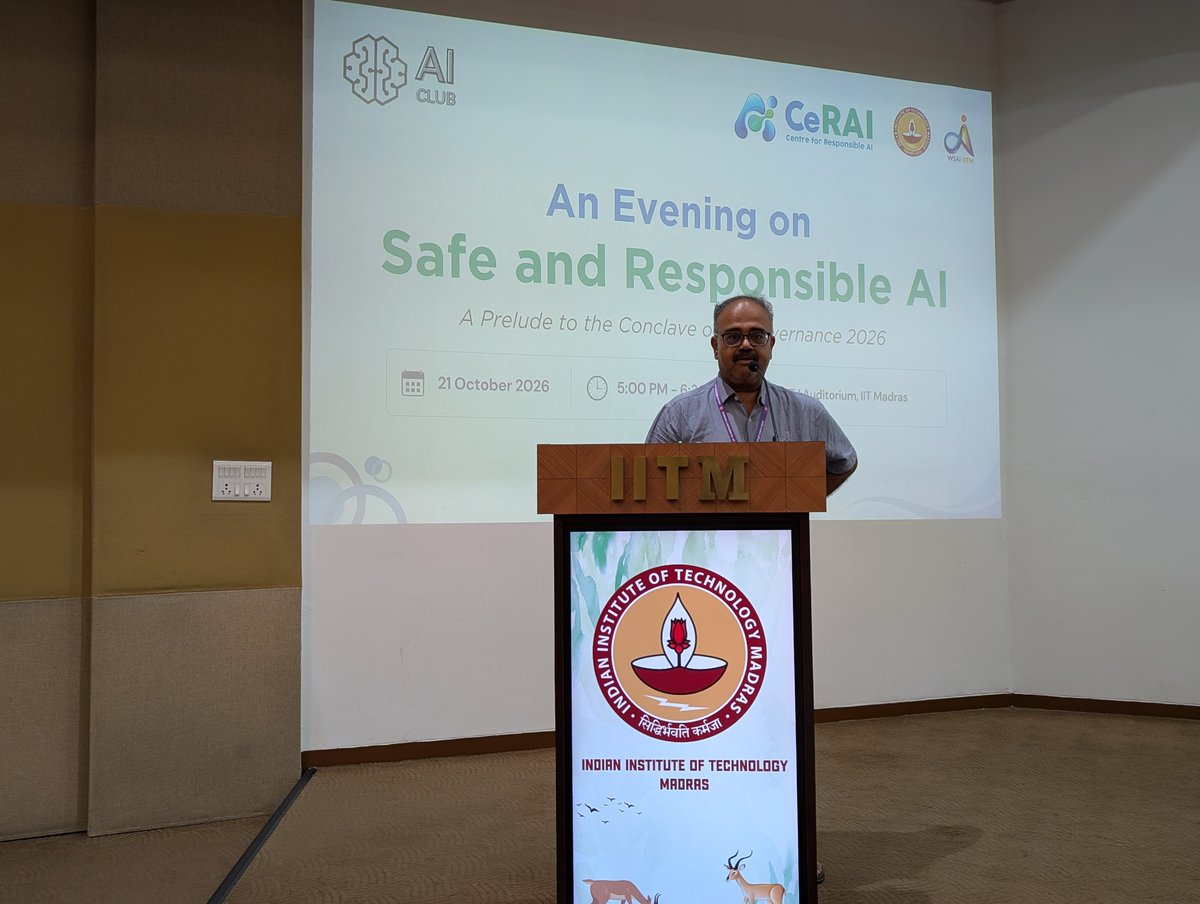
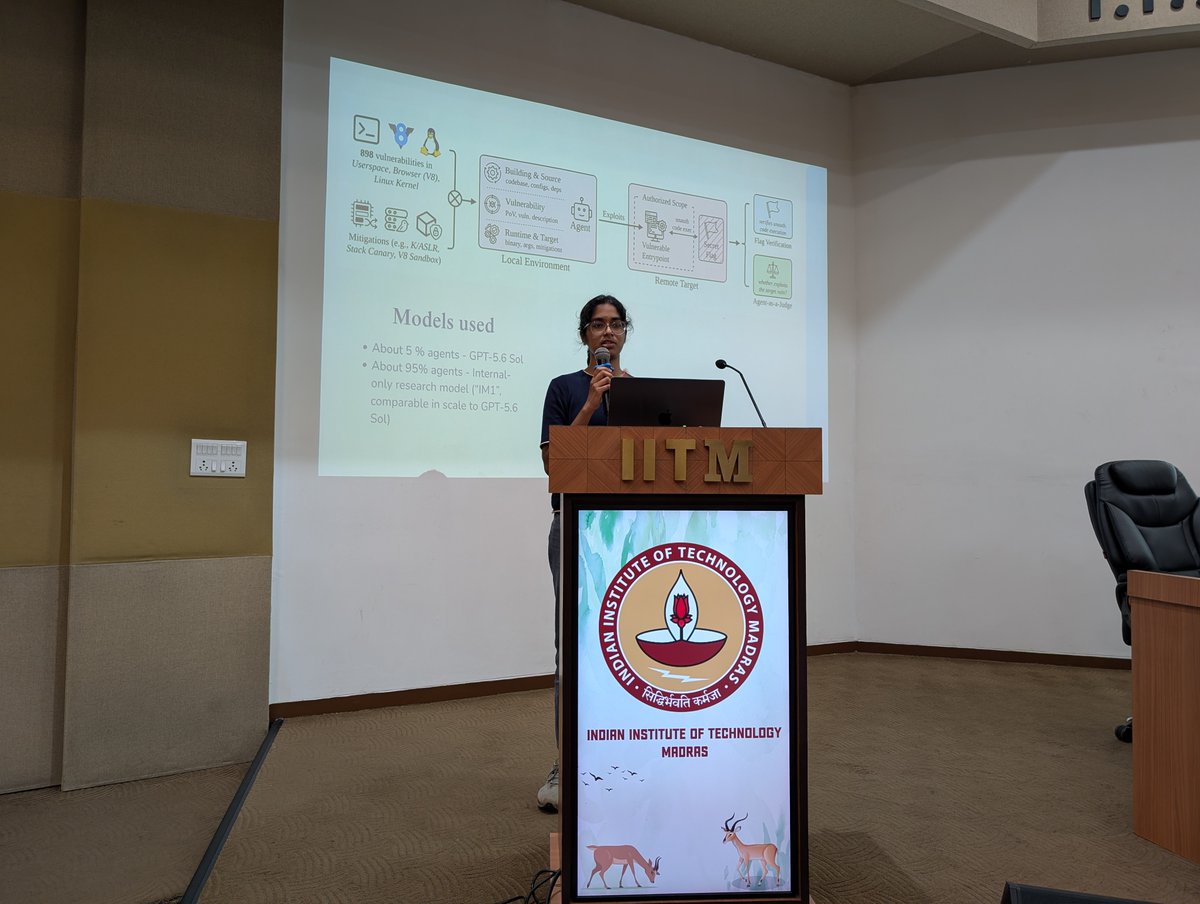
The evening also featured a thought-provoking faculty debate on the role of AI in education and research, with Prof. Mohan Kankanahalli, Prof. Balaji Srinivasan, Prof. @gramchurn and Dr. Ayana Ghosh, moderated by Prof. @ravi_iitm .
#AIinEducation#AIGovernance#ResponsibleAI
At An Evening on Safe and Responsible AI, @aiclubiitm , discussed the Hugging Face incident, exploring its lessons for responsible AI development and evaluation.
Thanks to @cerai_iitm for the opportunity to be part of these insightful conversations!
#ResponsibleAI#AISafety
Ahead of the Industry Conclave on AI Governance 2026, An Evening on Safe and Responsible AI brought together students, researchers and experts for discussions on AI incidents, responsible AI principles, and the role of AI in education and research.
I think the last month might have been the biggest month in (zeroth-order) optimization history.
In the 10 days since we released the Noise speedrun, the time to pretrain a transformer went from 1.76 hours to 1.6 seconds, a 4,000x (!!!) speedup. Dust itself was up to 10,000x more compute-efficient than the previous state-of-the-art.
Not only can we pretrain a transformer without backprop, it's much more efficient than anyone would've expected. Search fking works!
Now, scaling is the biggest open question. Some of the tricks that brought the time down to 1.6 seconds will simply not scale. To discard those, we'll be scaling the dataset every time it gets overfit, starting with 30M tokens instead of 10M.
Huge thanks to @jayden_teoh_, @spicey_lemonade, @RobertTLange, @EmanueleRodola, @ChunyuanDeng, @LuochengHuman, @Alaxarr, @pavleculafic, @IsaacYong13, Euraba and areu01or00 (GitHub), for the contributions. And @cs_serdar for gracefully maintaining the speedrun and @bishmdl76 for helping out.
Expect a lot more from us over the coming weeks.
Can you identify which LLM wrote a passage from the text alone? 👀
Each AI lab leaves behind distinct stylistic markers in vocabulary, phrasing, and punctuation. In Name That LLM, you'll identify which of 18 leading models from 6 organizations (Anthropic, Google, Moonshot AI, OpenAI, Qwen, and ZAI) wrote each unlabeled passage.
💰 Prize Pool: $50,000
⏰ Entry Deadline: January 6, 2027
I'm loving the era of personalised AI art!
Opus 5.5 wrote, composed and made a video for a song about the story of mech interp (and how things keep getting worse...), packed with obscure references, and tailored it to my tastes (no guarantees anyone else is into it lol)
Here are the questions that currently seem most important to me:
-- Better methods for "mind-reading" model activations. These methods have advanced a lot recently. We now have multiple techniques now for decoding activations into somewhat readable language! But all the existing techniques have obvious limitations. NLAs are often hallucinatory, Jacobian lens / related methods are limited to bag-of-words readouts (and capture only part of the full activation vector). Making progress on these failure modes seems pretty tractable. Moreover, the paradigm of decoding (single-token, single-layer) activations may be inherently limiting -- perhaps we should be building techniques to decode whole context's worth of activations (after all, that's what the model uses!). There's also important work to do in characterizing simple baselines -- "just ask the model what it's thinking about" is quite powerful, and worth studying in it's own right!
-- Better methods for answering "why" questions. We're much better at "mind reading" than we are at demonstrating causal claims about what caused the model to do something. For example, we can often tell that the model is aware of being evaluated, but have comparatively much greater difficulty telling whether this awareness is influencing this behavior. There are a few directions here: (1) black-box techniques for inferring causality -- such as resampling model responses after making edits to the prompt / context -- are very powerful, but also open-ended and require some taste. Getting LLMs to do these experiments well, in an automated fashion, would be a big unlock. (2) the science of activation steering is pretty immature, and typical practices (adding a constant vector at all token positions) are pretty janky / tend to brain-damage the model. More surgical / targeted steering, or fancier methods (examples: "on-manifold" steering using activation diffusion models) could help.
-- Fitting good linear probes for unverbalized motivations / awareness. Take deception as an example -- what's the best way to fit a probe that will generalize to covert deception? Fit it on CoT excerpts where the model's talking about its plans to be deceptive? Fit it on the part of its response where it's actually doing the deceiving? Is it important that you elicit on-policy deception examples and use those to fit your probe, or can you use synthetically written off-policy demonstrations of deception? Is it important that your probe be causally meaningful / predictive of an upcoming intent to deceive, or is it fine for it to merely recognize deception in the transcript post-hoc? The same questions apply to many other concepts of interest that we'd like to probe for -- evaluation awareness, grader exploitation, etc.
-- Understanding generalization in training. The literature is now replete with "weird generalization effects" -- emergent misalignment being a canonical example. In general, when you train a model to do X, it usually learns X, and sometimes it generalizes to Y and Z. But other times it just learns X. Why? Nobody really knows! Step 1 here is probably a much more thorough characterization of the behavioral empirics -- gathering data about which X's generalize to which Y's and Z's, for which kinds of training data / algorithms. Once we have a lay of the land, we can start to connect these observations to model internals, and ideally develop tools to predict such generalization a priori.
-- Model "psychology" and "biology." The above questions are largely methodological -- building better tools to answer questions about the model. But I think interpretability research has largely underinvested in the part where you actually then go answer the questions! Currently this feels like 5% of the field, and I think it should be 50%.
Brain dump of "psychology" questions: How well can LLMs introspect? How coherent are their belief or value sets? What's up with personas -- are LLMs best understood as "writing about a character," or have they "become" the character in some sense? Does the LLM have an agenda above and beyond what the Assistant wants? Do LLMs have explicit representations of goals or preferences? How can we tell which parts of the LLM's activations "belong" to the Assistant? Which kinds of reasoning necessarily route through "verbalizable" representations, and which don't? Do models think internally in phrases / sentences, like an inner monologue, or is it more like a jumble of concepts? Is the "global workspace" claim for real -- do models have a more "conscious" part of there activations and a more "unconscious" part? Can models tell when they're on-policy, and does it matter?
Brain dump of "biology" questions: Why do models like to represent information on some tokens but not others? How do models bind thoughts or attributes to particular entities (special case of interest: how are thoughts bound to the Assistant). To what extent are important functions localized to small numbers of MLP neurons or attention heads? What parts of a model change most during post-training? Do models represent some information in a fundamentally "cross-token" way? Some concepts appear to be represented on low-dimensional nonlinear manifolds -- is there a taxonomy of these manifolds, and is their geometric structure important? Are models able to represent information in a compositional / hierarchical way, with a "grammar" that can't be described as linear / additive combinations of primitive concepts?
A carefully controlled look at looped transformers (arXiv 2609.19107):
1. Weight sharing is not compute-optimal on fresh data. It costs a constant ~1.06–1.16x compute at every scale.
2. The looped model's gains over vanilla come from elsewhere: the norm + input re-injection boundary operator, and growing depth mid-training. Both improve the scaling exponent. Neither needs weight sharing.
3. Looping is still a parameter-free way to get growth. Tied growth keeps the exponent gain at vanilla param count.
4. Weight sharing wins on multi-epoch, data-constrained training.
https://t.co/FYGexgqiWj
Reasoning with Image Generation
TL;DR: ReImaGin turns image generation into a reasoning tool. Instead of thinking only in text, MLLMs generate helpful intermediate images—e.g., trajectories, depth maps, or bird’s-eye views—and feed them back into reasoning.
https://t.co/Te33RAezG8
In Project Viveka 1.0, we explored the Simplex framework. Extending "Constrained Belief Updates Explain Geometric Structures in Transformer Representations," we tested how MLPs convert constrained belief updates to full belief updates. 1/8
In Project Viveka 1.0, we explored the Simplex framework. Extending "Constrained Belief Updates Explain Geometric Structures in Transformer Representations," we tested how MLPs convert constrained belief updates to full belief updates. 1/8
Our group discovered that reasoning models produce fractals when asked to solve hard problems. We can use nonlinear dynamics to probe the thinking processes of recurrent depth models on Sudoku, mathematics, and even ARC-AGI (1/N)
https://t.co/Q3u8OqylZf
Define a complementary distribution μ_uniq instead as it assigns equal weight to each geometrically distinct mixed state.
Adam’s recovered representation is more like μ_B whereas SGD’s is μ_uniq . We do not know why. 7/8
When a transformer is trained on N sampled sequences, the distribution of mixed states it sees is the Blackwell measure μ_B i.e. the stationary measure of the MSP weighted by the sequence frequency. 6/8