In Project Viveka 1.0, we explored the Simplex framework. Extending "Constrained Belief Updates Explain Geometric Structures in Transformer Representations," we tested how MLPs convert constrained belief updates to full belief updates. 1/8
Background - We trained one layer transformers on the Mess3 Mealy Markov process (non-unifilar over token transition representation) across various parametrizations of (x,alpha) of the token-wise transition matrices. 2/8
How can we interpret the internal activations of LLMs? Logit lens is a popular technique to translate internal activations of an LLM to token space. In this blog, written during Project Viveka ,we examined where logit lens fails.
#AI#LLM#mechanisticinterpretability#logitlens
Logit lens applies the unembedding matrix to internal activations to decode them as tokens. While effective on small models like gpt2, it yields garbage tokens in some layers for models like gemma-2-2b-it.
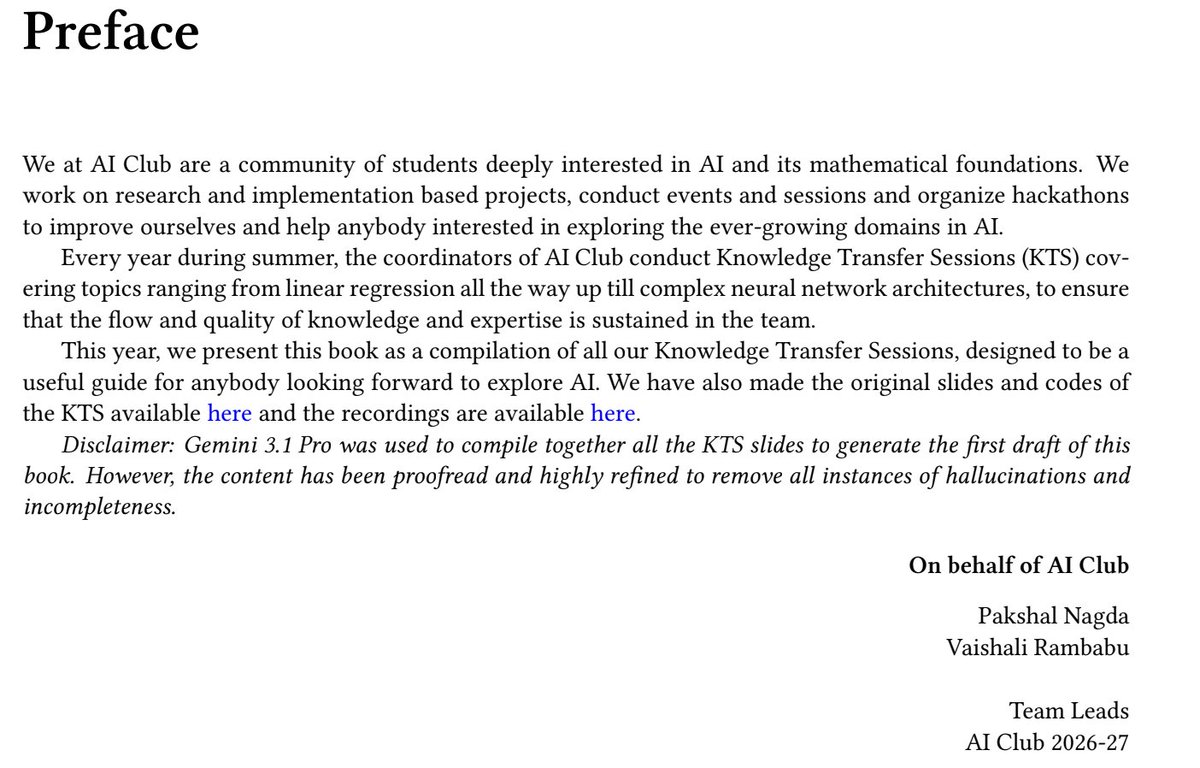
Ever wanted to start learning AI and ML but didn't know where to begin? Yeah, we've all been there.
We compiled our Knowledge Transfer Sessions into Translating Tensors, a from scratch intro covering regression, classification, core ML models, deep learning and a lot more .
It comes with the math behind each concept, code for every part of it.
So you don't just understand ML, you can practice it alongside.
Find it here: https://t.co/AzviAMTYzl
Meet our project Viveka 2.0, in which we dig into whether AI models solving ARC-AGI actually learn abstract rules, and advance non LLM approaches from our interpretability results.
https://t.co/rbr3zz5sQy
#ARCAGI#AI#Interpretability#MachineLearning#AIResearch#IITMadras
Tiny Recursive Model (TRM) approaches to solve ARC-AGI by packing a puzzle's entire transformation logic into one embedding vector, using a tiny 7M-param model as a pure "executor."
We tested if that's actually true. It's not that clean.