The Austrian National Funding Agency (FWF) support Ukraine researchers at all levels, that would work in the context of FWF funded projects. We do have one project on CD8 T-cells and AD. If you are from Ukraine and you are interested, let me know!
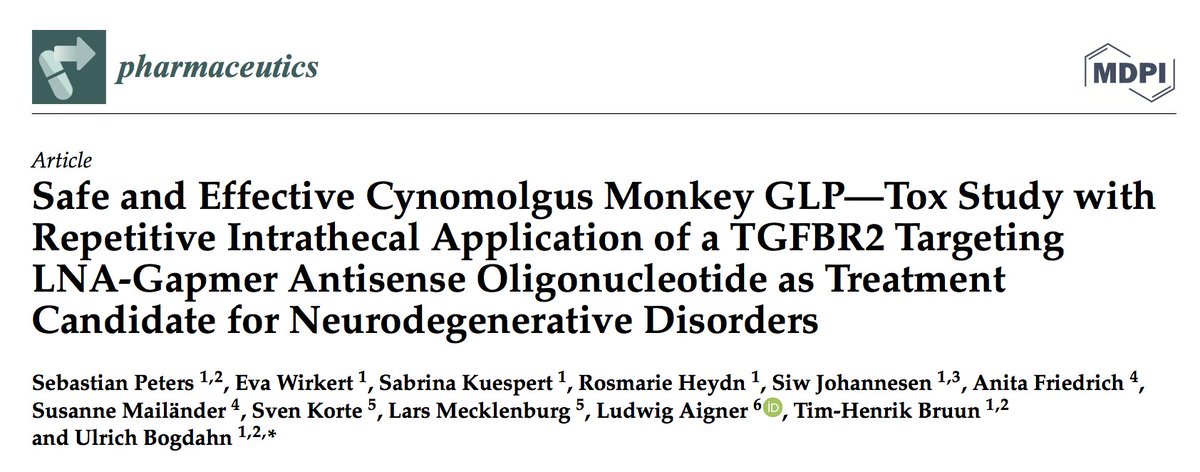
A further step towards a clinical study with a novel Anti-TGF-beta medication: Safe and Effective Cynomolgus Monkey GLP-Tox Study with Repetitive Intrathecal Application of a TGFBR2 Targeting LN… https://t.co/qePBIXP7YF
Another level of scarring after #spinal cord injury: Subarachnoid Fibrosis in Human Post-Traumatic Syringomyelia: A Prospective Observational Clinical Study https://t.co/r3ZYhOm3YH
Imagine we developed a drug to repair synapses and neurons and learned that the supply routes keeping neurons alive are broken in AD brains - it’s a possibility. Check out @andcyang ’s human brain vascular atlas https://t.co/4Dw4m9x8EO and the related study from Heiman/Kellis
Food and #microbiota in the context of brain #aging! Great collaboration with the DiCogPlast consortium.
Food and Microbiota Metabolites Associate with Cognitive Decline in Older Subjects: A 12-Year Prospective Study https://t.co/kR9XvE9ygT
Happy to share our recent collaborative work together with the Reitsamer group on #Montelukast as a potential therapeutic in #glaucoma
https://t.co/pK4YVnHAOn
Great opportunity to contribute a bit to the fantastic paper in Science by David @DGateLab and Tony @wysscoray . CD4+ T cells contribute to neurodegeneration in Lewy body dementia https://t.co/GkLjAXHagv
Huge congratulations to David Gate @DGateLab who just started his lab at Northwestern and an amazing team including @andcyang, Andreas Keller, Doug Galasko, Mark Davis and Kathleen Poston
CD4+ T cells contribute to neurodegeneration in Lewy body dementia https://t.co/hLhEzuZszD
We need to understand how #Covid_19 affects the brain. Our study out now at @Nature provides a molecular basis. Terrific experience, sharing co-first with @andcyang and exceptional guidance by Tony @wysscoray and Andreas Keller. Free link: https://t.co/UthIOBC8fL @Stanford_Neuro