New paper from the Colonna lab! cMAF is a key regulator of BAM identity and drives communication with brain arteries via IGF1. We show that this cMAF-dependent program in BAMs supports cerebrovascular function in mice and is protective against AD.
https://t.co/IEzw44YYdB
The transcription factor MAF is known from human genetics to be important in Alzheimer’s disease, but its precise function within the brain has been unclear.
Our latest, out today in @CellCellPress, dissects the role of MAF in brain macrophages. 1/
https://t.co/5jtMEvvNMd
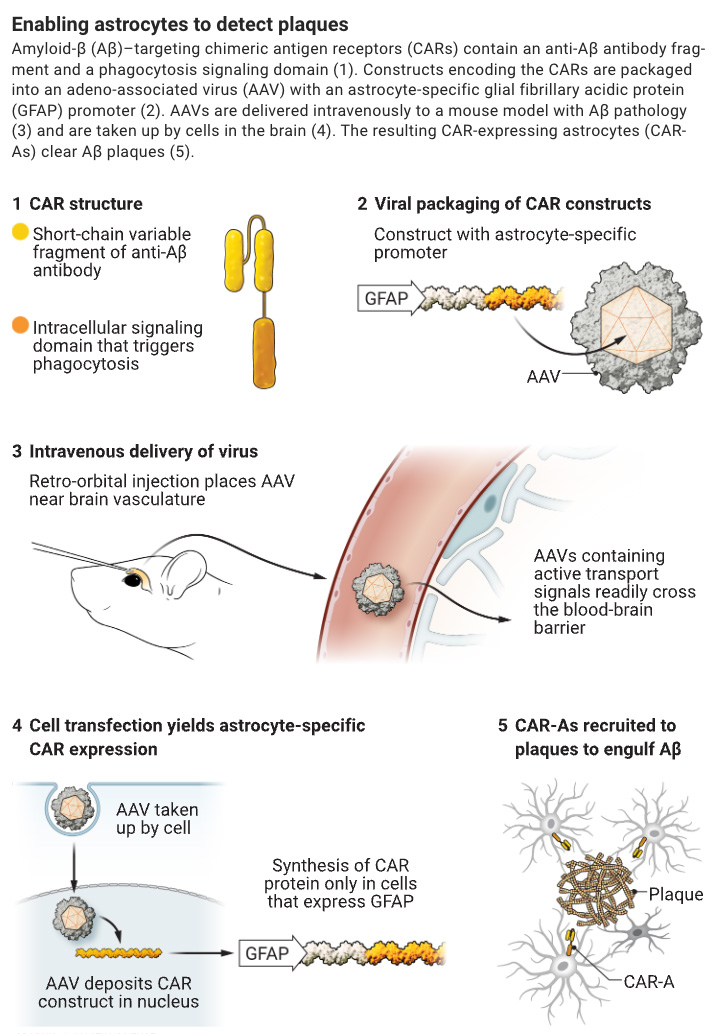
Genetically altered astrocytes that express chimeric antigen receptors offer a promising immunotherapy system capable of clearing accumulations of amyloid-β in the brains of mice—a hallmark pathological feature of #AlzheimersDisease, according to a new study in Science.
📄: https://t.co/jMTIzVznEV
#SciencePerspective: https://t.co/h1aL5tdltT
Congrats @DGateLab on having one of the Top 3 Episodes of Breakthroughs Podcast in 2025! If you haven't listened you can do so and learn more here; https://t.co/MkdqLkLVnf
Key to research success: ambition in vision, but pragmatism in execution. You must be guided by a long-term, ambitious goal that addresses a fundamental problem, rather than chasing incremental gains on established benchmarks. Yet, your progress should be grounded by tractable short-term metrics/tasks that force you to constantly make contact with reality.
We are proud to announce a collaboration with @ARC_Neuro at Northwestern University Feinberg School of Medicine to harness AI for rapid discovery and innovation in Alzheimer’s disease research. Using Lens, the Center and Tempus teams will work together to uncover genomic patterns that have the potential to advance the understanding of Alzheimer’s disease, investigate the gene and cell types affected, enable the development of new therapeutics, and accelerate the creation of novel clinical applications.
Learn more: https://t.co/m0ZEWjK9qc
I am excited to present our new study out in @NatureMedicine where we discover a novel synaptic protein biomarker to predict if and when someone will get Alzheimer’s disease dementia. Part 2/3 from my PhD work in the @wysscoray lab. 🧵1/12
Full study 🔗: https://t.co/yg8lmRXuTN
We’re happy to share that our labs first #ALS and #FTD study “A stress-dependent TDP-43 SUMOylation program preserves neuronal function” is now online @MolNeuro!
https://t.co/fqv8ivFde4
It’s quite an experience to have some of your favorite labs like @TheColonnaLab and @Haass_Lab comment on your lab’s research. Great reporting by Alzforum! https://t.co/vtERMRGhyU
This Northwestern Breakthroughs podcast nicely encapsulates our study. The host does a great job leading the discussion for the lay audience to digest our work. I hope this allows people to better understand the results and impact of this study. https://t.co/9v3MwmIr68
This video describes the findings from our recent study conducted at @ARC_Neuro. In the video, lead author @LynnOlst and I discuss the findings and their implications for Alzheimer’s disease. https://t.co/qUZbFpo5FZ
Excited to share our latest @NatureMedicine study from our new center @ARC_Neuro! 🧠✨ Using spatial transcriptomics & scRNA-seq, we uncover how Aβ-targeting immunotherapies shape microglial responses in AD patient brains.
A thread with our key findings is below! 🧵(1/15)