Today, we released Gemini 3.5 Live Translate, our latest audio model for live speech-to-speech translation.
It supports over 70 languages and starts translating as soon as you start talking, streaming translations while listening to what you say next. No awkward pauses or choppy audio, just real connection without language barriers.
So, how does it work? 🤔
The model is able to make split-second decisions to juggle speed and translation quality so conversations actually feel fluid, human, and natural. In order to do this, the model must receive and contextualize the input while simultaneously outputting the translated speech.
Through this process, Gemini 3.5 Live Translate manages to stay mere seconds behind each speaker and can even maintain pacing, pitch, and intonation across extended sessions.
See it in action below, or try it yourself in the Google Translate app on iOS & Android.
Here’s what launched this week:
— Gemini 3.5 Live Translate our latest audio model for live speech-to-speech translation
— @NotebookLM got a major upgrade including agentic capabilities in chat, more advanced reasoning, and a suite of new output formats
— Project Genie from @GoogleLabs is now available to Google AI Ultra 5x subscribers globally
— Notebooks in @GeminiApp are now available in the European Economic Area, United Kingdom, and Switzerland
— DiffusionGemma, our newest experimental open @googlegemma model that explores text diffusion, an exceptionally fast approach to text generation
We’re shipping two major updates to streamline your creative workflow, allowing you to generate high-speed images with one model and then instantly animate them with the other—all at a fraction of the cost 🍌⚡️
1️⃣ Introducing Nano Banana 2 Lite: Our fastest and most cost-efficient Gemini Image model yet delivers text-to-image outputs in under 4 seconds. Now available via the Gemini API and Google AI Studio, and rolling out soon across @NotebookLM, @FlowbyGoogle, @geminiapp, @stitchbygoogle, Google Search and @GooglePhotos.
2️⃣ Gemini Omni Flash in Public Preview: Our natively multimodal model for cost-efficient video generation and conversational editing. Now available via the Gemini API, @googleaistudio, and Gemini Enterprise Agent Platform so you can integrate the model into your workflow.
While exciting on their own, the real magic happens when you build using these models together.
Watch how our interior design demo integrates Nano Banana 2 Lite and Omni to instantly reimagine any space. Upload a photo, swipe through tailored design concepts, and see Omni bring the details to life in cinematic motion.
Try out the demo app in AI Studio: https://t.co/EjYC2oHIDG
As generative AI tools continue to evolve, we believe it's more important than ever to know what's AI-generated and what isn't. That’s why @GoogleDeepMind launched SynthID in 2023—a technology that adds a hidden digital watermark to AI content.
Here’s a summary of SynthID’s journey and where the provenance technology (the documented history and origin of digital content) is today:
— SynthID watermarking was originally built for images, but now supports video, audio, and text.
— The technology has watermarked over 100 billion images and videos, alongside 60,000 years of audio.
— You can now verify content with SynthID directly in Google Search, Gemini in Chrome, and the @GeminiApp, where it has been utilized over 50 million times.
— We’ve also adopted C2PA Content Credentials across a growing number of our generative AI tools. This includes the images and videos created within the Gemini app. So now, in addition to the SynthID watermark, you can also see where an image or video originated and how it’s been altered.
— We have open-sourced our text watermarking technology, and we are working with companies like @OpenAI, @NVIDIA, and @Apple to apply SynthID to generative media.
Let us know what you think of the tool so far!
Step into the map with the Street View grounding feature in Project Genie from @GoogleDeepmind and @GoogleLabs.
Announced at I/O, this research prototype uses locations from @GoogleMaps Street View as a foundation, letting you generate and explore interactive, 360-degree virtual environments from just a text prompt or real-world starting place.
Cool, right? But… How does it actually work? 🤔
As an experimental tool, Project Genie tackles the "blank space" problem (showing both what’s in front of the camera and behind it) by utilizing Street View data to realistically generate a 360-degree view of the location you selected as the starting point for your world to generate from.
Worlds generated by Genie are far more dynamic and rich because they’re created frame-by-frame based on the world description and user actions. By predicting each subsequent frame, Genie is able to simulate what it looks like to swim across an ocean, or hike to the top of a peak, marking a massive shift in interactive media and simulation pipelines.
What real-world place would you want to step into and explore?
As AI models are now finding vulnerabilities faster than we can fix them, our approach to securing software must be built on highly efficient and capable models.
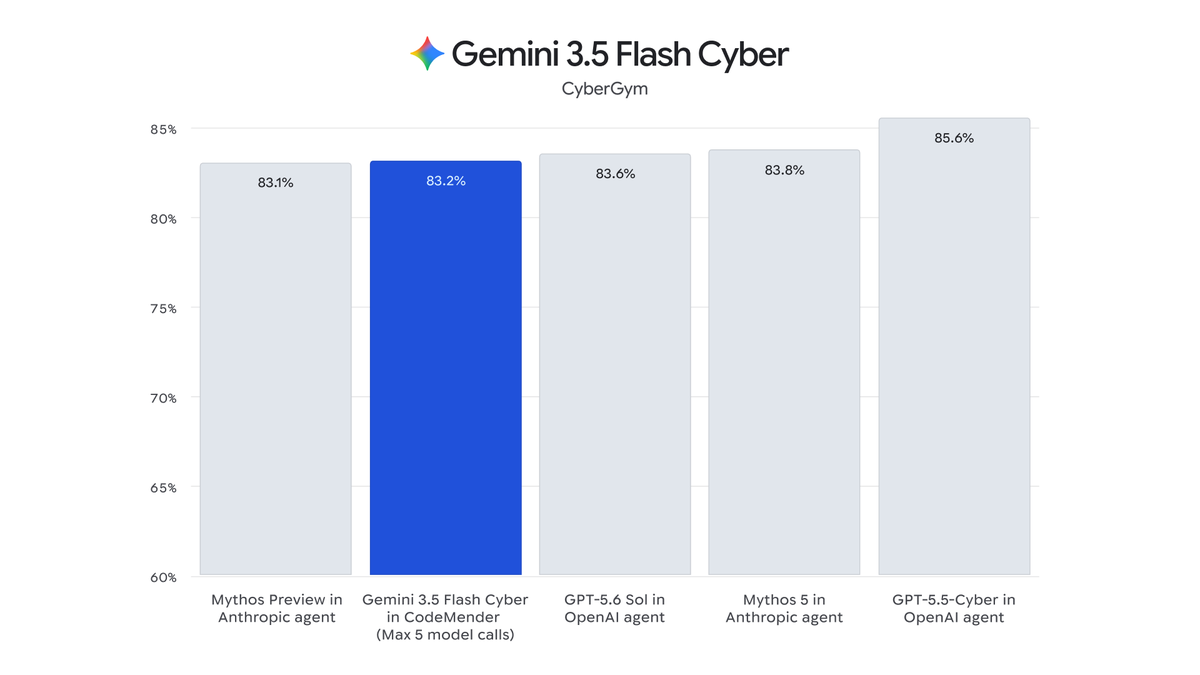
Which brings us to our third (!) model launch of the day: Gemini 3.5 Flash Cyber ⚡🛡️
Built on top of 3.5 Flash, in CodeMender (our AI agent for code security) it delivers competitive performance at the frontier. on benchmarks like CyberGym and is optimized for finding and fixing cybersecurity vulnerabilities at scale at a lower cost.
Given the dual-use nature of this technology, we have taken an intentional approach to its deployment. The model will be available exclusively to governments and trusted partners via CodeMender soon as part of a limited-access pilot program.