@WhaLarkAI@EditSatyjeet Interesting approach. Tying the idea directly to the exact sentence and rejecting if it changes the claim makes sense.
Have you tried this on longer videos yet? Curious how much of the first-pass thumbnails actually stick without needing a second round.
@WalrusProtocol Fair point. Cross-tool memory is still the hard part.
Have you seen anyone actually move context between tools (Claude → Cursor → another agent) without re-explaining most of it, or is that still mostly manual?
@Mahaximus_ Makes sense. Formatting and structure type tasks seem to land better on the first pass.
Have you noticed a clear difference between those and more open-ended tasks (research, multi-step coding, etc.)? Curious where the first-pass quality drops the most for you.
@claudeai Interesting feature. Has anyone actually connected accounts and asked it about real spending patterns yet? Curious how useful the first answers were.
@FlowbyGoogle Interesting update. Has anyone tried the longer continuous shots yet?
Curious how much of the first output is actually usable without needing to regenerate or heavily fix the consistency.
@claudeai Interesting feature. Has anyone actually connected accounts and asked it about real spending patterns yet?
Curious how much of the first answers were usable vs how much still needed extra context or corrections.
@GoogleAIStudio Interesting direction. Have you seen a clear improvement in first-pass quality for longer coding or agent tasks with the latest Gemini updates?
@RRRangle The harness approach makes sense. Have you noticed a clear drop in wasted tokens and cleanup rounds after adding checks and retries, or does it still need a lot of steering?
People who treat Grok Bot like a real teammate are already getting results.
Instead of just chatting, they’re giving it tasks, booking appointments, doing research, and managing work.
That’s the actual shift. Most people are still just asking “how are you?” while a few are already delegating real work.
Isn’t that right, @elonmusk?
Democrats are pushing for a day-one ban on superintelligence, with up to 20 years in prison and a new AI department.
AI is currently driving a big part of economic growth. A hard ban might protect against risks, but it could also kill innovation and hand the lead to other countries.
Controlled development seems smarter than a full stop.
BREAKING: 🇺🇸 Democrats face a push for a “day 1” ban on AI superintelligence, with up to 20 YEARS in prison for violators.
Arizona Rep. Yassamin Ansari says a pause on advanced AI and a ban on artificial superintelligence must be “top of the Democratic agenda on day 1.”
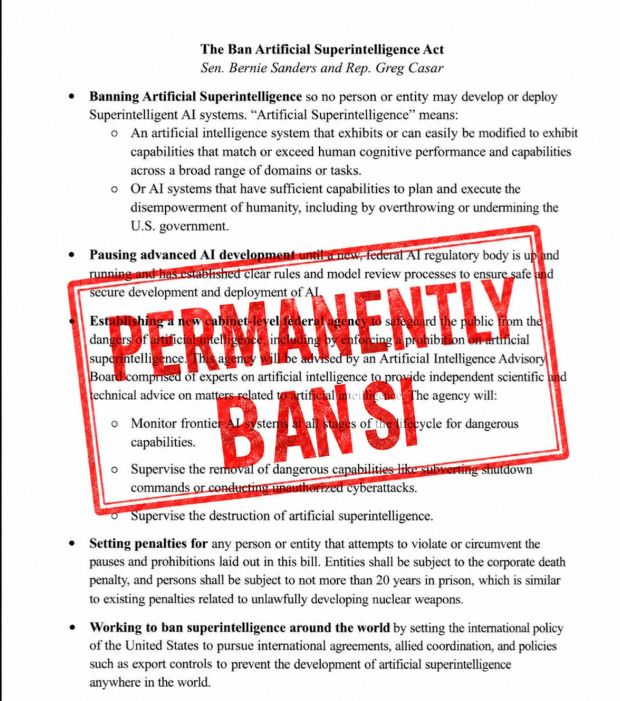
A bill that would do exactly that was introduced by Bernie Sanders and Greg Casar in September.
Under the bill:
- Developing or deploying superintelligent AI would be banned
- Advanced AI development would pause until a new federal regulator sets rules and a model review process
- A new cabinet-level AI department would monitor frontier models and oversee removing dangerous capabilities, like ignoring shutdown commands
- Companies that try to get around it would face the “corporate death penalty”
- Individuals would face up to 20 years in prison
AI and data centers were a “crucial or major factor” for 56% of voters in the midterms, per an NBC News exit poll.
Democrats want to pause advanced AI and ban superintelligence on day one.
Is a full ban the right move, or will it just slow down progress while others keep advancing?
Regulation makes sense, but a complete pause risks falling behind in the most important technology of our time.
Top of the Democratic agenda on day 1 needs to be a pause on advanced AI development, regulation of this out of control industry, and a ban on artificial superintelligence.
@EditSatyjeet Makes sense. Giving it more context from existing projects seems to help a lot.
When you say you haven’t needed too many rounds, is that mostly on shorter edits, or does it hold up on longer ones too? Curious how the cleanup load changes with video length.