🚀 New to AimHub?
We built it for ML teams to track experiments and collaborate with ease.
This 3-min walkthrough shows how to:
✅ Set up your organization
✅ Invite teammates
✅ Create & manage projects
🎥 Watch now: https://t.co/wEyarug6th
#MLOps#MachineLearning#AimHub
Aim is now available for teams!🚀
We're excited to announce AimHub, the new platform built to help teams easily track and manage their machine learning experiments.
- Self-hosted
- Users, teams and roles are available
- Much faster backend
- 100% compatible with Aim
Check out: https://t.co/gR7YyfZOUK
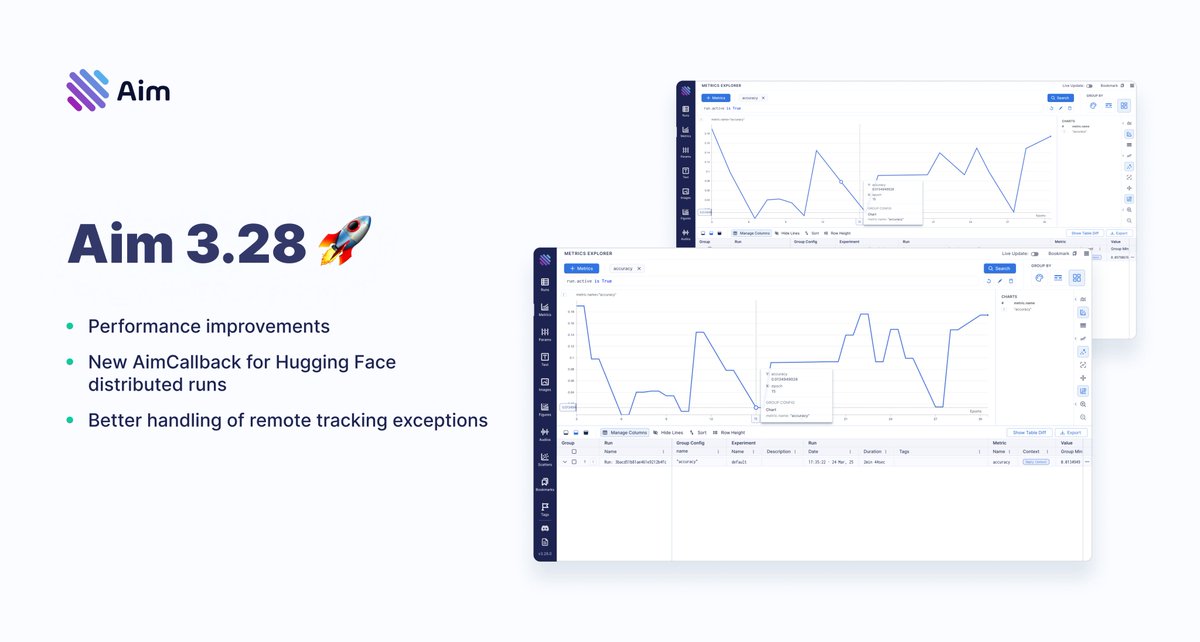
Aim 3.28 is out!!⚡️Key highlights:
- Performance improvements
- New AimCallback for Hugging Face distributed runs
- Better handling of remote tracking exceptions
🔗 Blog: https://t.co/Qr0j0F4M3b
🔗 Full changelog: https://t.co/GKCwIha9XH
What I love most about @aimstackio Reports:
Running snippets and getting charts in under 2 seconds, add my analyses, conclusions
- all in one place.
It’s a major upgrade from switching between training runs, Google Docs, exporting charts, and taking endless screenshots.
And yes, each report comes with a shareable URL—perfect for keeping your teammates in the loop!
But that’s not all—there's so much more you can do with Aim reports.
We know you’ve been waiting for this… 🤟
Docs: https://t.co/NRzYJzFGK1
Guide: https://t.co/z8BbGdjYDf
Iterating over analyses is an essential part of model training.
#ML engineers run many experiments, tweaking models and tuning hyperparameters.
This slows down the entire development process.
Reports make it easier to track the progress and see how models improve.
That's why we created Reports for you! 🎉
🖼️⏯️With simple commands you can retrieve images and audios from Aim storage.
You can also retrieve metrics, figures and texts and group them by color, stroke_style, row, column.
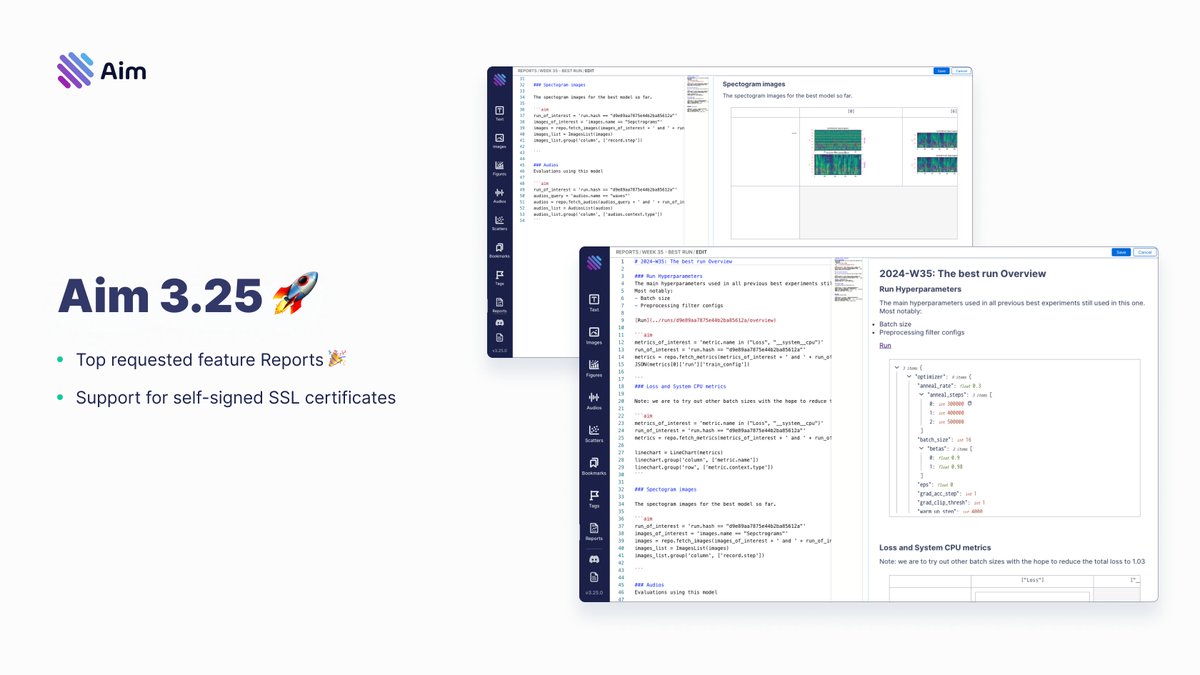
Hey all, Aim 3.25 is out! The top-requested feature —Reports—is now live! 🚀
Use Aim reports to showcase your work and iterate over the knowledge around it. And of course, do it with your collaborators.
Blog: https://t.co/cddxIAtGBX
Code: https://t.co/esR7vuA2um
Yeyy, we’ve hit another incredible milestone! 🎉
The Aim repo has crossed 5000 stars on @github !!
Huge thanks to our awesome community for the support.💜
If you haven’t yet, drop Aim a star and help spread the word! 🔁🌟 https://t.co/Hcfxj5LAsO
#opensource#MLops#ML#AI
Aim 3.23 is out! 🚀
This release is packed with amazing contributions. We’re lucky to have such a great community!! 🥰
THE CHANGELOG: https://t.co/kbJ8uoKUZl
🔧 Easy Setup:
1. Build a Docker image for Aim.
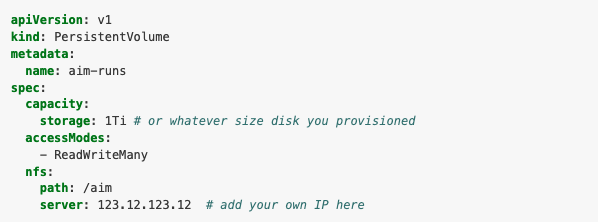
2. Provision a ReadWriteMany volume on your cloud provider.
3. Define your deployment with the volume mounted.
For detailed steps and code, check out the docs.
https://t.co/trxZMxt5Ds
#mlops#kubernetes#aimstack
🚀 Hosting Aim on Kubernetes (K8S) is a game-changer for ML practitioners!
1. All your training data and runs in one place, accessible to everyone in your org from everywhere
2. Aim runs can be centralized on a remote volume, providing additional support for remote model training and monitoring
3. Deployment to K8S abstracts away the Aim CLI, letting users focus on visualizations and applications without setup worries
#Kubernetes #MLops #Aim #experimenttracking #ml
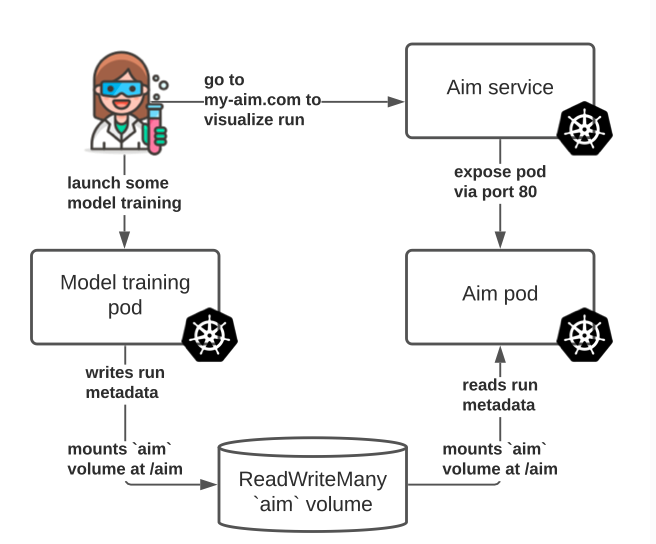
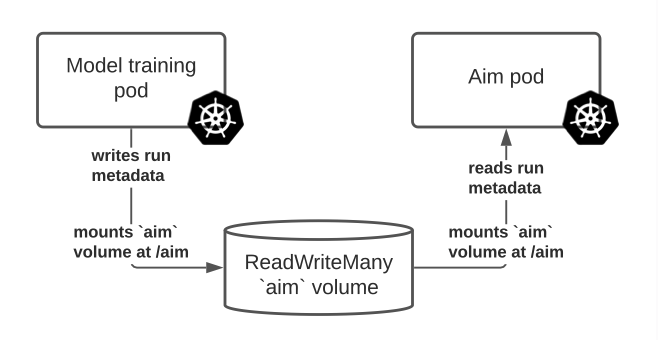
The core advantage of using a K8S volume to store Aim runs is that other K8S deployments can mount the same volume and store their runs on it.
This way, the core Aim K8S deployment can read the new runs and display them to users who want to visualize their results.
For example, one can have a deployment that performs model training and records Aim runs on the same volume mounted to the Aim deployment.
This model is illustrated by the following diagram:
You can also track distributions with Python code using the Aim API. The track_distribution() method takes two parameters: the name of the distribution and the value of the distribution.
Hint💡: Query distributions by step range and density.
2/2
👀Track the gradient, the weights and the biases across all layers with Aim.
Use the Distributions tab to:
- observe single runs,
- navigate between layers,
- search distributions by step.
1/2