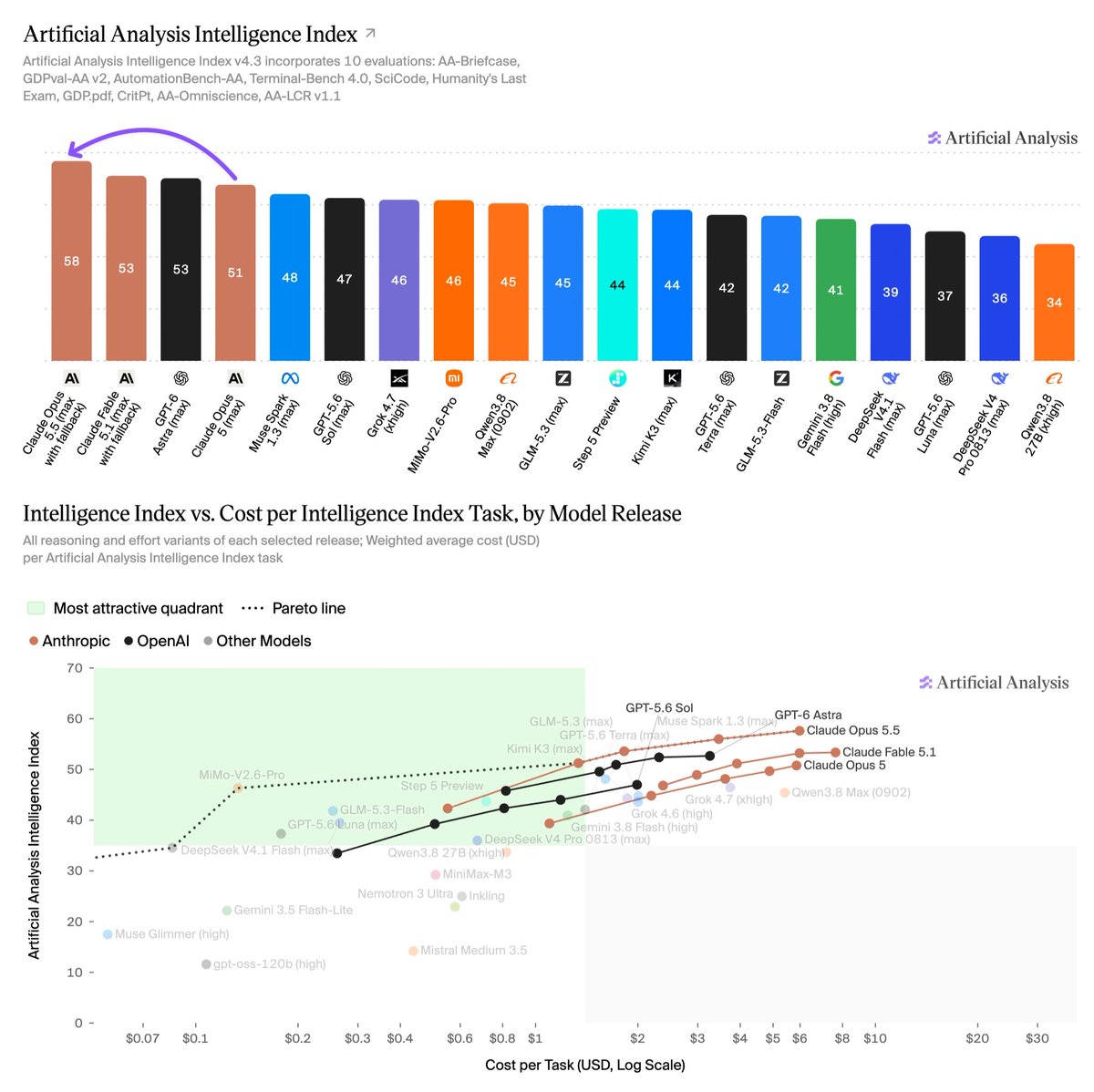
Claude Opus 5.5 takes the top spot on the Artificial Analysis Intelligence Index, along with a 20% price cut and larger cache hit discount
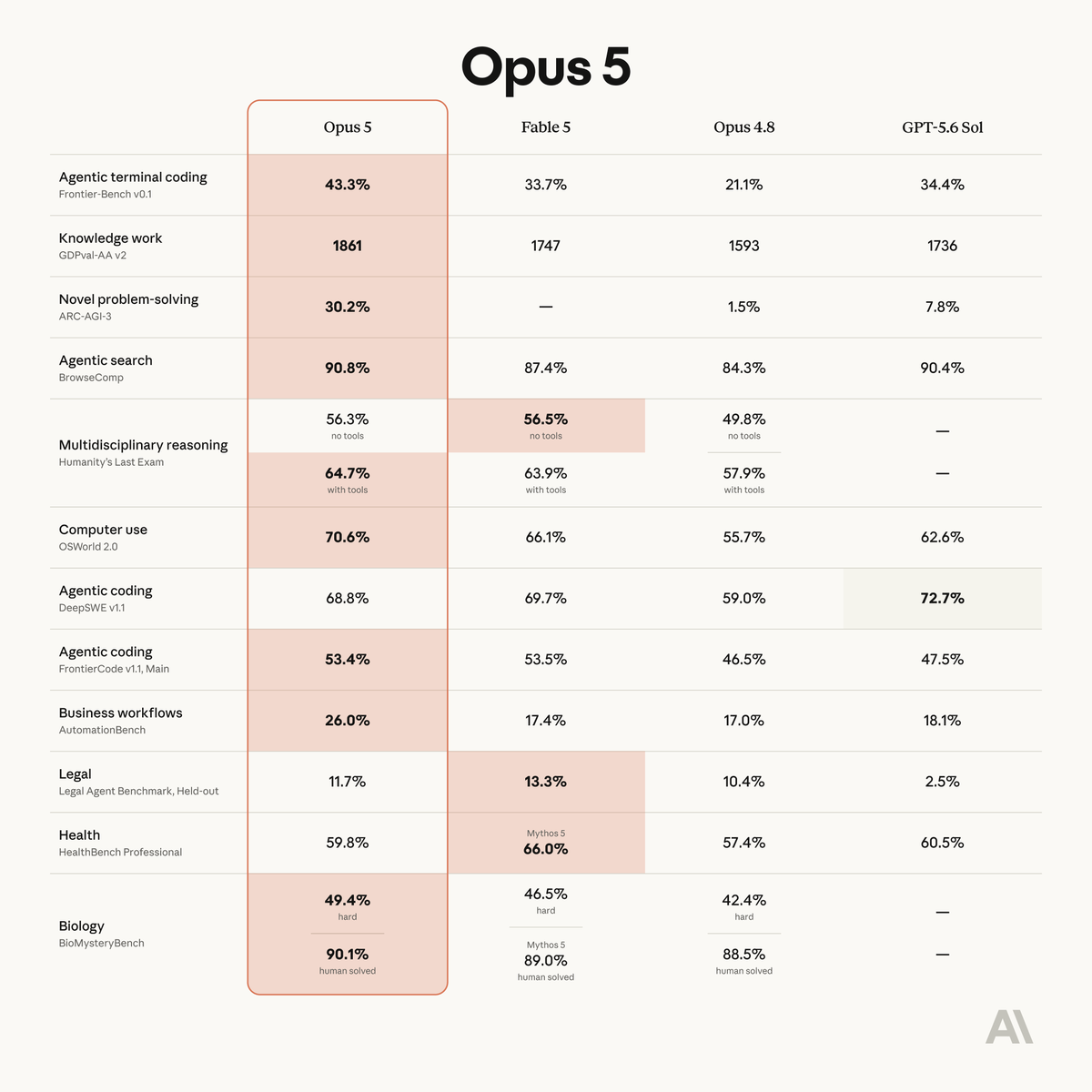
Claude Opus 5.5 brings Anthropic to parity with GPT-6 Astra on evaluations like Terminal-Bench 4.0 and AutomationBench-AA, while extending Anthropic’s lead in agentic knowledge work.
At max effort it scores 58 on the Artificial Analysis Intelligence Index, the highest score we have measured by several points. Anthropic has cut Opus pricing to $4/$20 per 1M input/output tokens (Opus 5: $5/$25) and cache reads from $0.50 to $0.20.
Key takeaways:
➤ Consistent strong performance, with leading scores on six of the ten Intelligence Index evaluations: Humanity's Last Exam 61.4% (previous best 59.1%, Claude Fable 5.1), SciCode 66.9% (63.1%, Fable 5.1), GDPval-AA v2.1, AA-Briefcase v1.1, AA-Omniscience and AutomationBench-AA. On Terminal-Bench 4.0 it scores 59.6%, level with the leader GPT-6 Astra (xhigh) and +11 points over Opus 5. It remains slightly behind on CritPt, AA-LCR, and GDP.pdf
➤ Leads in agentic knowledge work: On AA-Briefcase, our private frontier knowledge work evaluation, it reaches an Elo of 1822. This is +143 over Fable 5.1, ahead on both analytical quality and presentation, and is the first time Anthropic has reached presentation quality surpassing GPT-5.6 Sol. This evaluation tests whether models can produce accurate and well-presented professional outputs using our open source reference agent harness, Stirrup
➤ Level with Opus 5 on cost per task despite 1.6x the output tokens: Opus 5.5 (max) uses ~119k output tokens per Intelligence Index task, against ~73k for Opus 5 (max), ~78k for Fable 5.1 (max) and ~27k for GPT-6 Astra (max)
➤ Four of five effort levels sit on the Intelligence vs Cost per Task frontier: Opus 5.5 max, xhigh, high, and medium all sit on the Pareto frontier, costing less or outperforming other models scoring 50+ (GPT-6 Astra, Claude Fable 5.1, and Claude Opus 5)
Other model details:
➤ Context window: 1 million token context with image and text input support, unchanged from Opus 5
➤ Pricing: $4/$20 per 1M input/output tokens, down 20% from $5/$25 for Opus 5. Cache writes $5 per 1M tokens for the 5 minute TTL, down from $6.25. Cache reads have been further discounted to $0.20 per 1M tokens, down 60% from Opus 5’s $0.50. This is a 95% discount compared to uncached input pricing, up from 90% on previous Opus models
➤ Effort settings: Five effort settings (low, medium, high, xhigh, and max). Intelligence Index evaluations were run at all five with Anthropic's default fallback enabled
Claude Opus 5.5 is Crazy Good for web designers!
How is this even possible!!
Here's a 12-minute walkthrough on how to use Opus 5.5 to build $50k 3D Websites (step-by-step) 🙌
Introducing Claude Opus 5.5, the first model in our new Claude 5.5 family.
It performs at the level of Claude Fable 5.1 for most tasks, and costs 40% less to run than Opus 5.
okay Grok Bot is insane
it can:
- open a computer by itself
- log into all the apps, sites
- use websites like me (human)
- work while you’re asleep
- clean my inbox, reply to support emails
- research news on X, LinkedIn, and Google
- write LinkedIn, X drafts in my style
- remember how I write, pick content
- learn a workflow after watching me once
- run that workflow forever
- coordinate with other bots
- only bother when it needs a decision
and I'm still finding new stuff it does 😭
this isn't "AI assistant" anymore. this is like "hiring an intern, they became COO by Tuesday"
@spacexai COOKED
In this article, I cover setting up Grok Bot, use cases, plugins, and what makes Grok Bot so good
Claude Code creator Boris Cherny ( @bcherny )
"For people who aren’t building agentic products but are using Claude Code, every 6 months, delete your claude.md file, delete your skills, and delete your hooks. Then see what the model does. It might surprise you.
For Opus 5, we strongly recommend trying to delete all of these things because the model may no longer need the extensive instructions that were necessary for previous models."
- at Y Combinator Startup School 2026.
----
From "Y Combinator" YouTube channel, (full video link in comment)
New in Claude Code: your sessions can now message each other.
Instead of having to re-explain yourself in another session, you can now tell Claude to do it. It sends a summary (not your history or files), and the other session picks it up mid-task.
More time to create more videos: You now have until August 11, 2026 at 11:59pm PT to create 10 Gemini Omni videos at no cost in the app or on web. Have fun!
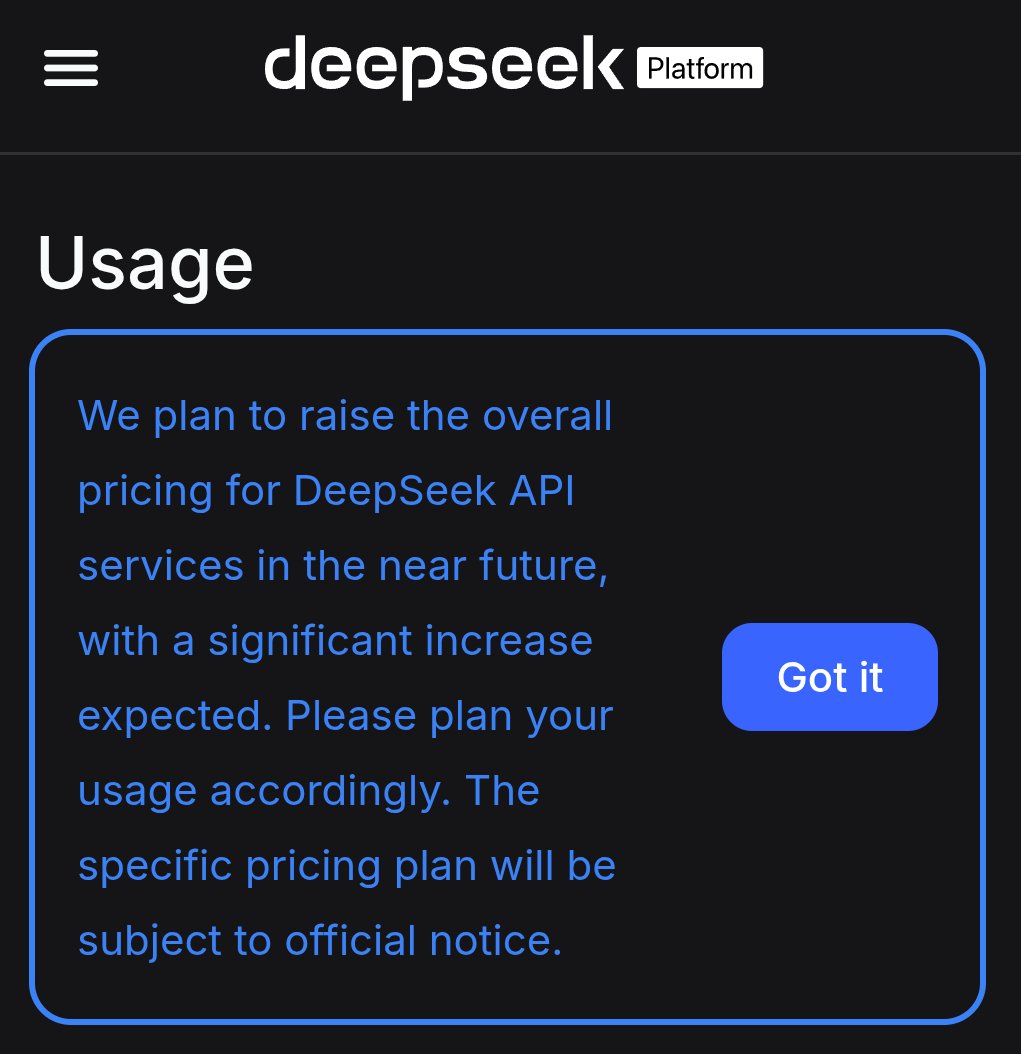
DeepSeek officially announced API pricing is going up “significantly”
That the cheapest near-frontier model on the market, at roughly 3 cents a task, is about to cost a lot more.
It landed a week after DeepSeek-V4-Flash-0731 shipped. Currently it ranks 2nd among open-weight models, behind only Moonshot AI's 2.8T-parameter Kimi K3.
The rates today are 14 cents/28 cents per 1M input / output, about 105X cheaper per task than Claude Fable 5.
Then demand broke the arrangement.
The new checkpoint became the fastest growing model ever by token usage on Ollama, which is now adding capacity across the US and Europe.
Serving that much traffic at a price built to prove a point stops working once everyone concedes it.
But now, the timing of this price increase invites trouble, because Meta's Muse Spark and OpenAI's GPT-5.6 Luna now match it on both capability and price.
Claude Code subscription is 81x cheaper than its API. Codex subscription is 44x cheaper than its API.
I max out 4 Max accounts last month and burned 56.5B tokens from plans, so I tested the ceiling — what a subscription gives you when you take everything it will give.
Claude Code — $400 paid, $32,310 of API
Codex — $400 paid, $17,609 of API
$800 in, $49,919 out.
$49,119 subscription subsidy.
They are insanely generous, even cheaper than Deepseek v4 Pro in effective pricing.
I am impressed. Do they even make money?
This guy explained agent harness, memory, and loop engineering in one video - clearer than most paid courses
a raw LLM with no harness is a wild horse. all power, no direction
> trace the run -> score it with an LLM -> diagnose the bottleneck -> patch it -> ship it
that loop is what lets an agent get sharper on its own, run after run
memory + harness + loop engineering + evals - that's the whole stack in one picture
watch it, then grab the diagram below
Build Slides with Kimi Work - Tutorial #1.
Kimi Slides handles the entire slide-building process:
- Clear structure and research, powered by Kimi K3
- Cohesive design, including polished charts and SmartArts
- Editable and ready to download
Let us know what you'd like to see next in the comments!
from prompt → context → harness → loop → graph engineering.
the list keeps growing, and every new term gets treated as a replacement for the last one. each layer wraps the one before it, and the cleanest way to tell them apart is to ask what a single unit of work looks like.
𝗽𝗿𝗼𝗺𝗽𝘁 𝗲𝗻𝗴𝗶𝗻𝗲𝗲𝗿𝗶𝗻𝗴 𝗶𝘀 𝘁𝗵𝗲 𝗺𝗲𝘀𝘀𝗮𝗴𝗲.
the model remembers nothing before this call, so the prompt has to carry the full universe of what it needs. a role, the background, the instructions, a few examples, a format.
when the output falls short, the skill is working out which ingredient let you down, not rewriting the instructions every time.
the unit of work is one input.
𝗰𝗼𝗻𝘁𝗲𝘅𝘁 𝗲𝗻𝗴𝗶𝗻𝗲𝗲𝗿𝗶𝗻𝗴 𝗶𝘀 𝘁𝗵𝗲 𝗺𝗲𝗺𝗼𝗿𝘆.
across many steps the window is finite and the available information is not, which forces a curation step. a curator keeps what matters, compresses what is useful but bulky, and drops the rest.
good curation is mostly about knowing what to throw away, not packing more in.
the unit of work is what stays in the window.
𝗵𝗮𝗿𝗻𝗲𝘀𝘀 𝗲𝗻𝗴𝗶𝗻𝗲𝗲𝗿𝗶𝗻𝗴 𝗶𝘀 𝘁𝗵𝗲 𝗺𝗮𝗰𝗵𝗶𝗻𝗲.
on its own a model just generates text. the harness gathers what it needs, runs it, calls tools or sub-agents, and verifies the result with tests or a judge.
that verify step is the entire difference between calling an api and running an agent.
the unit of work is one pass through the machine.
𝗹𝗼𝗼𝗽 𝗲𝗻𝗴𝗶𝗻𝗲𝗲𝗿𝗶𝗻𝗴 𝗶𝘀 𝘁𝗵𝗲 𝗿𝘂𝗻.
one pass rarely finishes the job, so something has to decide whether to run the machine again. that decision needs a goal defined upfront, brakes like max iterations and budget caps, and a completion check that is automated rather than felt.
an agent that stops asking for tools has ended its turn, which is not the same as finishing the task.
the unit of work is the whole run.
the diagram covers those four. here is the fifth.
𝗴𝗿𝗮𝗽𝗵 𝗲𝗻𝗴𝗶𝗻𝗲𝗲𝗿𝗶𝗻𝗴 𝗶𝘀 𝘁𝗵𝗲 𝗰𝗼𝗼𝗿𝗱𝗶𝗻𝗮𝘁𝗶𝗼𝗻.
once several loops have to work together, you need to say what runs when, what runs in parallel, and who checks whom. nodes do the work, edges decide what runs next, and shared state flows between them.
a single loop is just a one-node graph with an edge pointing back at itself, which is why graphs govern loops instead of replacing them.
the unit of work is the whole job.
here is the part that ties it together.
prompt and context both live inside the harness gather step. the harness is one pass, the loop decides whether to run that pass again, and the graph decides which loops run at all.
zoom out and the unit of work gets bigger. zoom in and you are back at the prompt.
that also tells you where to debug. find the layer whose unit of work broke, then fix that layer.
the prompt is the easiest layer to edit, which is why it keeps taking the blame for failures that live three layers up.
i also published this deep dive on graph engineering, covering the core idea, how to get started, shared state, routing you can trust, and when a graph is genuinely overkill.
the article is quoted below.