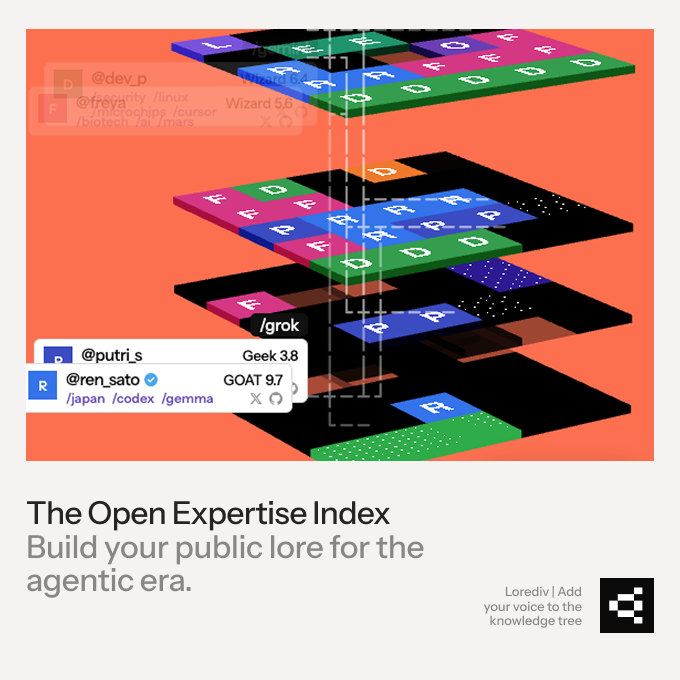
i’m currently building @lore_div_ , it's a public index of expertise, structured data for the agentic era, organized as an open knowledge tree.
Check it out here https://t.co/jCyhzEkvc0, beta release soon!
your msm was so funny, but idont think it's accurate. there is room for all kinds of personalities. not all of us "can be cool" for everybody... imo, the ideal is to be natural, in harmony with your fkin flow. whether u are cool or not is up to the observer, it's not for us to decide
I think everything has evolved. Even money has had its different versions, we could say it started at version 0.1, and now we’re on a different version... Anyway, the web has gone from Web 1.0 to Web3, and communication has shifted from a centralized TV model to something more streamer-driven.
So, what about the fkin SPAM? It needs to evolve too. There’s something inherently valuable in it, because even Elon Musk spams everyday, and, in a way, every startup or project needs to do some kind of outreach.
But that comes with a high risk of getting blocked, because SPAM can be annoying. No one can deny that. Your inbox is full of spam, even from OpenAI, X, Google, and so on, and we all hate getting it.
Well, I think it’s time for SPAM to evolve. I believe that combining context with spam could create something genuinely useful for the person promoting their product. But even if this new kind of spam is public, it should work differently from just dropping a flyer in someone else’s mailbox. We need to make spam genuinely valuable. And I think I’ve had an idea that I’m going to implement in @lore_div_ to explore what Spam 2.0 could look like.
Spammers im working for you now, stay tuned and follow lorediv
who gave this guy the permission to create a blocklist of fellow builders? 😭
if you don't like someone, just block them. That's your choice.
but why create an entire list and publicly label people?
there are so many innocent builders on that list who did absolutely nothing wrong.
you don't get to decide who deserves to be part of the community.
this is supposed to be a place where builders support each other, not blacklist each other.
The @lore_div_ stack and what each layer taught me:
1️⃣ Product
Idea → design → brand → domain.
-Design, structure and plan must be complete before the first line of code. Hardest phase, most notes for next time.
2️⃣ Frontend
React 19 · TypeScript · Next.js 16 (App Router).
-Server rendering, strictly typed, one process.
3️⃣ API
tRPC v11 — end-to-end type inference, no schema generation step.
-Restarted several times before starting from zero. Internal communication is vital.
4️⃣ Data
PostgreSQL + Drizzle ORM (typed queries, migrations from the schema). Redis for caching and rate limiting.
-Every column change means reviewing everything. Design the database before writing code.
5️⃣ Auth
Auth.js v5 — X · Google · GitHub OAuth, JWT sessions, role-based access.
-The most delicate part: you never feel fully sure it is secure.
6️⃣ Monorepo
apps: landing (static) · docs (Docusaurus) ·
frontend (Next.js) · moderation (Next.js, separate
app) packages: shared (schema, types, validators) ·
server-core (db, redis, visibility, moderation)
-Each surface is its own app, and shared logic lives
in packages. One source of truth avoids duplicated code.
7️⃣ Discoverability
Every public page ships in three formats: HTML for reading, Markdown for documents, JSON for machines. Plus a WikiLinks vault one .md per idea, wired with [[links]] — that drops into any local wiki.
An llms.txt index so an agent finds the map before it crawls.
- Building for humans, agents and search engines from day one, not retrofitted.
8️⃣ Legal
Terms, privacy, cookies, ads, agents, shipped with the app, not bolted on later.
9️⃣ Ingress
Cloudflare for DNS, proxy and WAF. TLS at the edge.
-The origin publishes no inbound web ports at all.
🔟 Runtime
Caddy for host-based routing. Docker Compose for the stack. One Linux VPS.
-One compose file defines the whole environment, so it is reproducible.
1️⃣1️⃣ Security
Layered on purpose: each layer assumes the others can fail.
1️⃣2️⃣ Operations
Automated backups, alerts, and manual, controlled releases.
-Simple and easy to reason about.
1️⃣3️⃣ Testing and beta
Vitest across the unit layer, then QA, then a private beta behind an access gate.
The lesson that repeats: design first, and write down the internal contracts before you type.
Almost there! Before I open the beta, I’d really appreciate your wisdom. What’s on your pre-launch checklist? Anything you learned the hard way?
Any tip is welcome. I’m all ears
If it's a pending task for Google, in general, they have a very diversified universe, and they don't really need such an exaggerated level of diversification. It creates layers upon layers of nested products, and it makes everything feel a bit like spaghetti... It happens with practically their whole brand. I'm sure Google's next big rebrand will make it more compact, but they have a lot of work to do.