JEV + Opus 5.5 is insane for building a company brain...
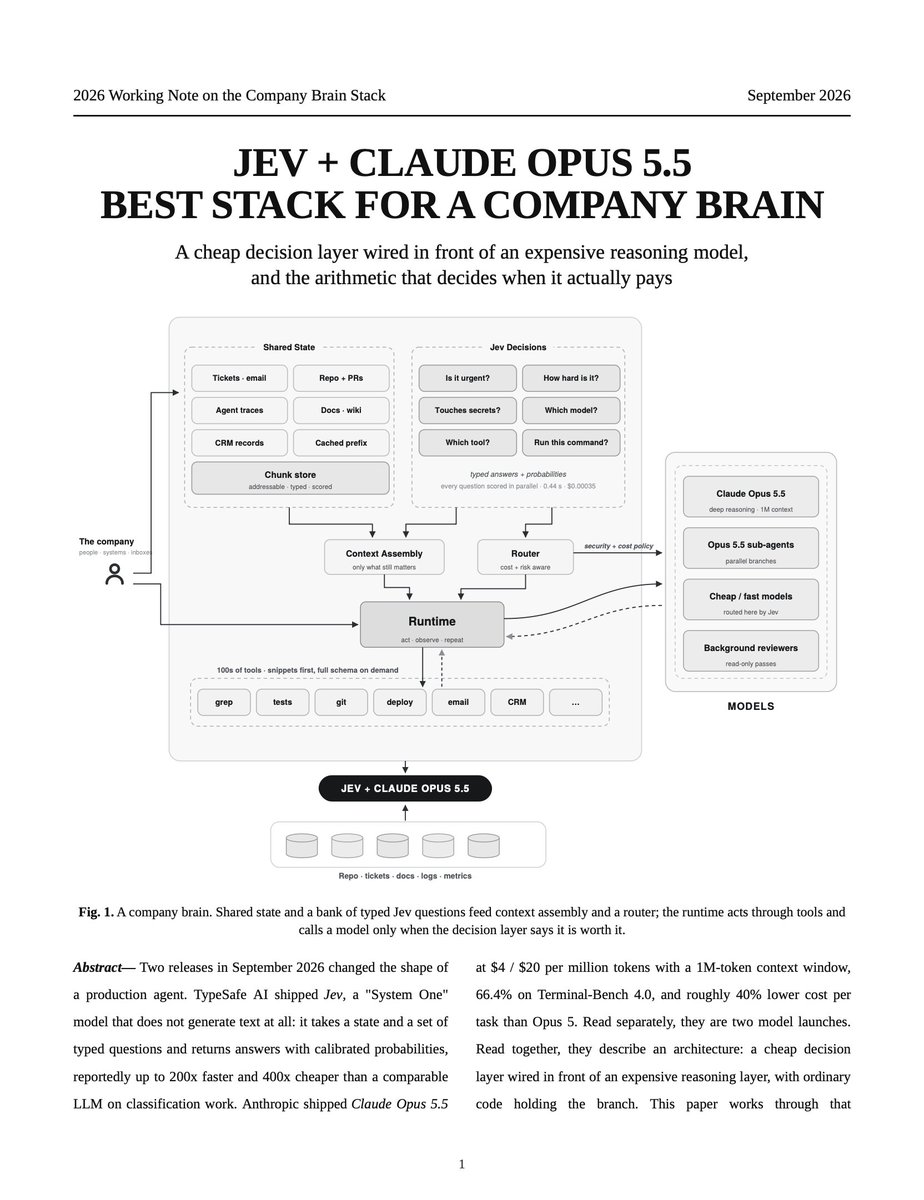
I collected the whole architecture from TypeSafe and Anthropic docs into a 14-page PDF.
Here are the 10 steps:
step 1 → meet the pair: Opus 5.5 thinks, Jev decides, your code holds the branch. two models, one loop, no prompt in the middle
step 2 → stop asking a text generator for a boolean: Jev takes a state and returns a typed answer with a calibrated probability in 0.44s for $0.00035
step 3 → ask everything at once: Choice, Score and Noul all evaluated in parallel, so the fourth question costs almost nothing. ask what you might need, not what you can afford
step 4 → branch on the number: 0.999 is not text you parse, it is the if statement. ~99% of turns end here and never become a generation call
step 5 → stop routing blind: Opus 5.5 → Sonnet → 5.5 costs 5.84 vs 3.32 for pure 5.5, because handing back reprocesses the whole context
step 6 → keep one context warm instead: cache reads at $0.20 per Mtok are 20x cheaper than loading fresh. route work, not context
step 7 → escalate, don't delegate: the hard 1% goes to Opus 5.5 with 1M context, 128K output and 66.4% on Terminal-Bench 4.0. pay for thinking, not plumbing
step 8 → score every chunk per query: keep whole, summarize, or drop. context stops being a transcript you append to and becomes something rebuilt each turn
step 9 → gate the command, not the intent: classify the concrete bash call before it executes. the auto-mode that lived inside closed harnesses, now in your own code
step 10 → judge 100% of runs: $3.50 a day for 10,000 traces, variance 92-913x lower than an LLM judge, and it matched the human label on all 500 decisions
the result: a while loop that pays a frontier model for every small decision becomes a brain that spends a third of a cent to notice and spends properly to think
Copy the complete 14-page company brain blueprint, then read the full 10-step roadmap below ↓
I still don't understand why people are still building agents as a straight line
you write "do A, then B, then C." half those steps never needed to wait on the one before them. you just paid for the wait anyway, every single run
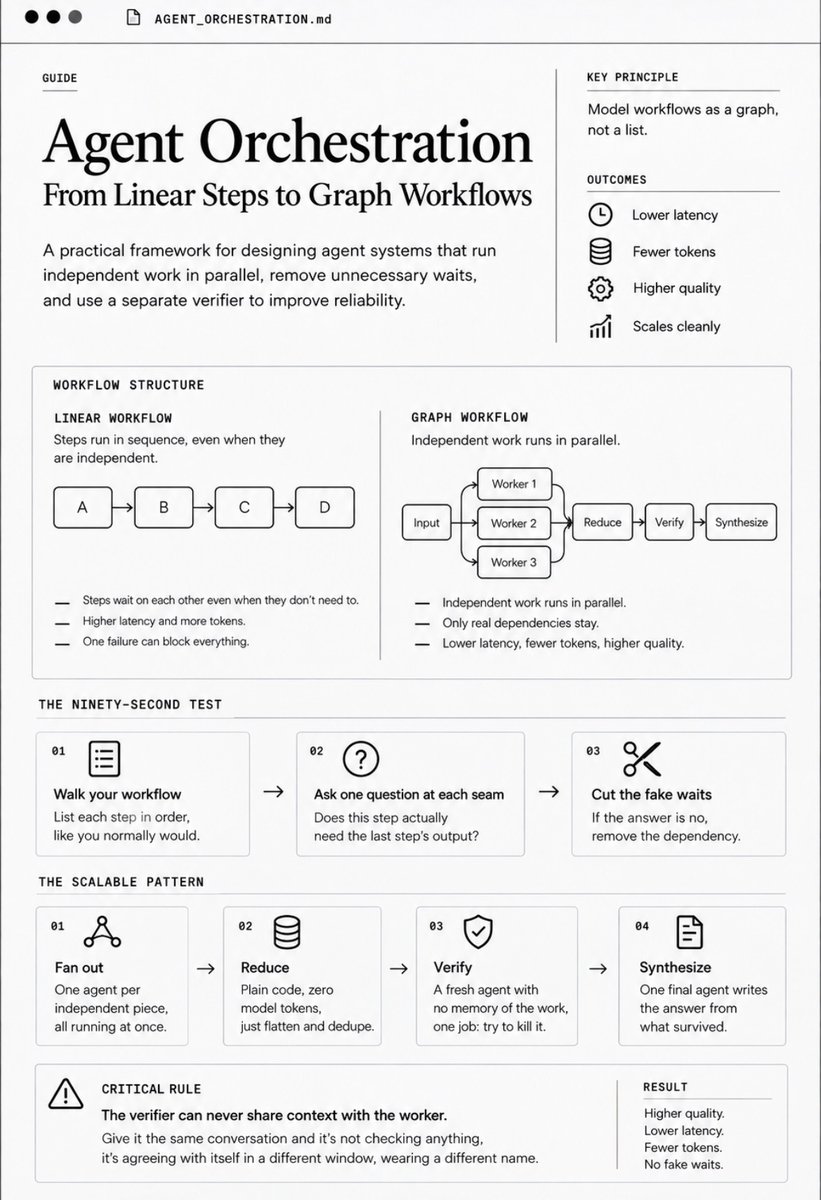
one test tells you everything, ninety seconds, before you write a single line of orchestration code:
walk your workflow step by step → ask one question at every seam → does this step actually need the last one's output
if yes → keep the order, it's a real edge
if no → cut it, that wait was fake and cost you nothing but time, on purpose, this whole time
now split what's left into the pattern that actually scales:
fan out → one agent per independent piece, all running at once
reduce → plain code, zero model tokens, just flatten and dedupe
verify → a fresh agent with no memory of the work, one job: try to kill it
synthesize → one final agent writes the answer from what survived
here's the part that breaks every setup people skip:
the verifier can never share context with the worker → give it the same conversation and it's not checking anything, it's agreeing with itself in a different window, wearing a different name
one rule, no exceptions → worker and verifier, separate context, always
most people build the fan-out, call it done, and never notice the thing checking their work has been the exact same hand the entire time
ninety seconds to run the test. you never queue a fake wait again
If you are trying to understand where AI agents are going, learn harness engineering.
A capable model is only one part of an agent system. Once the model begins reading files, calling tools, modifying state and working across many steps, the quality of the system depends increasingly on the software around it.
Consider a coding agent working through a large repository. The model can decide that it needs to inspect a file, search for a symbol, make an edit or run a test, but those decisions do not execute themselves.
The surrounding runtime has to decide which resources are available, whether the requested action is permitted, how the operation should be performed, what result should be retained, and what information should be presented to the model on the next step.
This becomes harder as the run gets longer. As history accumulates, replaying everything can become costly and less effective. The harness has to decide what should remain in context, what should be summarized or retrieved later, and what belongs in persistent state outside the context window.
Execution has similar problems. A long-running agent may need to survive an interruption, avoid repeating completed work, enforce permissions around consequential actions, and preserve enough history to reconstruct what happened when the final result is wrong.
These are harness problems.
The harness is the layer that manages context, tools, execution, state, checkpoints, limits and traces around the model.
Harness engineering is the work of designing and improving that layer. Engineers inspect execution traces, evaluate agents on representative tasks, look for recurring failure modes, and then change things such as context selection, tool interfaces, state handling or execution controls.
That last part matters because agent failures are often not fixed by changing the model. Sometimes the useful change is in what the model sees, how a tool is exposed, what state is preserved, or what the runtime does after a failed step.
As agents take on longer tasks, the demands on this surrounding software grow. Model capability remains essential, but harness engineering is what turns that capability into an execution process that can be controlled, inspected, tested and improved.
Harness engineering is the most important AI skill you can learn right now
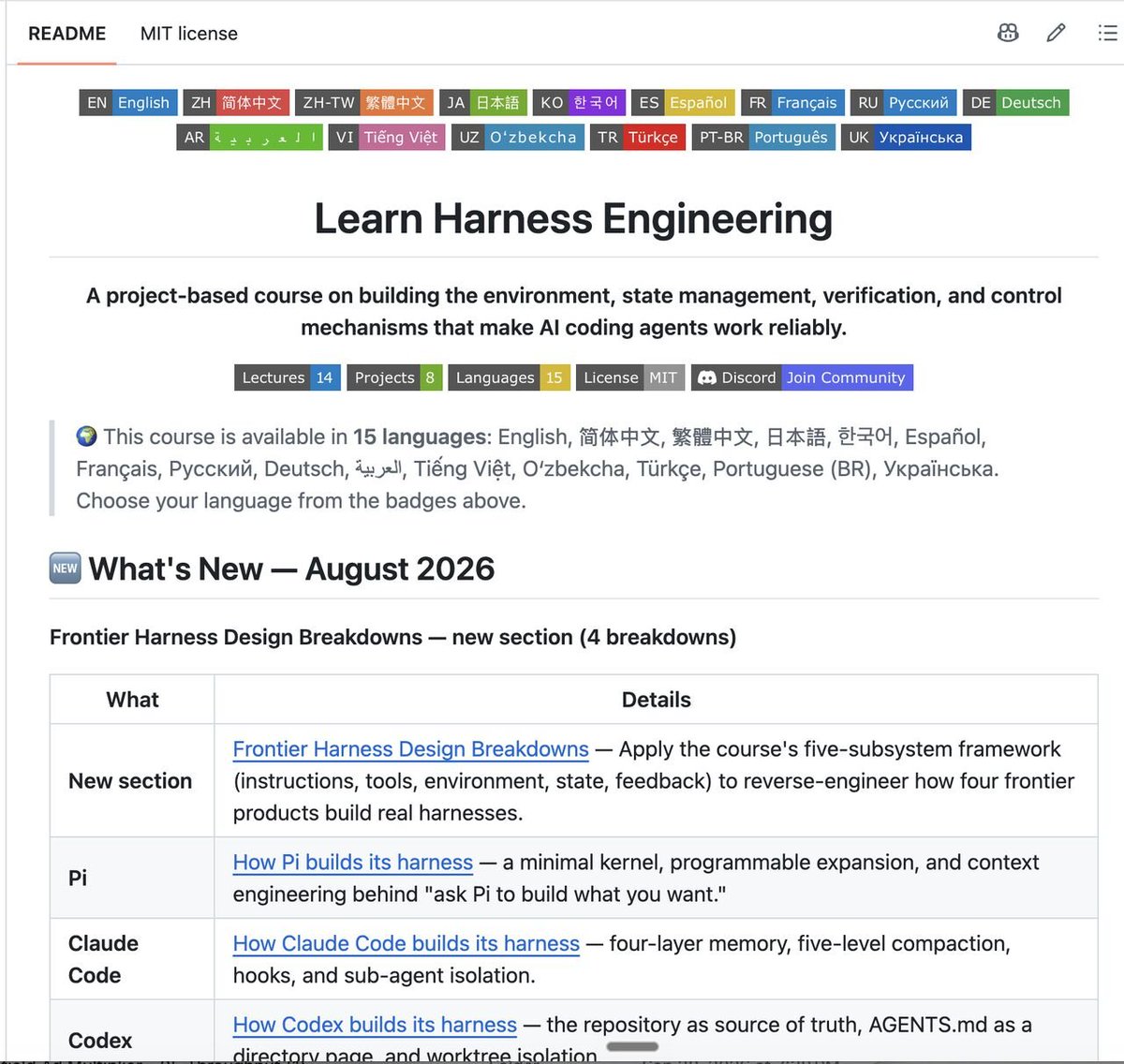
And someone just open sourced a full course on it. Free
Anthropic ran an experiment. Same model (Opus 4.5), same prompt: "build a 2D retro game editor"
No harness: $9, 20 minutes, didn't work
Full harness: $200, 6 hours, a game you could actually play
The model didn't change. The environment around it did
That's what this course teaches. 14 lectures. 8 hands-on projects. 15 languages. 15.4k stars on GitHub
You build one real app the whole way through (an Electron knowledge base) and watch your agent go from breaking tests and saying "done" to verifying its own work before it stops
Here's what I'd do if I were you:
1. Grab the 4 starter files from the resource library (AGENTS .md, init .sh, feature_list.json, progress log) and drop them in your project tonight
2. Run their audit-harness .sh script on your repo. It checks you against all 5 harness subsystems
3. Install the harness-creator skill and have it scaffold a proper harness for you
4. Read the breakdowns of how Claude Code and Codex build their own harnesses
5. Do Project 01. Run the same task prompt-only vs rules-first. Seeing the difference will change how you build forever
Everyone is fighting over which model is best
The people winning are building better harnesses around whatever model they have
GitHub repo: https://t.co/rAVOMIs8MF
I still don't understand why people are still explaining themselves to AI from scratch every single day
a hundred times this year, you told it who you are. a hundred times, it forgot
five minutes fixes this:
create a folder → name it raw → drop in any source, article, transcript, PDF, voice memo
tell the model to read it once → link it to everything already there → never touch it again
create one more file → name it CLAUDE.md → who you are, what you're building, what already failed
now every session starts here → the model reads it automatically → before you type a single word
ask it anything across everything you've ever fed it → it answers from months of compiled understanding → not from zero
most people quit around month one → nothing looks like it's working yet → that's exactly where the value starts
five minutes to set up. you never explain yourself from scratch again
Graph Engineering became the default way every serious team builds agents now, and here's what people have already shipped with it
if you want to actually draw the graph instead of guessing, copy this:
LangGraph - the framework behind Uber, Replit, LinkedIn, and GitLab's own production agents. models every workflow as nodes and edges with conditional branching, the exact vocabulary that makes fake edges impossible to hide
https://t.co/O9l4KMrfmz
CrewAI - role-based multi-agent teams with async execution. 47,000 stars, 5.2 million monthly downloads, no LangChain dependency since version 1.14
https://t.co/DoY7bpLp7j
crewAI-examples - the self-evaluation loop flow example is the one to clone first: a working verifier pattern you can read end to end before you build your own and get it wrong the first time
https://t.co/16yKmAf6HG
open-multi-agent - TypeScript-native, three runtime dependencies, nothing else. one runTeam() call decomposes a goal into a task DAG, resolves every dependency, and runs the independent pieces in parallel without you drawing a single node
https://t.co/2HIlOPd7G6
AutoGen - Microsoft's event-driven framework, merged with Semantic Kernel for production. the conversation-based model that taught half the industry exactly what a shared-context failure looks like, the expensive way
https://t.co/p2Uvq9BUqo
Google ADK - modular agent dev kit with native Gemini and Vertex AI integration, built for teams that refuse to run the graph anywhere they don't already trust the infrastructure
https://t.co/cQUnOo5mQ6
Mastra - the TypeScript entrant carving out ground the bigger frameworks ignored, built specifically for graph control without Python's weight sitting on top of it
https://t.co/aHtdHOBtBD
none of these frameworks fix a bad graph for you. they only make it visible the moment your worker and your verifier have been sharing the same context the entire time
full build in the article, then run the fake-edge test before you wire up an eighth
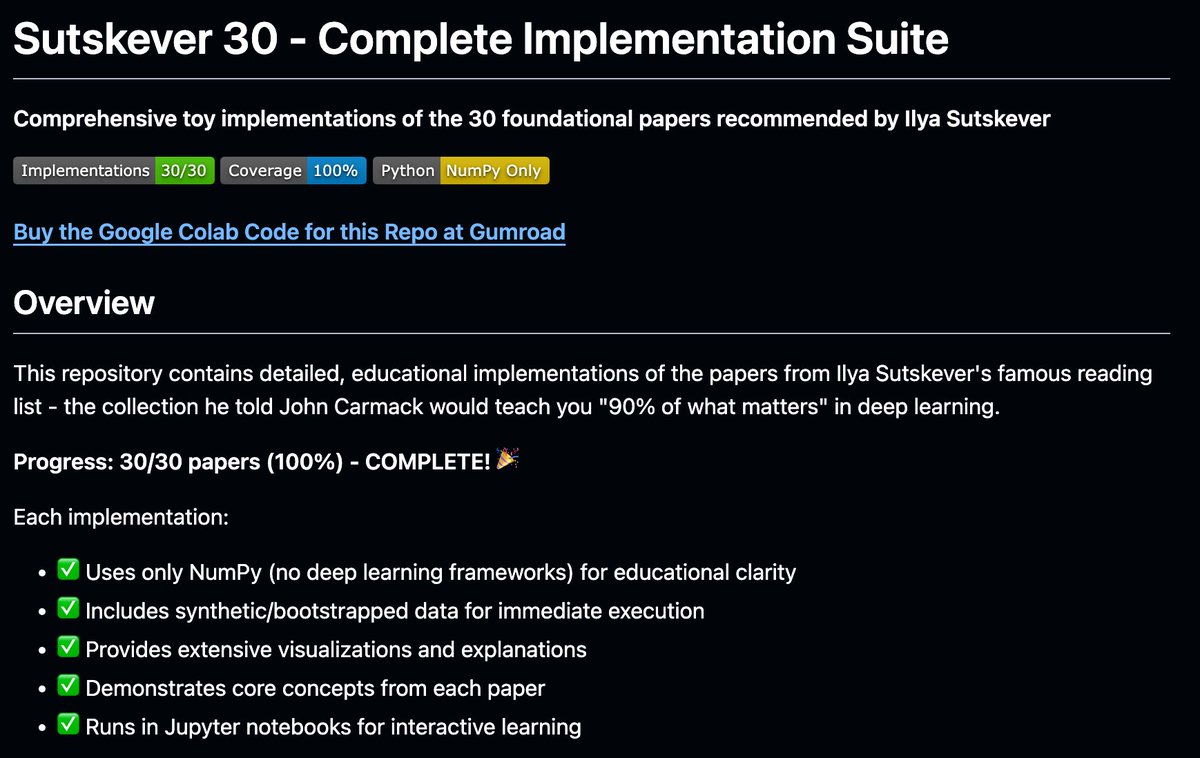
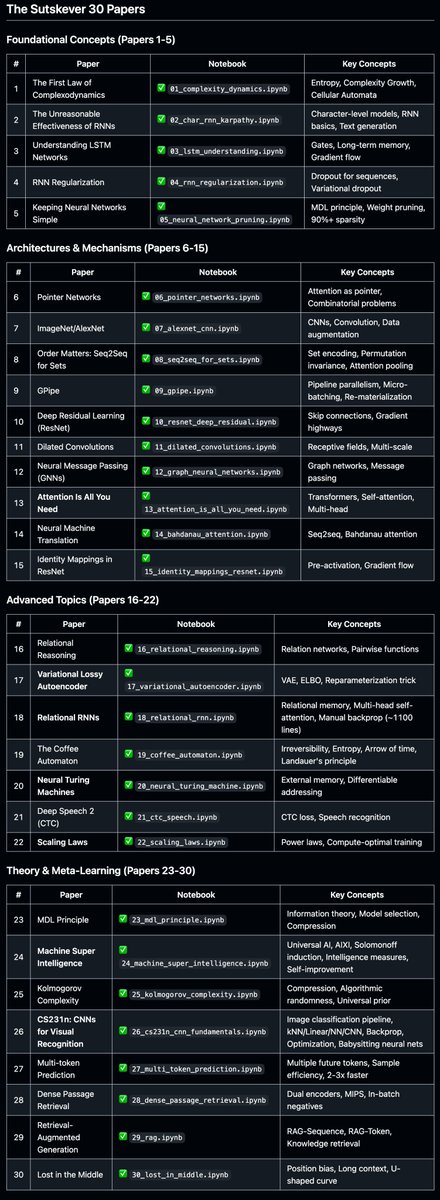
Ilya Sutskever said: learn these 30 papers and you know 90% of what matters in AI.
this repo rebuilt all 30 in pure NumPy, No PyTorch, No TensorFlow, Just notebooks you can run.
- RNN
- LSTM
- Transformer
- ResNet
- VAE
- AIXI.
Ilya’s reading list, now executable.
Every paper in Jupyter, Synthetic data included,
Zero DL frameworks.
- https://t.co/GEAzryNQxm
She is 17 built one agent with Opus 5.5 and Anthropic wrote a check for $4.8M - and came to Stanford to show how to do it from scratch:
00:12 - how Opus 5.5 builds a $3.8M agent in one evening
43:34 - 2 agents replaced 440 Anthropic engineers
52:47 - from first prompt to a $3.8M check from Anthropic
after watching I spent 60 minutes building my first agent with Opus 5.5 - it cut my workday by 90% and a week later I got a $120k check from Anthropic:
save & watch - article below on how to go from one prompt in Claude Code to an agent people pay millions for.
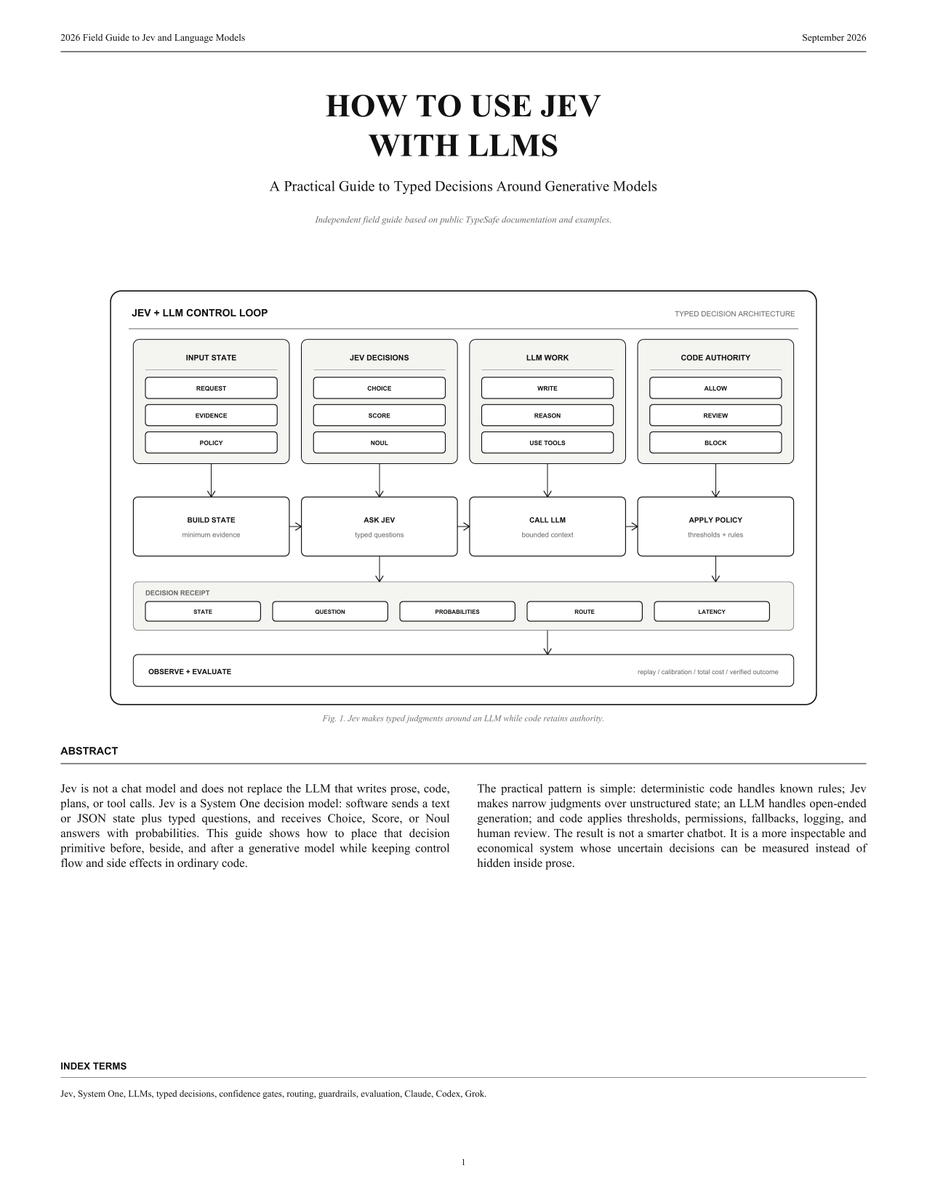
Jev Founder, Diogo Almeida, just released a 12-page PDF on how to use Jev with LLMs
It is more useful than most paid AI courses:
this is a 10-step blueprint on how to build a faster, cheaper and more controllable AI system around Claude, Codex, Grok or any other LLM:
step 1 → split the responsibilities: the LLM generates, Jev makes bounded semantic decisions and deterministic code keeps authority
step 2 → build the state: give Jev the current request, relevant evidence, policy and proposed action instead of sending the entire conversation
step 3 → choose the right primitive: Choice selects a route, Score evaluates an ordered rubric and Noul returns the probability that a statement is true
step 4 → replace giant evaluation prompts with atomic questions: intent, urgency, evidence, risk and scope become separate typed decisions
step 5 → put Jev before the LLM: select the context, tools, provider and workflow before paying for an expensive generative call
step 6 → give the LLM a bounded job: once Jev selects the route, the model receives only the instructions, files and tools required for that branch
step 7 → put Jev after the LLM: check whether the result answers the request, uses sufficient evidence and stays inside the permitted scope
step 8 → route by confidence: high-confidence low-risk cases proceed automatically, uncertain cases request more context and consequential actions go to review
step 9 → batch independent decisions: ask multiple Choice, Score and Noul questions over one shared state instead of creating another LLM call for every judgment
step 10 → record the complete decision receipt: state version, question, probabilities, selected route, model, latency, outcome and human override
most AI courses teach you how to write a bigger prompt
this 12-page guide teaches you how to build the control system around every prompt
the result: smaller contexts, fewer unnecessary LLM calls, safer tool execution and decisions you can actually inspect, test and improve
Send this PDF and the original Jev article to Claude Code or Codex and start rebuilding one expensive LLM decision at a time ↓
@Badie912@HyperliquidX@BitMNR@fundstrat Palantir is a 10000x better investment than Bmnr(not Eth). Their ontology based product is bridging ai with the business domain and they have no competitor other than Microsoft Fabric(which is a joke compared to Palantir). $ETH is great. $BMNR is a watered down version of $eth
@classicray_@BMNRTracker he needs to focus on creating investor value once in a while instead of using them as cash machine. 5% made sense but 10%, 15% are bs