It was a pleasure to join a panel of industry experts yesterday for the Saving Housebuilding event jointly held by @Savills and Public First. It is no surprise that a man made housing crisis in Britain over the last 10-20yrs is having generational implications.
Unless you have rich parents - your options are to either move very far away from where you grew up as I did, or stay living with mum and dad in your 30s. It doesn't have to be this way.
Economic arguments about supply can work too, especially with people already supportive of development, but they’re less persuasive in abstract terms.
Affordability needs to sit at the centre of the argument for new homes.
Full research here: https://t.co/v5sliFJltY
Affordability is the biggest untapped opportunity to build support for new homes.
New Public First research finds 46% of the public see making housing more affordable as the main potential benefit of housebuilding.
https://t.co/v5sliFJltY
The messages that work best are local and tangible:
• helping young people stay in the area
• supporting first-time buyers
• creating jobs and apprenticeships locally
This holds for mobilising support and softening opposition, with some differences.
@s8mb I wrote at the start not all YIMBYs are the same - eg I have seen some argue against cutting AH targets. The broader q - and purpose of my piece - is whether YIMBYS channel their efforts on the things that would make most difference to building, particularly in the next few years
YIMBYs reshaped the housing debate. But if we’re honest they've done more to influence elite thinking than increase housing delivery.
To make a difference they need a broader approach - focusing more on demand, viability, real schemes and cost of living.
https://t.co/47uDtoSGGu
The rent is too damn high.
And in much of England, we’re not building enough homes.
Targets alone won’t fix it.
We need to raise the baseline rate of development and persuade voters that supply lowers costs.
New piece: https://t.co/RKJZlAN27s
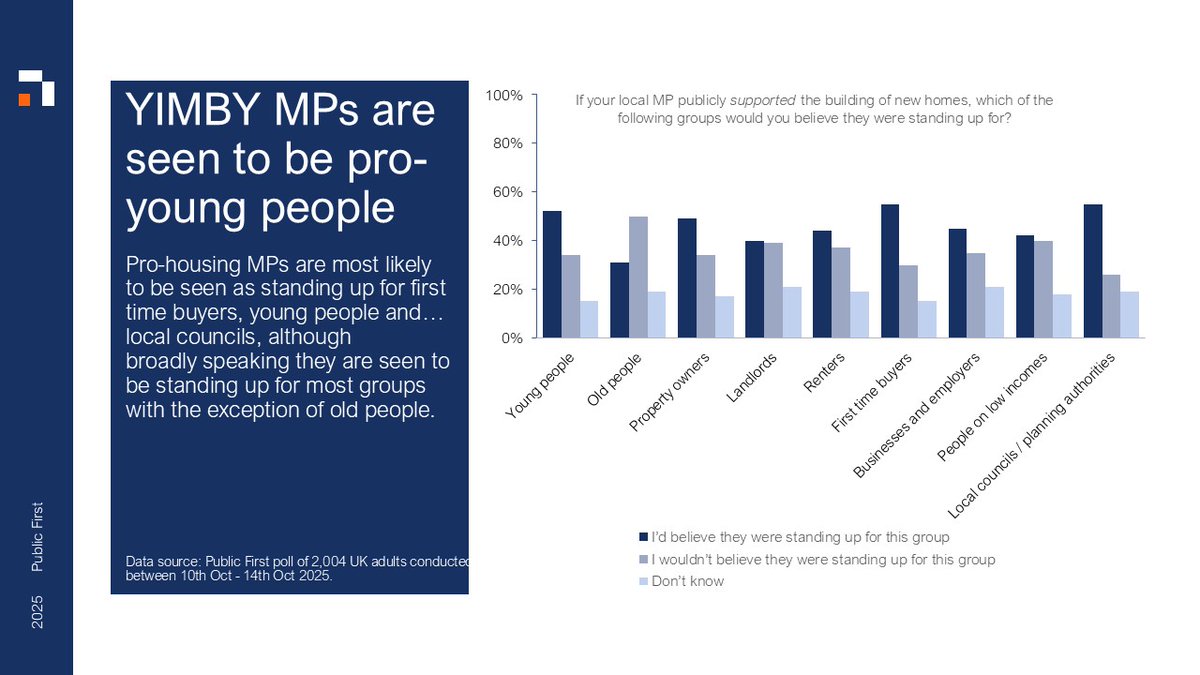
Overall this suggests that fighting for better housing locally is far more aligned with public opinion than simply fighting against housing altogether.
Should MPs support or oppose new homes? New Public First research finds voters prefer MPs who back housebuilding while visibly fighting for who it benefits. Our polling found 46% of people would view a pro-housing MP more positively (vs 15% negatively).
But this only happens if policymakers tackle the reasons why homebuilding in London is in freefall, like high build costs and viability.
The cost of not doing so is tens of billions a year in lost growth, higher housing costs and lower pay.
What happens if London hits its housing target?
The economy goes gangbusters.
New Public First research finds the benefits would reach £40bn a year - through higher construction output then through raised productivity that reshapes the capital's growth https://t.co/v9uS08blPr
Boosting the number of homes in London would then reverse some of the long-term damage caused by the housing shortage. Productivity would rise by close to 6%, lifting wages and living standards in the capital.