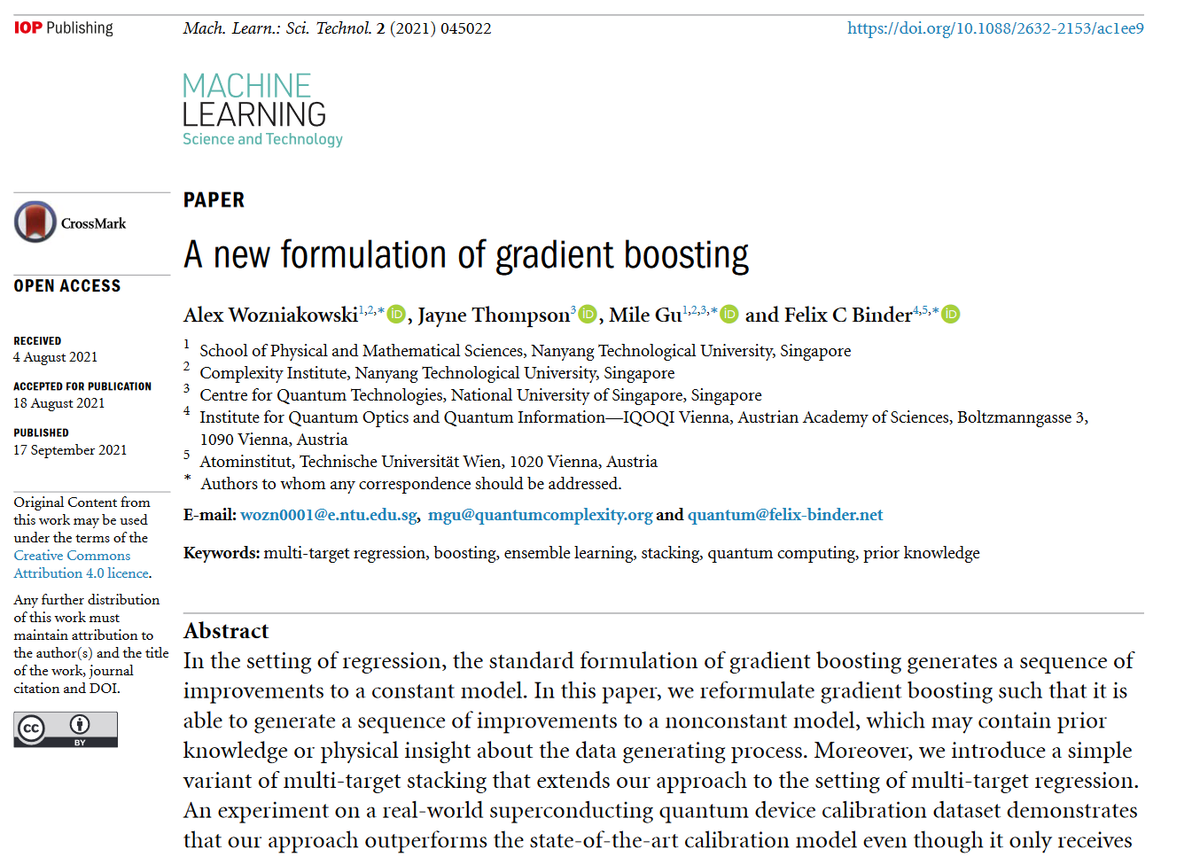
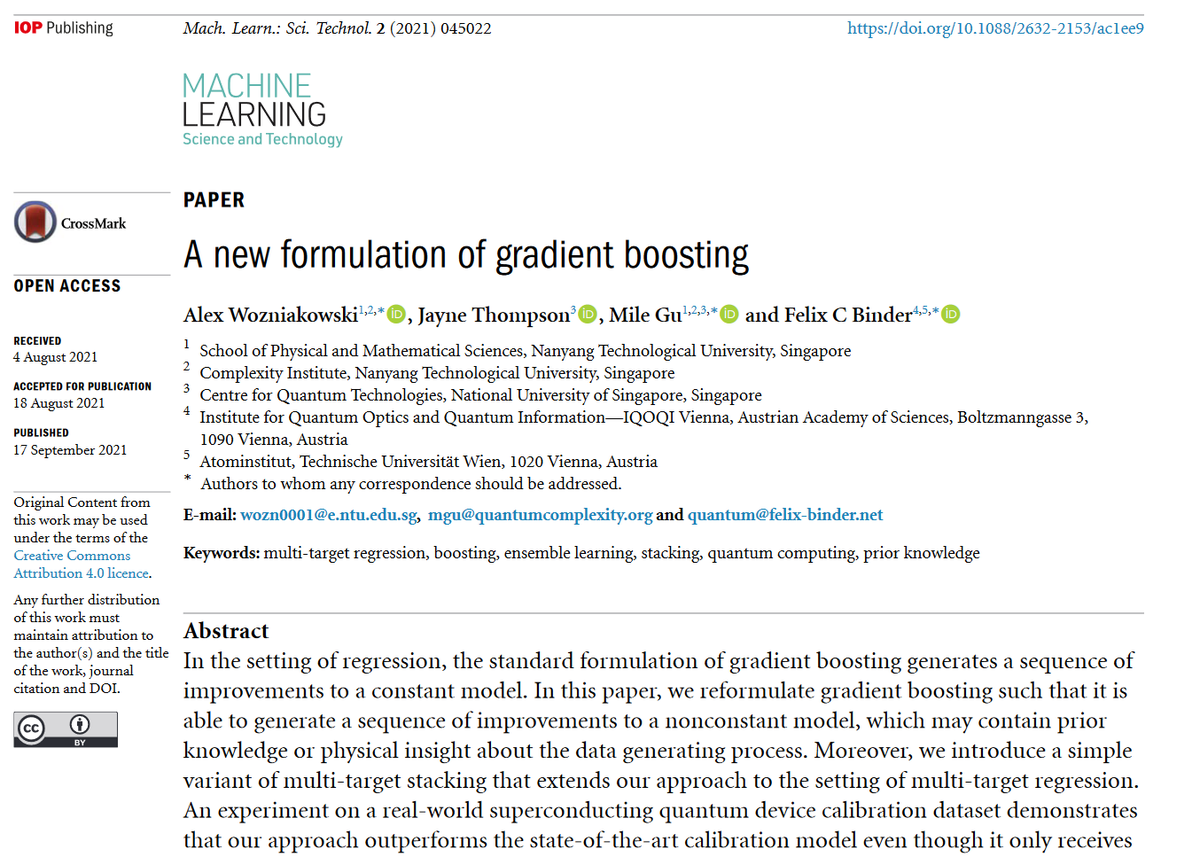
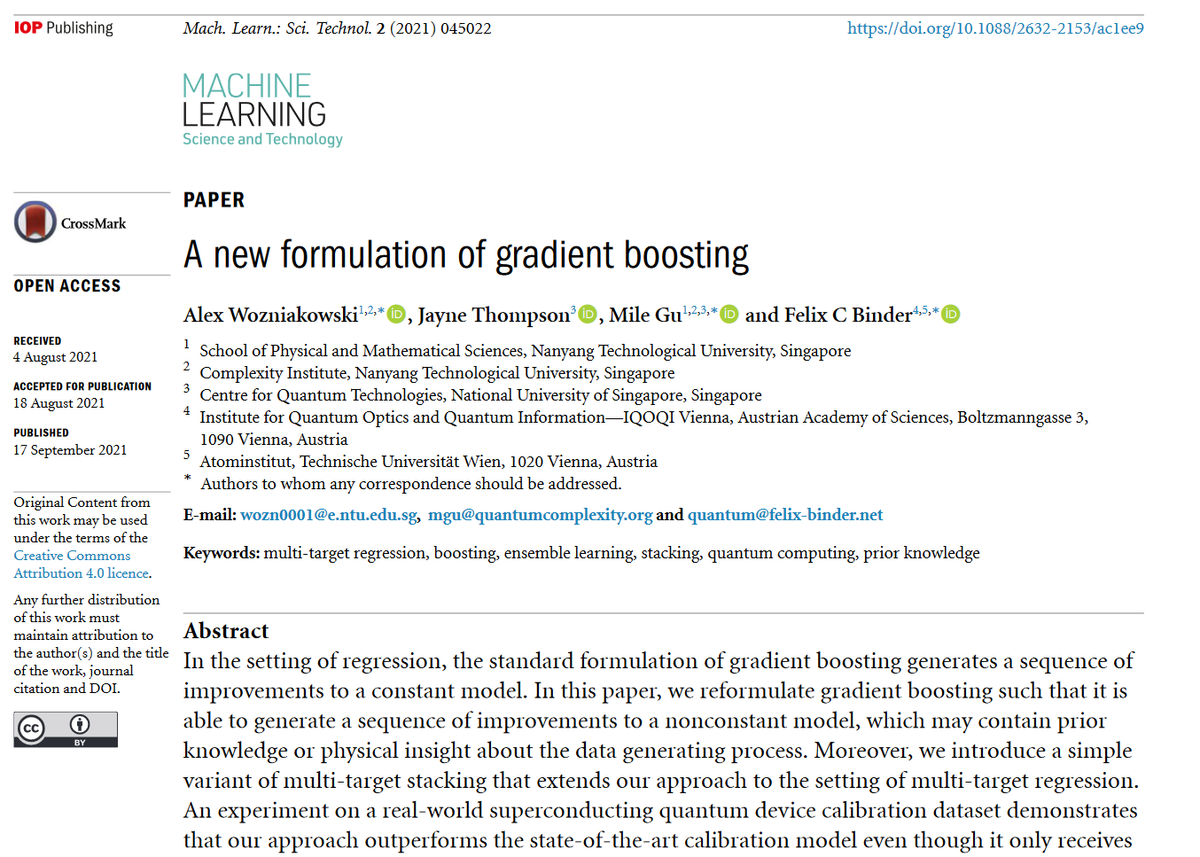
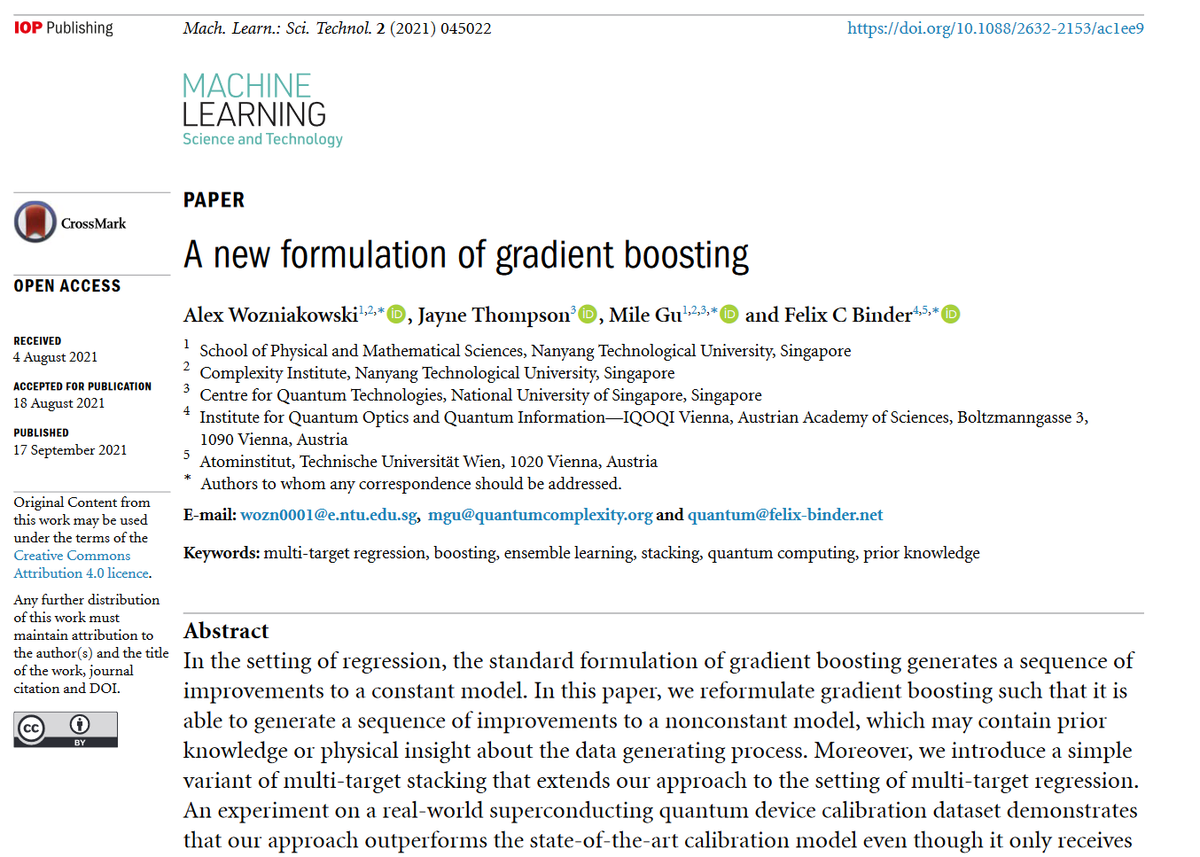
Our paper generalizes gradient boosting in the setting of regression.
@MLSTjournal publication:
https://t.co/PlgMQzvhAX
@github repository:
https://t.co/TxcJz5nZH5
@rasbt@tdietterich@MuhammadAnas707 Gronlund's conclusion seems to be: "While not final proof that this is the real or only explanation, it suggests that the success of gradient boosters, despite having poor margins, may be explained by the many small predictions made by the base learner trees."
@rasbt@tdietterich@MuhammadAnas707 Gronlund et al. and Cortes et al. have recent works on gradient boosting, regularization, and margin bounds: https://t.co/vwbFO2PacQ and https://t.co/gC4qpLn1sn
@rasbt@Sidsharmaa22 On the regression front, there's a more general formulation: https://t.co/PlgMQzvhAX… that allows gradient boosting to regard predictions from any regression model as an inductive bias.
@rasbt@Sidsharmaa22 Around the same time, there is AnyBoost by Mason et al. Then, SAMME came later and the paper formulates it with forward stagewise additive modeling.
@Sidsharmaa22@rasbt For binary classification, it traces back to Friedman, Hastie, and Tibshirani, when they rederived adaptive boosting in terms of the additive model and maximum likelihood estimation. Then, Friedman reformulates the results in terms of the gradient boosting machine.
Buhlmann and Yu, then others, such as @docmilanfar, pointed out connections between gradient boosting and Tukey's method of reroughing.
This paper fully merges the two methods, and a comparison with LightGBM suggests its viability.
Our paper generalizes gradient boosting in the setting of regression.
@MLSTjournal publication:
https://t.co/PlgMQzvhAX
@github repository:
https://t.co/TxcJz5nZH5
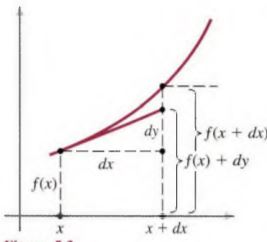
@stevenstrogatz Simmons is the MIT OCW book (so there are some online lectures from David Jerison). It describes radians from scratch, illustrates the differential (below), etc., where the underlying theory is kept to the Appendix. https://t.co/SGGYD7htv9
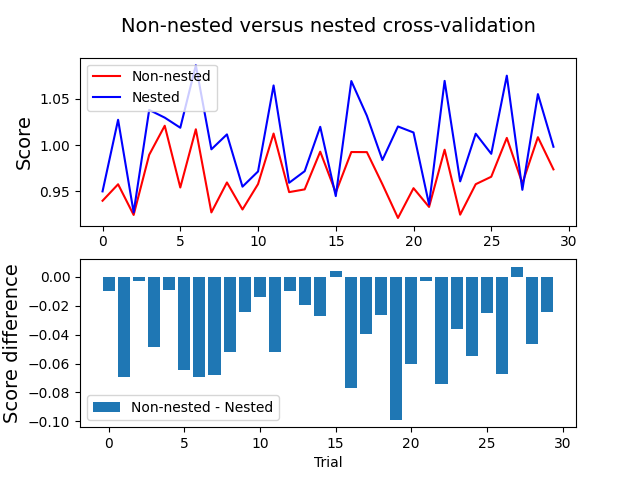
The plots compare non-nested and nested cross-validation in a @GoogleAI regression task. As the score is mean absolute error (nonnegative), the non-nested procedure exhibits a performance evaluation bias.
Code: https://t.co/TxcJz5FB5F
Scikit-physlearn is now available open-source: https://t.co/TxcJz5FB5F
It provides a unified regressor (@scikit_learn, LightGBM, XGBoost, @CatBoostML, Mlxtend), and it supports base boosting.
Paper: https://t.co/lOjixDo6os
@carrasqu In general, eschewing prior scientific knowledge in machine learning appears counter to science, which builds on previous discoveries. In contrast, conventional applications, such as NLP, computer vision, etc., emanated from the lack of an explicit model of the domain.
@carrasqu Here's a recent survey on the few-shot learning problem, which addresses the incorporation of prior domain knowledge in scenarios with a paucity of labeled data: https://t.co/6L78zaU6wn
@carrasqu In the low data regime (which frequently occurs in quantum experiments), we definitely want to leverage prior domain knowledge: https://t.co/lOjixDFHg0