BBC reporter: 'Sounds like you’re saying 1 Jewish life is worth 100s of 1,000s of Palestinian lives'
Israeli West Bank settler: 'No. MILLION. 1 Jewish life, it’s 10 million, ok'
BBC: 'That just sounds racist'
Settler: 'Yes. I know. But it’s the truth. Because God chose us'
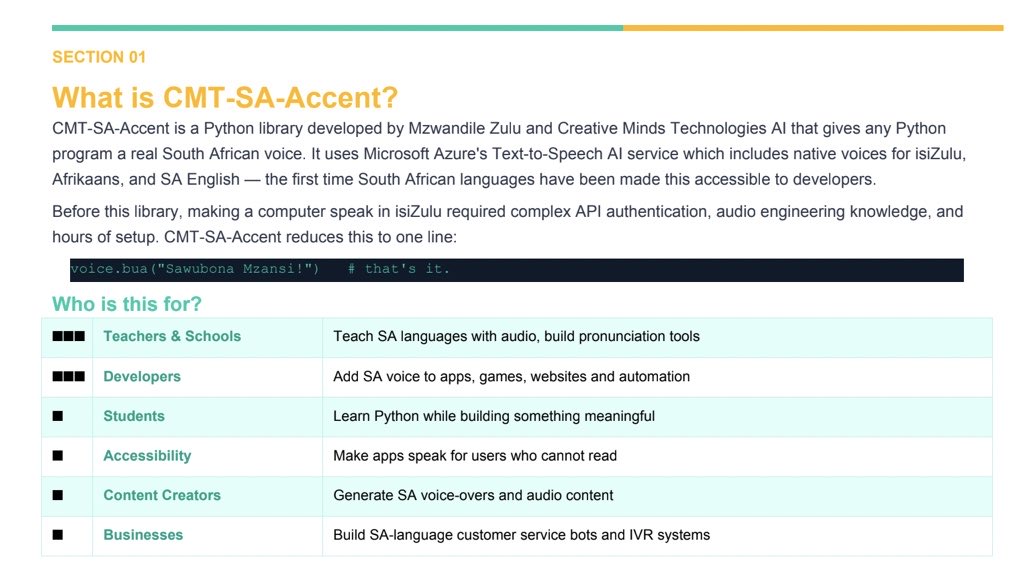
Finally, for the first time in South Africa, robots can now speak South African languages fluently. 🇿🇦
For too long our languages were invisible to technology. No isiZulu voice. No Setswana voice. No Xitsonga voice. Technology spoke to us in someone else's language.
Not anymore.
Schools teaching Robotics across Mzansi can now build robots that speak to learners in their home language. South African developers can now create apps, games, assistants and systems that sound like us — because they ARE us. 🙌🏾
This is not just a library. This is a statement. Our languages belong in technology. Our voices belong in the future.
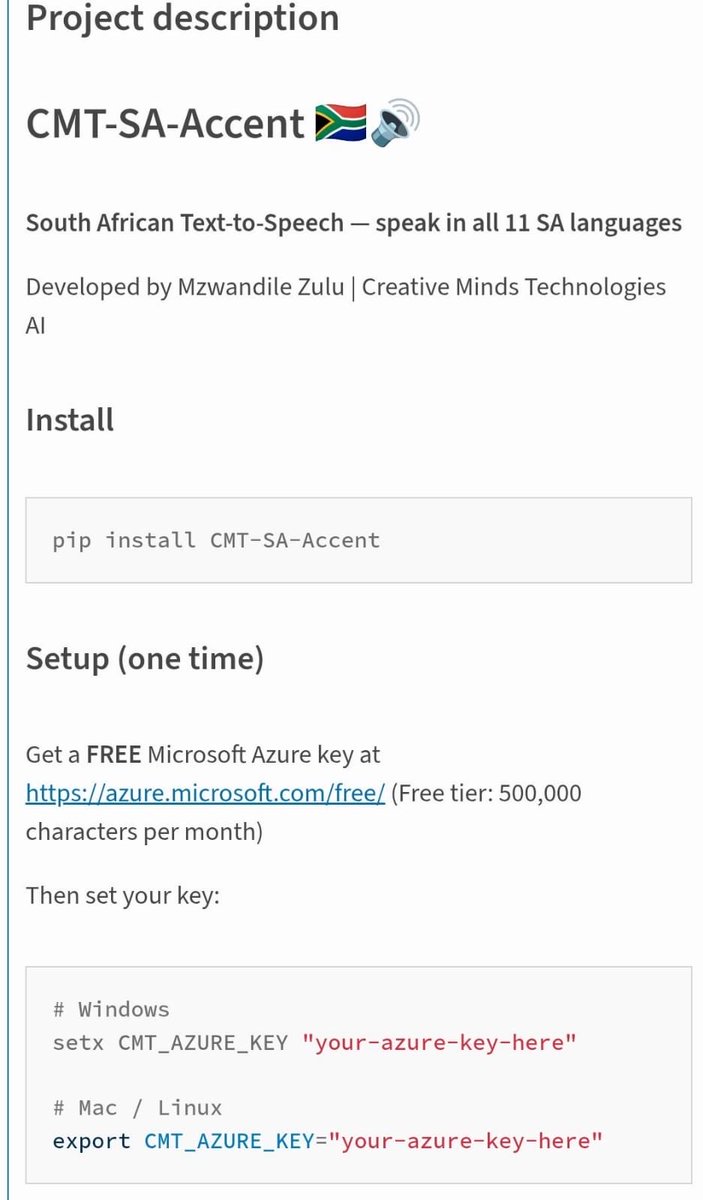
CMT-SA-Accent — pip install CMT-SA-Accent
Sikhona. We exist. Ons bestaan. Re teng. 🇿🇦
View here:👇🏾
https://t.co/7P2UA2YtbH
Poverty rate in South Africa
🔺 Black South Africans - 43,8 percent
🔺White South Africans - 1.4 percent
The fact that black South Africans remain economically disempowered is a terrible failure of democratic South Africa and the ANC ‘s inability to tackle white capital, white supremacy and racial injustice
I don’t know what else to do.
I need to be at Harvard by 10 August, and right now, I don’t know how I’m going to get there.
Over the last few months, I walked 1,600 km across South Africa as a fundraiser to help me get to Harvard and to better understand the housing challenges my AI platform is trying to solve.
I built Ubuntu Home, an AI platform that helps families design and plan affordable homes. But I knew technology alone wasn't enough. I wanted to learn directly from the people I hope to serve. So I slept in people's homes, from shacks to rondavels. I listened more than I spoke. I walked through storms, learning how people build, where they struggle, and what a housing solution that truly works for South Africans should look like.
That journey, together with my work building Ubuntu Home, led to my acceptance into Harvard's Master in Design Engineering program. Only 25 people from around the world were admitted this year.
Artificial intelligence is one of South Africa's most critical scarce skills. My dream has never been to leave South Africa. It has always been to return with world-class AI and engineering skills to build Ubuntu Home into a platform that helps solve our housing crisis.
I reached out to the Office of the Presidency, who referred me to Higher Education. I was told they fund study only in specific countries, and the US is not one of them. I reached out to the Minister of Human Settlements. I approached @AbsaSouthAfrica, @StandardBankZA, @FNBSA, and other major organisations. I applied for education loans, but as an international student going to the US, I don't qualify in South Africa, and the international loans available cover only a fraction of the cost.
After walking 1,600 km across my country, I may have to stay home. Not because I wasn't admitted, but because I can't afford to go.
I feel like I've exhausted every avenue I know.
If you can help with funding, make an introduction, connect me to someone who might be able to help, or simply share this story, I would be incredibly grateful.
@PresidencyZA@HigherEduGovZA@The_DHS@AbsaSouthAfrica@StandardBankZA@FNBSA@SollyMalatsi
Let's not lose South African talent because of funding. Let's invest in the people who will build South Africa's AI future.
From a R250k goal, to R500k and now over R715,000! 🙌🏾🙌🏾
Thank you to the 6,882 South Africans who have contributed to the SACR fundraising campaign. Your support is helping us take this mission forward.
If you’d still like to contribute, you can still donate here: https://t.co/iH6QvhGiEe
Now, let’s plan our IMBIZO together. 😇
#gratitude
South Africa has taken Israel to the ICJ, yet we remain one of their biggest coal suppliers. Coal directly fuelling the electricity grid that sustains the very Apartheid and genocide we are challenging in court. Make your voices heard!
A campaign has started to pay some people to discourage our people from voting. Citizens, be careful: Europeans will go out in large numbers to vote while you are listening to foolish advisors.
Built a K53 Learners App with 100 questions 🔥
Register with email + phone.
Take tests. See if you pass 83%.
It will help you with your learners 🇿🇦
Try it: https://t.co/c3zfFMpqhB
These anti-nuclear lobbyist are lying with impunity about nuclear destroying tourism & the Eastern Cape economy. France has dozens of nuclear plants, yet millions still flock to Paris & coastal areas every year. Nuclear has never killed tourism.
Facts:
Nuclear plants create economic magnets. Construction draws workers, engineers & visitors. Operation brings stable power that grows businesses, hotels & services. More people will travel to see the site + boosted local economy. Stop the fearmongering.
Look at Koeberg: It contributes around R20.7 billion to Western Cape GDP. Reliable clean power supports tourism, industry & growth. Exactly what the struggling Eastern Cape needs for jobs & development. Why deny EC this?
Koeberg proves coastal nuclear + tourism coexist fine. EC deserves jobs (10k+ during build), spinoffs & energy security, not slogans.
Anti-nuclear lobbyists must stop spreading misinformation.
#NuclearForEC #JobsForEasternCape
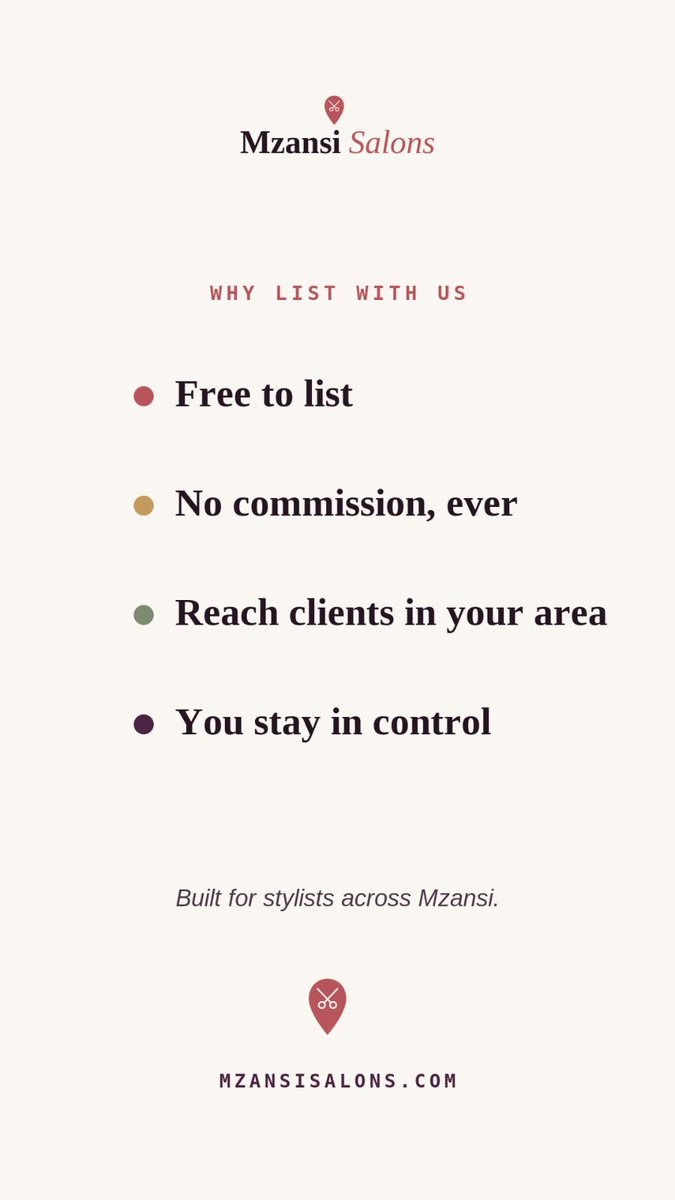
Molweni guys, my friend and I have built this new website called https://t.co/EBbVs8C08y, it is for finding salons, barbershops, nail techs and makeup artists. @MzansiSalons
It’s still new so anyone who does anything beauty related can sign up by choosing Become A Host.
South Africa is the most economically unequal country in the world because it was deliberately designed to be so.
While other highly unequal nations arrived there through capitalism or just plain corruption, South Africa arrived there because inequality was the literal law of the land for generations.
Pick a year, any year of South African history and evidence that the natives of the land were to be deliberately kept poor is right there in palin sight.
After all, the Xhosa Frontier Wars broke out in 1779 after decades of systematic land and wealth dispossession.
Even when you look over six decades before the country known as South Africa was formalised, and a century before Apartheid-era townships were codified, the formal policy of setting aside “locations” for Black people had already began.
In 1846, British colonist Theophilus Shepstone was tasked with managing thousands of Natives who were returning to lands they had historically occupied before the British violently invaded the region.
Rather than integrating them, Shepstone established several rural “Native locations” in the least fertile land available to ensure they would be available as cheap labour for farms and colonial industries.
Similarly, in the decades following 1886, when gold was discovered in what is today Gauteng, the entire colony’s immense wealth came from the mining sector powered by cheap, state-controlled electricity and heavily exploited, low-wage migrant labour.
Because this Mineral-Energy Complex built an economic system controlled by an elite few and because the economy was heavily geared toward resource extraction rather than broad-based manufacturing, it never developed the large, stable blue-collar middle class that lifted up countries in Europe, America or East Asia.
You could also skip to 1913, when the South African government decreed that the Black majority, which made up 80% of the population, could legally own just 7% of the land.
This overnight act destroyed Black farming and wiped out generational wealth. So, unlike in most other countries where inequality is a result of capitalism, in South Africa it was a state-enforced intentional destruction of a population’s asset base.
Over a century after the Locations were introduced, the Group Areas Act of 1950 locked Black families into townships and rural homelands, far from economic hubs. Today, transport costs consume 30–40% of a low-income worker’s salary vs. <10% for affluent suburbs, while property values in historically White areas have appreciated exponentially. The physical distance from opportunity is a daily tax on time and money that compounds generational poverty.
You could also zoom in on 1953, when the Bantu Education Act deliberately stripped math, science, and technical training from Black school curricula. The explicit, stated goal of the government at the time was to train Black citizens to be nothing more than manual labourers. Once again, the poor education given to Natives was not an inadvertent side effect of poor planning or execution.
As luck would have it, when 1994 rolled around, Western nations were shifting away from heavy labour industry and toward service economies. South Africa imitated this model and then found itself with an oversupply of blue-collar workers, products of Bantu Education.
Even though Bantu Education was repealed, public schools are still largely funded by local property taxes and since wealthier, historically White, suburbs raise vastly more per child than townships, the quality gap in maths and science persists. A child in Sandton receives 2–3x the per-learner funding of a child in Soweto.
Meanwhile, after 1994, wages for tech, banking, and executive roles skyrocketed, while wages for manual labour stagnated or vanished entirely. It goes without saying that the wage gap expanded rapidly during the very years democracy was meant to close it.
At the same time, during the transition to democracy, political administration was handed to the Native majority, but existing property rights were legally protected, which meant that while the laws became equal overnight, the capital, real estate, stocks, and business ownership stayed exactly where they were.
And because wealth compounds via interest and investments much faster than wages grow, the starting line of the new democracy was so skewed that the markets naturally made the rich richer, regardless of the change in political leadership.
Today, the Johannesburg Stock Exchange’s top 100 companies are still ~87% White-owned in terms of executive control and beneficial equity. Transformation policies, which, by the way were designed by the White elite, have created a small Black elite, but the aggregate wealth distribution remains frozen because ownership concentration drives inequality. After a all, wealth begets wealth via dividends and buybacks, while wages, even well-paid ones, cannot catch up to capital’s compound growth.
Anyway, the point is that South Africa’s historical economic inequality was by design and when we say it continues to be actively maintained to this day, this is not a conspiracy theory. It may seem that way because the design’s final trick makes the outcomes look like “the economy” doing what it does, so the original sin of dispossession fades from view.
🙌🏽 I am very happy and very honoured to have my newly published book WHITE PRIVILEGE. BLACK PAIN in the Top 20 at Exclusive Books in Rosebank alongside @djsbu new book BRICK by BRICK 🙌🏽
Thank you to Rosebank Exclusive Books for hosting my book launch and for all your support. A great bookstore with excellent management 🙌🏽🙌🏽
Do visit this store and support local writers