The sweet potato is the carbohydrate you are allowed to feel virtuous about, which is a strange privilege for what is, once the marketing settles, a sweet starchy tuber.
Take the headline boast first, the one about being loaded with vitamin A.
What it actually holds is beta-carotene, which your body has to convert into vitamin A using the BCO1 enzyme, and it does the job badly.
Carotenoids are barely absorbed to begin with, the conversion officially runs at twelve to one, and around 40% of people carry a gene variant that cuts even that by up to 70%. The retinol in liver, eggs and butter arrives ready to use. The orange tuber hands you a raw material and wishes you luck.
Then the starch, because under the halo it is mostly glucose held together with good intentions. Roast it long enough and its glycemic load climbs happily toward the white potato you were told to fear.
Then the defences. Oxalates, the calcium-binding compounds that build kidney stones, in the very food the clean-eating crowd inhales by the trayful. Trypsin inhibitors to block your protein digestion. Mannitol and raffinose to ferment in your gut and clear the room. And a bruised or mouldy one quietly brews furanoterpenoids, toxins that go after the lungs and liver.
So eat it because it is tasty. Just stop bowing to a tuber that promises a vitamin it cannot reliably deliver, wrapped around a chemistry set.
ARLA WON -- YOU LOST - BOVAER SOON ALL MILK
After the Arla - DMK takeover last week a Huge New Milk Supply Monolith has been Formed.
This means Bovaer‑milk will quietly become the default “standard milk”, while organic milk becomes scarcer and more expensive.
AND YOU WILL NOT BE INFORMED ON LABELS
Why this matters now with the Arla–DMK merger:
This is where things get strategically interesting.
1. Arla is already the most aggressive adopter of Bovaer
They defended it publicly, continued trials, and positioned it as central to their climate strategy.
This means the merged entity is WILL scale Bovaer faster, not slower.
2. DMK brings Germany — a huge dairy market — into the equation
The merger forces a harmonised methane strategy, and Bovaer is the only ready‑to‑deploy tool.
CONSUMERS: Exoect Organic Milk to be Priced out of the Market, not just UK, not just EU, but there will be plans through those financially involved, like Bill Gates, to get BOVAER in Animal Feeds as the de facto position.
And before Mr Gates Operatives on X start to argue:
The Company holding Bovaer Trademarks is DSM-Firmenich -- The Gates Foundation holds extensive shareholdings in this Company.
From Scottish Parliamentary Briefing Papers re Nicola Sturgeon's involvement...
"There also seems to be some information hidden from public view, such as DSM-Firmenich denying any connection with Bill Gates, only for us to discover Bill Gates has purchased 1m shares in the Company, with the major investor behind the scheme, Black Rock"
There will also be price differentiation between Bovaer Milk and Non-Bovaer.
OF COURSE TEN YEARS FROM NOW THERE WILL BE ZERO CHOICE - JUST BOVAER.
For the Arla–DMK giant, this means:
They will push Bovaer harder than ever — because climate targets demand it.
They must avoid another consumer revolt — because the merged brand is too big to hide.
They will likely invest heavily in “green dairy” PR, transparency dashboards, and retailer‑aligned messaging.
Any future health concerns (even unfounded ones) will hit twice as hard because of their scale.
LACK OF CHOICE, LACK OF TRANSPARENCY, PUBLIC REJECTION
We’re sleepwalking into a food system where the public has no real choice at all.
Supermarkets are quietly shifting to “low‑methane milk” using feed additives like Bovaer — and most people don’t even know it’s happening.
There’s no clear labelling.
There’s no public documentation.
There’s no way for families to choose milk without these additives unless they pay organic prices or hunt down tiny local suppliers.
And here’s the truth nobody in the industry wants to say out loud:
Even if every analysis says “no harm”, even if regulators approve it, even if the science is solid…
The public still won’t want it if they feel tricked.
People want transparency.
People want choice.
People want to know what’s going into the food chain — not find out years later through a press release.
This isn’t anti‑science. This isn’t anti‑farmer.
This is about trust.
If the industry keeps rolling out feed additives without open discussion, clear labelling, or public consent, they’re going to trigger a backlash far bigger than they expect.
Choice matters. Transparency matters. Trust matters.
And right now, the public is getting none of them.
MANY FARMERS DO NOT WANT CHEMICALS OF ANY KIND PUT INTO ANIMAN FEED AND THEN INTO THE HUMAN FOOD CHAIN..
Because. It. Is. Insane...
"Red meat causes cancer. The WHO said so."
The scariest headline in food, and it is built almost entirely on people misreading a filing system.
In 2015 the WHO's cancer agency, the IARC, dropped processed meat into Group 1 and red meat into the weaker Group 2A. Group 1 also contains smoking, alcohol, and sunlight. Here is where everyone gleefully loses the plot. Those groups rank one thing only: how sure the scientists are that a thing does something at all, not how much harm it does. Sunshine and bacon sit in the same box. Oddly, nobody has launched a campaign against going outside.
So what is the actual risk? Fifty grams of processed meat a day, a couple of rashers, lifts your relative risk of bowel cancer by about 18 percent. Terrifying, until you do the sums. Lifetime odds of bowel cancer sit around 5 or 6 in 100, and the daily bacon habit nudges that from roughly 5 to roughly 6. A real effect, worth a shrug. Smoking, for scale, raises lung cancer risk by around 2,000 percent.
And here is the bit that should embarrass everyone involved. Even the processed meat link cannot really be pinned on the meat, because in these studies the keen bacon-eater is also, on average, the keen smoker, the keen drinker, the bloke who thinks a vegetable is a garnish and exercise is for other people. The studies are observational. They spot a pattern, call it a cause, and quietly file the steak-and-greens man next to the man whose "red meat" arrives in a bun at 2am with a pint.
You were sold a frightening number and charged nothing for the context. A fresh steak is a long way from a cigarette, and the filing cabinet was never evidence.
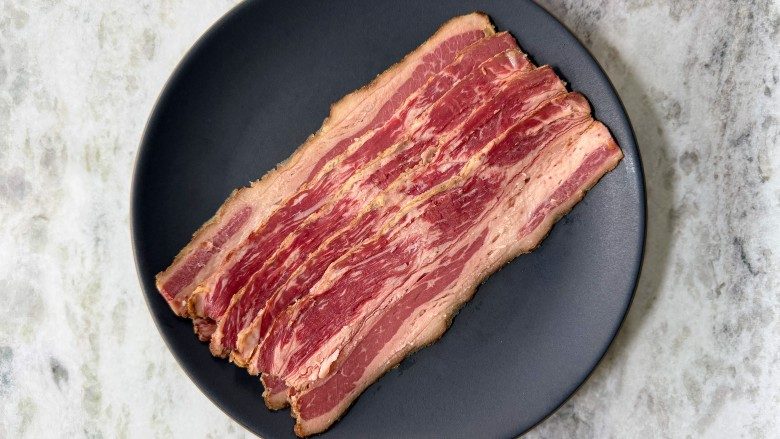
Eat the bacon.
Alcohol and tobacco are available on every street corner.
Cigarettes proven to cause cancer. Alcohol proven to destroy the liver, the brain, the marriage, and the careful plans of an entire weekend.
Both legal. Both taxed. Both stocked at the petrol station.
Raw milk, on the other hand, sold by a farmer three miles down the road from a cow that has a name, must apparently be regulated as a public health threat.
The petrol station sells nicotine pouches, vodka, energy drinks containing seven grams of taurine and a kilogram of sugar, and an entire wall of ultra-processed snacks designed by chemists.
The farm gate down the lane sells a glass of milk. The same milk humans have been drinking for ten thousand years.
The petrol station is fine. The farm gate is the problem.
You can decide which of these your government is actually trying to protect you from.
"I eat clean." She drizzles industrially refined rapeseed oil over her salad.
"I'm avoiding processed food." He unwraps a protein flapjack assembled by a team of food scientists in Slough.
"I cut out red meat for my heart." Her breakfast was a bowl of sugar-coated wholegrain cereal.
"I'm dairy-free now." He pours oat milk made of water, sunflower oil, and three stabilisers into his coffee.
"I'm watching my cholesterol." She butters her toast with a margarine spread containing fourteen ingredients designed to mimic butter.
"I'm gluten-free for my gut." He eats a £4 cookie made of rice flour, palm oil, and xanthan gum.
"I'm vegan for the animals." Her almond milk just killed half a hive of commercially trucked Californian bees.
"I prefer plant-based fats." He pours sunflower oil into a smoking pan and inhales the aldehydes.
"I had a healthy salad for lunch." Her spinach, almonds, and quinoa just delivered the daily oxalate quota in one bowl.
"I don't eat anything with a face." He bites into a Beyond Burger with 22 ingredients and a flavour profile assembled in a Californian laboratory.
"I'm being good today." Her breakfast was sweetened oats, a banana, and a glass of apple juice. Eighty grams of sugar before nine.
The labels are doing the talking. The food is doing something else entirely.
In the 1980s, the Norwegian salmon farming industry ran into a colour problem.
Wild salmon are pink because they eat krill and small crustaceans containing a pigment called astaxanthin. The pigment accumulates in the muscle tissue and gives the flesh its colour. That colour is one of the cues a diner uses, consciously or otherwise, to decide whether the fish on the plate is appetising.
Farmed salmon, raised on soy protein, corn meal, fish meal from wild-caught smaller fish, and stabilisers, do not eat krill. They do not accumulate astaxanthin. Without intervention, their flesh is grey. Washed-out, unappealing grey.
Nobody buys a grey salmon.
So the industry adopted synthetic astaxanthin, manufactured by Hoffmann-La Roche, originally developed as a feed additive to brighten poultry yolks. It is added to salmon feed in measured doses.
The doses are calibrated against a colour chart called the SalmoFan, produced by the same company, which the farmer holds against a slice of flesh from a slaughtered fish to confirm the pigmentation has reached the commercially desirable shade.
The SalmoFan has fifteen shades.
The farmer picks the target shade based on what the supermarket buyer in the destination country considers appealing.
Norwegian salmon, sitting on the ice in a British supermarket, has been colour-graded to match the expectations of a marketing department in Hoddesdon.
The fish you're looking at is the colour the company chose.
The fish didn't pick it. The krill didn't provide it. The pigment came from a Swiss laboratory.
You're eating a paint sample.
The paint is fish-flavoured.
The fish remembers krill. It has never tasted krill. The krill is in a different part of the supply chain.
Activist: "Your cow looks depressed."
Farmer: "She's chewing."
Activist: "Her eyes look sad."
Farmer: "Cow eyes don't have eyebrows. The droop is structural. The sadness is in your head."
Activist: "She's not interacting with the others."
Farmer: "She's twelve feet from her best friend of nine years. They take turns lying down. The one standing is on lookout. You arrived during her shift."
Activist: "She didn't run when I approached."
Farmer: "Running is for predators. You are a person with a notebook. She has classified you correctly."
Activist: "She just seems so resigned."
Farmer: "She is digesting. Resignation requires a sense of unfulfilled ambition. The cow's ambition this afternoon was to eat that bit of grass. She has done it. She is having, by every measure available to her, a triumphant Tuesday."
Activist: "But I can feel it."
Farmer: "You can feel what's in your own head. The cow isn't there. The cow is here, on her side, full of grass. Project somewhere else."
Patient: you said butter would kill me.
Doctor: that was the advice at the time.
Patient: I switched to margarine.
Doctor: yes.
Patient: the margarine contained trans fats.
Doctor: that was before we knew.
Patient: you've now banned trans fats.
Doctor: yes.
Patient: because they cause heart disease.
Doctor: correct.
Patient: so the butter was fine and the replacement was killing me.
Doctor: the science has evolved.
Patient: my arteries haven't. Are you going to write a letter.
Doctor: a letter to whom.
Patient: to my arteries. They'd like to know.
The whole point of carnivore, the thing that makes it work, is that it is almost insultingly simple.
And then the meatfluencers got hold of it.
Now you cannot scroll three posts without being told that carnivore is a complicated metabolic intervention requiring electrolyte protocols, desiccated organ capsules, grass-finished certification, bone broth simmered overnight for the collagen, magnesium glycinate before bed, twelve cuts in rotation, and a nose-to-tail rota of organ meats most people would rather not look at.
This is nonsense. Well-meaning in some cases, content-farming in most, but nonsense.
Here is what carnivore actually is.
Eat as much steak as you want. Cook it in butter.
Eat as many eggs as you want. Cook them in butter.
Eat as much butter as you want. Then add a little more butter.
Two proper meals a day. One if you're not hungry for two. Don't time them, don't space them, don't fret about the gap.
No calorie counting. No tracking. No app. No supplements, bar a few drops of iodine if you're not going crazy on seafood. No electrolyte protocols. No bone broth. No organ meats if they don't appeal. Supermarket beef is real beef. Birthday cake won't end you. Tomorrow's eggs are still in butter.
That is the entire protocol.
This is a diet that runs in the background. It does not ask for your attention. The hours you used to spend negotiating with hunger, planning the next snack, counting something, weighing something, all come back to you.
Use them. Build something. Train harder. Read the books you said you would. Be present for the people in your house. The diet will keep working while you do.
Meaningful changes in weeks. Steady, compounding progress over months. Weight settles. Energy holds. Mood stabilises. Hunger stops being the loudest voice in the room.
The meatfluencers cannot sell you this, which is why you are not being sold it. There is no affiliate code for "eat the steak with butter on it." No twelve-week protocol. No premium tier.
There is just the steak. And the butter. And the eggs. And the quiet recognition, somewhere around week three, that your great-grandmother already knew everything you needed to know about food.
Carnivore is the most idiot-proof diet ever assembled.
That is precisely why it is the most powerful.
Eat the steak. Add the butter. Get on with your life.