"The value of time
The success of perseverance
The pleasure of working
The dignity of simplicity
The worth of character
The power of example
The influence of life
The obligation of duty
The wisdom of economy
The virtue of patience
The improvement of talent
The joy of originating"
Sonnet has been good enough for everything I've needed to do for the last year, so I didn't switch to Opus after testing it out to see it's capabilities.
Trying Fable now to step out of my comfort zone and work on ads/marketing, will share any interesting results.
Some people may not realise this, but until 2008/2009, Nigerian students took the JAMB exam without using calculators. I mean, all those gruelling physics, chemistry, and maths questions were answered primarily through mental maths.
Fast forward to today, and with the rise of Agentic AI tools, we now have agents that can write, conduct in-depth research, draft emails and messages for loved ones, and perform advanced computing. We are living in an era where more and more skills are being lost at the altar of comfort and convenience.
What will this mean for us? I am not anti-technology, nor do I want a ban on calculators 🫠, as that would be like the story of John Henry, the legendary "steel-driving man" who, in an age where his profession was being made obsolete, challenged a steam-powered drill to a rock-cleaving race to prove that human power can't be replaced. He hammered through the mountain faster than the machine, won the wager and immediately collapsed and died from exhaustion.
Mental maths isn't just about numbers. It is a workout for your cognition and working memory. The poorer you are at basic arithmetic and maths, the more likely you are to struggle as an adult. This is why I am very particular about ensuring that developing countries get primary education right. Those foundations are difficult to correct later on in life. You need that cognitive friction to make estimates, tell the time, budget, make financial decisions, bargain, weigh risk, even navigate relationships.
We must find a way to task our brains daily. Keep solving puzzles, keep doing mental maths, keep some tasks that you will only ever do yourself. Personally, these are the things I have continued to do. I keep calculating the grocery bills. I have maintained the first draft rules for my emails, so I always have my initial thoughts raw and unfiltered. I change something biweekly (even if it is taking a different path to work/on a run, or changing the font on my screen, which are all hacks for neuroplasticity)
In the age of AI, it is even more important that we treat our minds like our bodies and ensure we "work out" daily. It will be tempting to outsource every task to an AI agent. But we risk being the pilots of our own minds and becoming merely passengers. It should be a daily conscious effort to create that cognitive friction that makes us the people who build these powerful tools in the first place. Let AI be the tool, but keep your brain sharp enough to command it.
New: @ServiceNow is the latest major public company to say it’s blown through its full year budget for AI coding tools from Anthropic in the first few months of 2026, just like @Uber CTO @praveenTweets said abt his company. “It’s a really hard problem,” CIO Kellie Romack said.
GLM-5.2 is the open-source Claude moment.
The demand we’re seeing at Databricks is astonishing. The world is going to see massive adoption of oss LLMs.
Also, more companies will shift toward post-training their own models on top of oss models and owning the weights.
The darkest LGAs on this map have the most retail outlets we mapped — in Lagos, Port Harcourt, Onitsha, Abuja.
Count the gold squares(NIPOST offices) in the dark zones. The infrastructure gap is visible.
For logistics operators and fintechs, could that gap be new markets? @bosuntijani@tola_odeyemi
Nigeria has 1,104 post offices spread across 774 LGAs.
Looks like decent coverage, until you overlay 300,000 retail outlets.
The dots tell a different story: commercial activity is concentrated in the south, and post office density does not follow.
For me the magic of technology is when you apply it to solve a specific problem.
Pure research or pushing capabilities just for the sake of it never fascinated me as much.
One of the best parts of my job is that some days the most important task is to block out a few hours and really read through a bunch of somewhat technical documents.
@eldivine I don't see any scenarios where humans are removed from the loop entirely, materializing in our life time. Especially as an effect of these current capabilities.
@Ssaasquatch Yup, terrible response for someone with such a profile. I’ve been curious about him for years but this wasn’t impressive for his first major showing on the national stage.
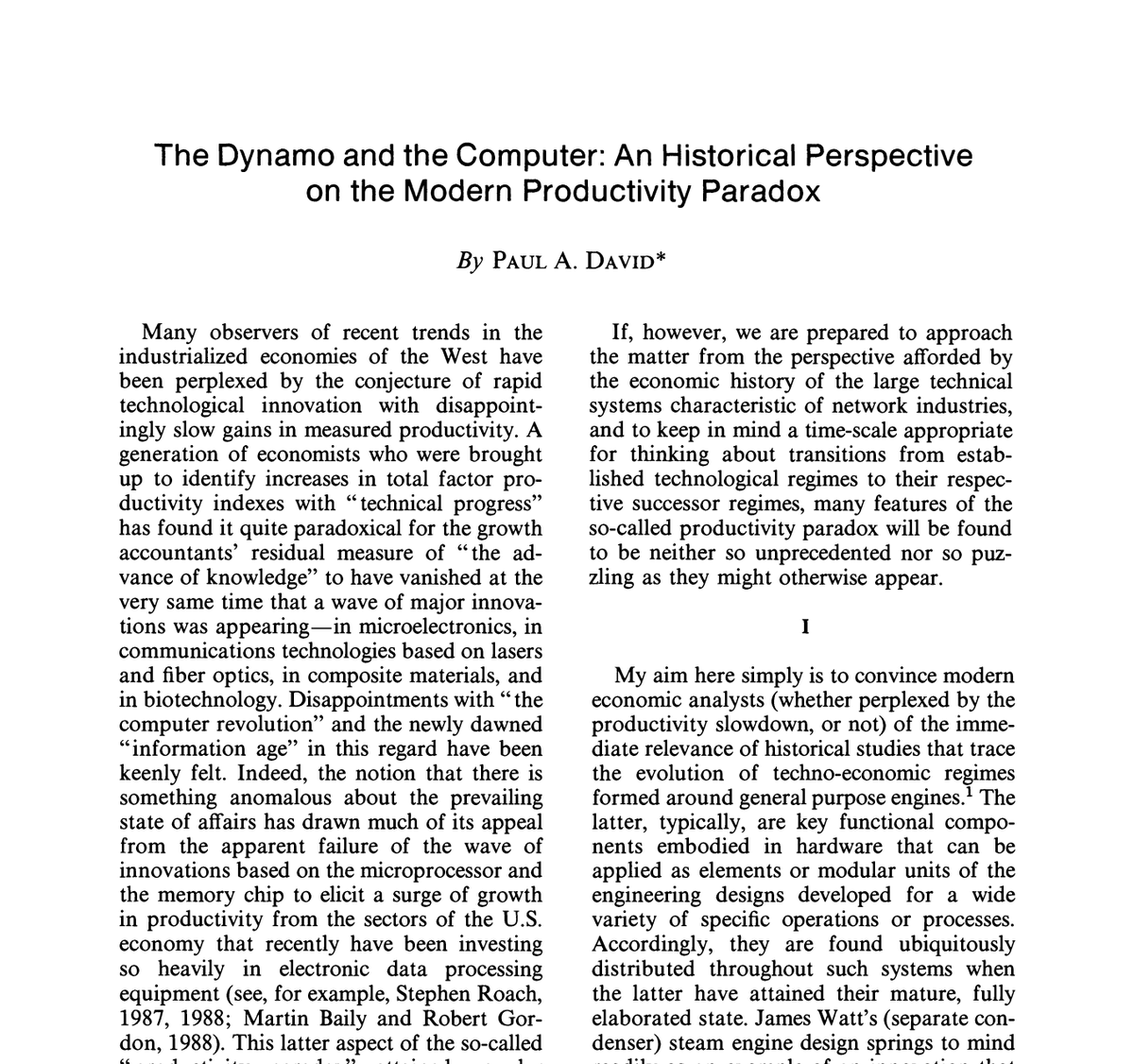
If you've adopted AI at your company but haven't seen any tangible results, read this 1990 article: "The Dynamo and the Computer" by Paul David.
When electricity first arrived, factories that "adopted" it barely got faster. They just swapped the steam engine for an electric one and ran everything else exactly as before: same machine layout, same workflow, same management. Electricity in, no real gains out.
The most common mistake with any new technology is to drop it into the old organization and then declare the transformation done.
The real leap came decades later, when each machine got its own small motor. Suddenly machines no longer had to be lined up around one central drive shaft. They could be rearranged around the actual flow of work.
The productivity gains didn't come from electricity. They came from REDESIGNING THE ENTIRE FACTORY around it.
AI is the same. Bolting it onto your existing process gets you a faster steam engine. The payoff comes when you redesign the work itself.
(link to paper in comments)