@Baoliaogeming64 Why has he wasted almost 2 years not doing what he promised before elections! Why does this become the top priority 3 weeks before the midterms? Just 🤔.. too busy fighting wrong battles?!
When Amazon hired me on an H-1B visa, Amazon was making losses for 10 straight years. It was operating out of a rented building where we worked on door desks in small cabins. I was in the initial team that built AWS.
Today AWS contributes more than 60% to Amazon's profit. The stock price has gone 300x. Amazon's buildings have changed the skyline of downtown Seattle. Jeff Bezos went on to become the world's richest man.
There were about a hundred H1B visa holders like me in the initial team of Amazon. Good luck building companies and wealth without these 'indentured servants'
The Physician Who Signed His Name in 1675...
In April 1675, inside a Dutch fort in Cochin, a physician signed a certificate in a script that very few people can read today.
It vouched for a book that was about to cross the ocean. More than 350 years later, it is still the reason we know his name.
His name was Itty Achudan, a hereditary physician from the village of Kodakarapalli in Karappuram, chief of a family of traditional healers, the Kollatt house.
The ruler of Cochin, Veera Kerala Varma, had introduced him to the Dutch governor Hendrik van Rheede, who was putting together a book on the plants of Malabar.
Achudan travelled to the fort at Cochin, and spent several days dictating the names and uses of plants. He drew on his memory, and on palm-leaf manuscripts his family had kept for generations.
At the end, he signed a certificate dated 20 April 1675, confirming the accuracy of the knowledge he had shared. He wrote it in the old Malayalam script known as Kolezhuthu. It describes him as a hereditary Malayalam physician born in Kollatt house in Kodakarapalli.
It was printed at the start of Volume 1 of the book.
The book became the Hortus Malabaricus, 12 volumes, covering 742 plants of the Malabar coast, published in Amsterdam beginning in 1678. Van Rheede never saw it finished. He died in 1691, on a ship off Bombay.
The book is said to have been drawn on by Linnaeus in his own work.
In India, though, its contents stayed locked in Latin for centuries. One day, a young botany student named K. S. Manilal found the Hortus Malabaricus in the stacks of the Forest Research Institute in Dehradun.
He later became a prof. at the University of Calicut. In 1964, almost exactly 3 centuries after Van Rheede began his work, Manilal decided to translate it.
He had one problem. He did not know Latin.
So he found Catholic priests and bishops who did, and learned from them.
Every one of the 742 plants had to be identified again under modern botanical names, because taxonomy had changed so much in three centuries.
The project took 35 years, longer than it had taken Van Rheede's team to compile the original.
The English translation was published in 2003, by the University of Kerala, 325 years after the original appeared in Amsterdam. The Malayalam edition followed in 2008.
Manilal also wrote a separate book, in 1996, on the role of Itty Achudan in the making of the Hortus.
Manilal received the Padma Shri in 2020. He also received the Janaki Ammal Taxonomy Award, and from the Netherlands, the Order of Orange-Nassau. He died in Thrissur at the age of 86.
On the first pages of a book that went halfway around the world, a physician had signed his name, in his own language, in a script few could read.
300 years later, someone finally read it.
@Lawyer_Kalpana LoP should remember when joining hands with a foreign oligarch against our own, that the person he is supporting is a trillionaire and 10x richer than the “oligarch” and the “other guy” combined. Only wines mature as they age!😂
अथक परिश्रम, अद्भुत संकल्पशक्ति व राष्ट्र प्रथम को जीवन का लक्ष्य बनाने वाले यशस्वी प्रधानमंत्री श्री @narendramodi जी के सेवा और समर्पण के 25 वर्ष पूर्ण होने पर उन्हें हार्दिक शुभकामनाएँ।
आज ही के दिन, 7 अक्टूबर 2001 को मोदी जी ने गुजरात के मुख्यमंत्री के रूप में शपथ ली। तब से लगातार मुख्यमंत्री और प्रधानमंत्री के रूप में उनकी सेवा, संघर्ष व समर्पण की यह यात्रा गरीबों का कल्याण, महिलाओं का सशक्तीकरण, युवाओं का उत्थान और हर वर्ग की समृद्धि का पर्याय बन गई है।
#25YearsOfSeva में मोदी जी ने जनकल्याणकारी नीतियों, उनके क्रियान्वयन, निर्णय की दृढ़ता, पारदर्शिता व परिणाम की गारं��ी से शासन की परिभाषा ही बदल दी और 'पॉलिटिक्स ऑफ परफॉर्मेंस' का आदर्श स्थापित किया।
I don't like Kapil Sibal as he is always found to be protecting the corrupt, extremists & anti social elements.
For the first time, I like him because he has exposed the bogus vote chori drama of Congress party through his old speech in Parliament as Law Minister!!
Requesting all Hindus to make our children watch this video and make them realize the impending threat to their future....explain the content of the video, to our children grand children friends and relatives and call for practiving pure Hinduism at home.. lets give life to our faith..
Vande Mataram. 👌🏼👌🏼👌🏼🚩🚩🚩
Gurudev Sri Sri Ravi Shankar’s lifelong dedication to peace, service, and humanity has touched millions worldwide and earned recognition across the globe 🌍💛✨ #Gurudev#SriSriRaviShankar#ArtofLiving#Worldwide
अवजानन्ति मां मूढा
मानुषीं तनुमाश्रितम् ।
परं भावमजानन्तो
मम भूतमहेश्वरम् ॥
When Krishna says “Me,” it refers not to the physical form-the charming form adorned with a peacock feather or holding a flute- but to the pure, transcendental Consciousness (Param Bhāva)-the one infinite spirit from which everything arises and in which everything exists. People mistake this for an ordinary human being and fail to recognize the divinity. People think I am a human being; they only see my outer [form], they don’t see the spirit inside of ME that is light. I am the light of which the whole universe is made.
( Above is #WisdomFromGurudev while explaining the Verse from Bhagavad Gita…)
@Gurudev, even as we are blessed with this profound truth, we joyfully wish You a very Happy Birthday!! 💐💐🙂
May Your light continue to guide us 🙏🙏
#Gurudev70 #ArtOfLiving45Years
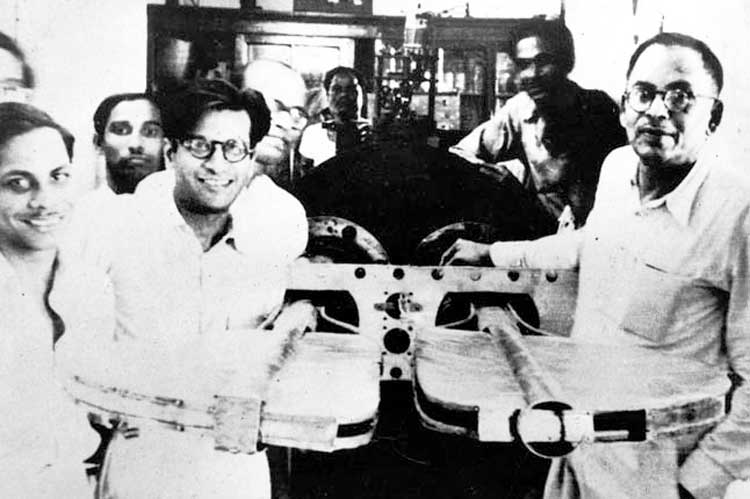
Imagine a man standing on the docks of Calcutta, watching the empty horizon where a ship was supposed to appear. He realizes the future of his country’s science is at the bottom of the sea. Instead of crying, he turns around, walks into a local welding shop, & starts sketching a vacuum pump on a piece of brown packing paper.
We celebrate the architects of the atomic age, but we have forgotten the man who actually built the engine. He was the ghost who brought the 1st Cyclotron to India, dragging the future of nuclear physics across a war-torn ocean, only to let others take the bow.
In the 1930s, the world of physics was shifting from chalkboards to massive machinery. Dr. Basanti Dulal Nagchaudhuri was at Berkeley, working directly under Ernest Lawrence (the inventor of the Cyclotron). He was not just studying; he was learning how to build the God-Machine, the particle accelerator.
In 1941, Nagchaudhuri & his mentor Meghnad Saha secured the parts for India’s 1st Cyclotron from the US. It was a moment of national pride, India was about to enter the elite club of nuclear research. But then, the tragedy struck. The ship carrying the crucial vacuum pumps & magnets was torpedoed by a Japanese submarine in the middle of World War II. The heart of India’s 1st great machine sank to the bottom of the ocean.
Most scientists would have quit. Nagchaudhuri did not. He did not wait for a new shipment. He went to the scrap yards & local factories of Calcutta. He used Jugaad before the word existed, fabricating complex vacuum systems & high-tension transformers from scratch in a colonized, resource-starved India.
By 1954, he had succeeded & 1st Cyclotron became fully operational in the East at the Saha Institute of Nuclear Physics. He was the man who trained the 1st gen of Indian nuclear scientists. If Bhabha was the Visionary, Nagchaudhuri was the Engineer of the Infinite.
Every cancer hospital in India that uses radiation therapy & every nuclear power plant we operate owes its existence to the technical lineage started by Nagchaudhuri’s Scrap-metal Cyclotron.
Like many indian unsung heroes, he sacrificed his personal research to build institutions. He became the Vice-Chancellor of JNU & the Scientific Advisor to the Ministry of Defence. He was notoriously modest. While his contemporaries were building public personas, he was in the basement of the physics lab, his hands covered in grease, ensuring the pumps were still running.
While everyone knows the name Homi Bhabha, almost no 1 knows the man who was his intellectual superior in the lab... the experimentalist who actually "caught" the particles that Bhabha theorized.









![AOLSwamiji's tweet photo. अवजानन्ति मां मूढा
मानुषीं तनुमाश्रितम् ।
परं भावमजानन्तो
मम भूतमहेश्वरम् ॥
When Krishna says “Me,” it refers not to the physical form-the charming form adorned with a peacock feather or holding a flute- but to the pure, transcendental Consciousness (Param Bhāva)-the one infinite spirit from which everything arises and in which everything exists. People mistake this for an ordinary human being and fail to recognize the divinity. People think I am a human being; they only see my outer [form], they don’t see the spirit inside of ME that is light. I am the light of which the whole universe is made.
( Above is #WisdomFromGurudev while explaining the Verse from Bhagavad Gita…)
@Gurudev, even as we are blessed with this profound truth, we joyfully wish You a very Happy Birthday!! 💐💐🙂
May Your light continue to guide us 🙏🙏
#Gurudev70 #ArtOfLiving45Years](https://pbs.twimg.com/media/HIJ9VW0bkAAJkN2.jpg)