🍭Meat popsicle ⚒ Peasant ⚙ Cog in the machine 🔫 Civilian Dumbass 'Most would rather live a life of comfortable lies than a hard life of truths.' -Atrain
We hate having to call cops out - but when you're wrong, you're wrong. A Midland police officer pepper-sprayed a seated citizen inside City Hall who was requesting paperwork.
Vicente Jimenez III went to Midland City Hall on July 2 to request a Notice of Claim form. He spent roughly 30 minutes speaking with Strategic Communications Director Stewart Doreen.
Video shows him seated and speaking without raising his voice or becoming violent.
Officer Sanchez arrived, ordered him to leave, pulled him from the chair when he asked for her supervisor, warned him, and then deployed pepper spray inside the public building.
A second officer handcuffed him outside, took his phone, and he was transported to the hospital while expressing concern about his heart condition and the extreme heat.
He was later released with no charges after officials reviewed the footage.
There was no identified crime. No charges. A citizen asking his government for paperwork ended up sprayed, cuffed, and hospitalized.
On behalf of the largest police news outlet in the world... the is BS. This use of force was unjustified. Officer Sanchez should be fired.
The second officer who assisted in the handcuffing and phone seizure should also face disciplinary charges.
#MidlandTX #Insanity
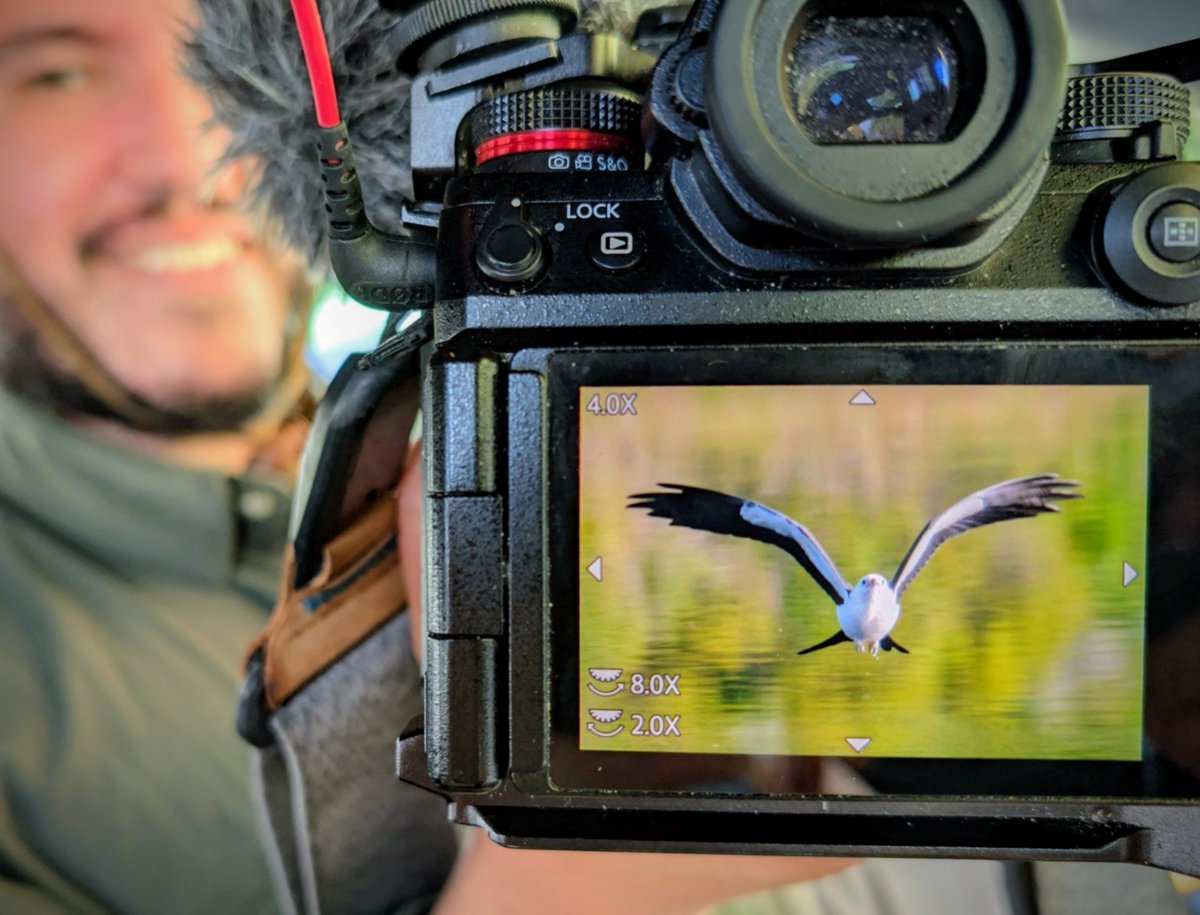
Watched swallow-tailed kites descend slowly over the slough this morning, hunting for a sip of water on the wing. The window to catch that splashdown moment is brutally tight and I missed those shots. But the in-flight captures more than made up for it.
My thoughts on signal jammer use in South Africa — based purely on my own lived operational experience.
To be clear: this is from what I’ve seen and dealt with on the ground in SA. Not second-hand reports.
Signal jammers aren’t exotic tech. High-end units exist that can turn a vehicle or property into a complete black hole, but the vast majority in circulation here are cheap imports. They overheat easily and have an effective range of roughly 10 to 15 metres on a good day.
The overwhelming use case is vehicle theft and hijacking. There are also sporadic reports of them being used in cash-in-transit heists, farm attacks, and home invasions.
It’s become bad enough that many insurers now insist on two tracking units per vehicle — something you see constantly on Toyota Hiluxes, Ford Rangers, and the smaller 1-ton flatbeds.
Another common application is copper theft, specifically targeting the trucks that move large copper sheeting (not the underground cable).
The units you most often encounter are the typical two- and three-row antenna systems. They’re poorly made, have a very limited effective field, and overheat quickly. They are portable to a degree thanks to built-in batteries, but power drops significantly in portable mode. They’re most effective when plugged into a 12V vehicle socket.
These models commonly sell for anything from R1 800 up to R12 000 depending on the supplier. Many are bought (and smuggled in) from Zimbabwe and Mozambique via platforms like Bobshop, Amazon SA, or the suppliers’ own websites. A simple Google search for “signal jammer for sale” will show you how easily they ship.
They typically block Wi-Fi, Bluetooth, GPS, and common bands like LowJack, SigFox, and 433 MHz.
There is a famous photograph from the Korean War of a young Marine officer scrambling over a seawall, rifle in hand, leading his men off the boats and into the fight at Inchon. The man in that picture, Lieutenant Baldomero Lopez, was dead within minutes of it being taken. He is one of the very few people on earth photographed in the last moments of his own life while earning the Medal of Honor.
Lopez was a Tampa kid, the son of Spanish immigrants, sharp enough to earn his way into the Naval Academy at Annapolis. By September 1950 he was a Marine first lieutenant, and he came ashore in the assault waves at Inchon, the daring amphibious landing that turned the whole war around. That is where the photographer caught him, going up and over the seawall at the head of his platoon, straight into the teeth of the beach defenses.
The beach was a mess of enemy bunkers and pillboxes, and one of them had his men pinned down with automatic weapons fire. Lopez did what a good officer does. He went after it himself. He crept up alongside the position, pulled the pin on a grenade, and raised his arm to throw it into the gun port.
At that exact instant an enemy gun caught him, hitting him in the shoulder and the chest. The wounds knocked him backward, and the live grenade fell out of his hand and dropped to the ground right next to his own Marines.
He was badly hit, bleeding, in shock. His arm no longer worked well enough to pick the grenade back up and throw it clear. He had a couple of seconds and one terrible decision to make. He could roll away and try to save himself, and let the grenade go off among his men. Or not.
Lopez pulled the grenade in underneath his own body, wrapped himself around it with a sweep of his ruined arm, and took the entire blast into himself. It killed him. It saved the men around him.
He was twenty five years old. His parents received his Medal of Honor. And that photograph of him going over the wall has hung in Marine Corps history ever since, a young officer forever frozen at the front of his men, seconds from giving up everything so they could live.