TRENDLINE TRADING MADE SIMPLE
✔ TRENDLINE BASICS.
A trendline shows where price keeps reacting.
✔ BOUNCE ENTRY.
Enter when price respects the trendline and moves in the trend direction.
✔ BREAKOUT ENTRY.
Wait for a retest after the breakout, then enter in the breakout direction.
��� STOP‑LOSS PLACEMENT.
Always place SL beyond the trendline to protect your trade.
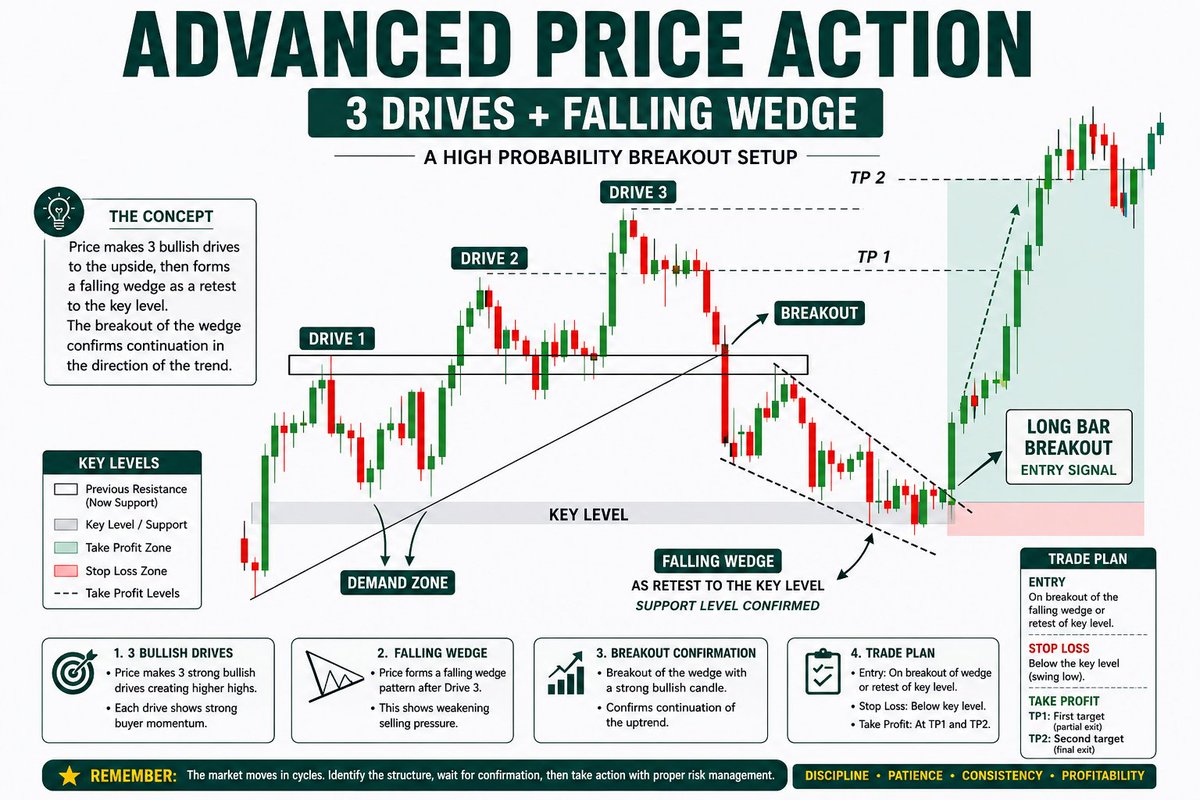
Not every breakout is worth trading. The best ones tell a story.
This setup combines two powerful price action concepts:
✅ 3 Bullish Drives – showing strong buying pressure and trend continuation.
✅ Falling Wedge – a bullish continuation pattern that traps impatient sellers before the next expansion.
The edge isn't in recognizing the pattern alone—it's in waiting for confirmation.
Wait for the breakout.
Enter after confirmation.
Place your stop loss below the structure.
Target the next liquidity zone.
A gap is not an entry signal. It's an opportunity
if you know how to trade it.
Most traders jump into the market as soon as they see a gap up. Professional traders wait for confirmation.
A high-probability Gap Up strategy:
1.Identify the trend with a trendline.
2.Wait for price to retrace and fill the gap.
3.Use Fibonacci Retracement to locate the optimal entry zone.
✅ Enter only after bullish confirmation.
🛡️ Place your stop loss below the key Fibonacci level.
🎯 Target the 1.618 Fibonacci Extension for maximum reward.
Distribution is where smart money exits while retail traders keep buying.
Wait for the breakdown.
Trade the retest.
Let the market confirm your entry.
Patience pays.
Stop chasing breakdowns. Start selling pullbacks.
One of the biggest mistakes traders make is selling immediately after support breaks.
Professional traders know that the highest-probability entries come when price pulls back into resistance, not after it has already moved away.
📌 In a downtrend: ✅ Sell at Resistance ✅ Wait for bearish rejection ✅ Follow the market structure ❌ Don't sell at broken support ❌ Don't chase price
The best sell setups don't happen at random—they happen at key institutional levels. 📉
A Bearish Order Block marks the area where smart money stepped in before a major decline. Instead of chasing the move, wait for price to retrace into the order block and show rejection.
A high-probability bearish setup:
🔹 Confirm the downtrend with a Break of Structure (BOS).
🔹 Identify the Bearish Order Block and Fair Value Gap (FVG).
🔹 Wait for price to retrace into the zone.
🔹 Enter only after bearish confirmation.
🔹 Place your stop loss above the Order Block.
🔹 Target the next liquidity pool or swing low.
Remember: Patience creates precision. Precision creates consistency.
FVG öğrenmeden önce şunu öğren:
Piyasa boşluk bırakmaz.
İnsanı boşlukta bırakır.
Çoğu kişi FVG görünce
“işlem geldi” sanıyor.
Hayır.
Asıl para
fiyat o boşluğa geri döndüğünde kazanılır.
Çünkü marketin çalışma mantığı şudur:
İmpulsif hareket → Dengesizlik → Geri dönüş → Devam
Ama insanlar sadece ilk kısmı görüyor.
Sonra ne oluyor?
Fiyat sert giderken atlıyorlar.
Tam FVG’ye dönüşte korkuyorlar.
En iyi bölgeyi kaçırıyorlar.
Profesyoneller neden sabırlı biliyor musun?
Çünkü onlar hareketi değil
verimsizliği trade ediyor.
Bekledikleri şey:
• Güçlü displacement
• Temiz FVG
• %50 mitigasyon
• HTF yön onayı
• Likidite hikayesi
İşte gerçek confluence budur.
Ve en kritik detay:
FVG tek başına setup değildir.
Bağlam yoksa
o boşluk sadece rastgele bir mum aralığıdır.
Market önce acemeye hareketi gösterir.
Sonra profesyonele girişi verir.
Kaydet.
Çünkü çoğu trader FVG çiziyor ama neden çalıştığını hâlâ bilmiyor.