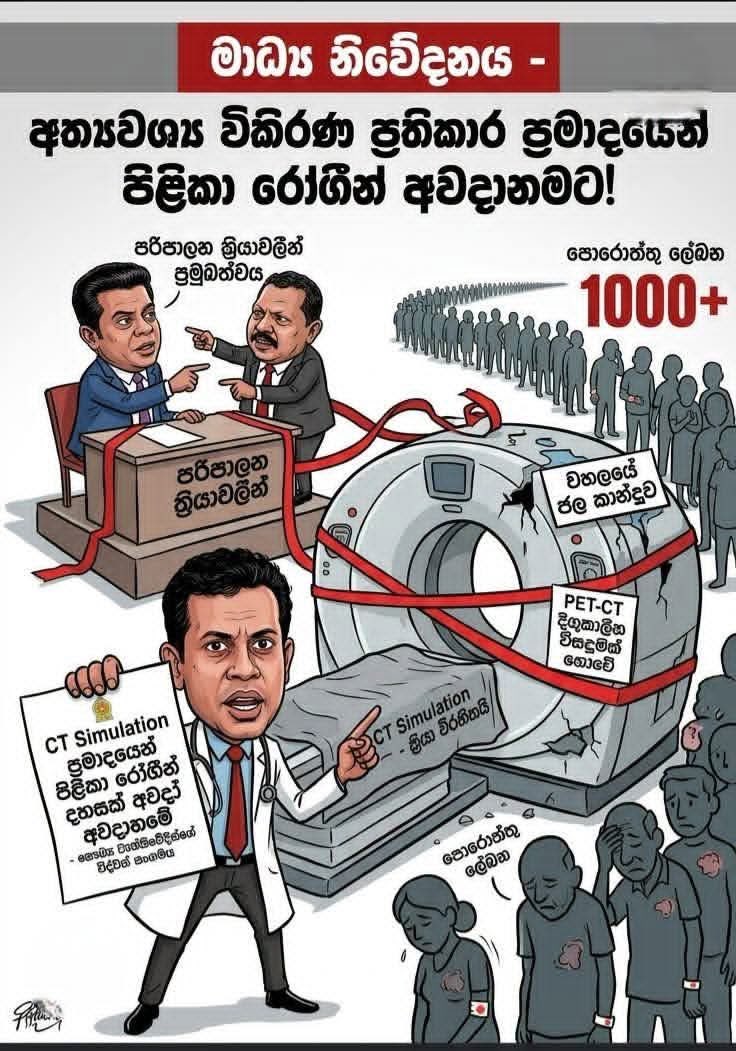
This sums up the entire JVP-NPP ship-of-fools governance.
1⃣Incompetence
2⃣Lack of management bandwidth
3⃣Lack of imagination
AND
4⃣Belief that building and growing is easier than destroying which the only thing they knew how to do
18 May 2009.
A date every Sri Lankan carries in their heart.
It was the day the bombs stopped. The day families stopped fearing what the next morning would bring. The day a country that had bled for so long finally got to breathe.
I think about the people who made that possible. Ordinary men and women who walked into extraordinary circumstances and never looked back. Many of them never came home. We owe them more than words.
But here’s the thing about peace. It doesn’t maintain itself. It asks something of us too.
It asks us to build a country that actually reflects what they died for. Not a Sri Lanka divided by race or religion or language. But one where every person, regardless of who they are or where they come from, gets to live with dignity and a real shot at a good life.
That’s the Sri Lanka worth fighting for. That’s the Sri Lanka worth building.
Seventeen years on, I remain deeply grateful to everyone who contributed to ending that chapter of pain. And I remain hopeful, genuinely hopeful, that the best of this country is still ahead of us.
For every Sri Lankan. Without exception. 🇱🇰
Diplomacy is not about winning arguments. It is about finding solutions. It is about knowing when to stand firm and when to compromise, always guided by principles, not ego. In a world that is increasingly divided, the ability to build bridges rather than walls will define true leadership.
It is always easy to sell a dream, especially one that is sweeping, emotive, and detached from reality. The more ambitious it sounds, the less it is questioned. In opposition, promises become easy currency. They cost nothing, demand nothing, and carry no immediate consequence.
But governing is an entirely different discipline.
It is not about rhetoric. It is about responsibility. It is about choices, trade offs, and constraints. It is about taking difficult decisions, often at political cost, to secure long term stability and credibility. It is about execution, consistent, measured, and accountable.
The moment a promise meets reality, its true weight is revealed. What once inspired hope quickly becomes a burden when delivery falters. Credibility erodes. Public trust weakens. The gap between expectation and outcome breeds frustration and disillusionment.
A nation cannot be governed on aspiration alone. It must be anchored in honesty, realism, and competence.
Because in the end, people do not live on promises. They live on results.
I have always considered the so-called midweek Wednesday holiday to be a misfit, an ill - conceived measure that disrupted the natural momentum of the working week.
It imposed a significant strain on continuity, with adverse ripple effects on education, public administration, and the broader functioning of the economy.
I therefore welcome the government’s decision to reverse it promptly, without prolonging its negative consequences.
If anyone wants to give any credit to anyone for developing the National Fuel Pass QR based system, it should be to Jayantha De Silva & his team at ICTA, Supun Weerasinghe & his team at Dialog Axiata, Shevan Goonathilake & his team at Millenium IT.
Their teams developed the platform within 2 weeks of our first meeting and rolled it out within a month at no cost to the government. It was implemented with the assistance & dedication of many more stakeholders.
I was present in the hall at the Raisina Dialogue when Foreign Minister Vijitha Herath made his remarks during the panel discussion on The Future of the Indian Ocean.
Very often, Ministers are not necessarily experts in foreign relations or foreign policy. One cannot fault them for that. However, it is the responsibility of the Foreign Ministry and our diplomatic missions to properly brief and prepare the country’s representatives for all possible questions and scenarios.
In this instance, I believe it was entirely foreseeable that the question regarding the two Iranian vessels would be raised — particularly with Palki Sharma moderating the discussion.
A carefully calibrated response could easily have been given. For example, the Minister could simply have said that Sri Lanka maintains friendly relations with all these nations, and that our decisions will always be guided by law, principle, and what is in the best interests of the country.
Such a response would have resonated well with the audience — a hall of over 600 influential leaders, policymakers, diplomats, and analysts from across the world.
I sincerely hope that lessons are drawn from this moment, and that in the future our representatives are better prepared and supported, particularly when speaking on global platforms of such significance - BASL President Rajeev Amarasuriya
When answering a serious question about the current war situation that Sri Lanka got involved indirectly, why is the Foreign Minister laughing while responding and why is the audience laughing at his answer?
Don’t think that was a matter to laugh at!
Sri Lanka deserves strong and professional representation on the international stage. When our leaders speak to the world, preparation, clarity, and respect for the audience matter.
Foreign minister, please come prepared, use proper translators if necessary, and communicate our country’s position clearly. Every appearance reflects on all Sri Lankans.
As a nation, we deserve representation that reflects the intelligence, dignity, and potential of our people. Let’s raise the standard of how Sri Lanka is presented to the world.