We’ve designed and built our first AI chip: Jalapeño.
Designed from the ground up by OpenAI and brought to production with @Broadcom, Jalapeño is purpose-built for the LLM workloads powering ChatGPT, Codex, the API, and future agentic products.
Chips are foundational to the AI economy. Building our own expands our full-stack platform from products to models to infrastructure, and will help us scale intelligence, serve more people, and expand access to AI.
It’s time for everyone to realize that the fight against data centers has nothing to do with data centers.
They have become a proxy for the hate towards AI and the concentration and accumulation of wealth it’s creating.
Until those running the big LLMs understand this and start a community tour, not to explain the benefits of AI, it’s too late for that, but to help towns and cities that may be impacted by job losses (and I’m a believer their will be a net gains in a few years), this battle is only going to get more intense and let me tell you now , no matter how much money you pay to buy politicians and races, you will lose.
One thing I have learned is being hated is not good for business.
How can they help ? They will tell you. You will need to do what they ask. Billions of dollars is a lot of money across towns and city programs. Across the major LLMs, it’s a cost of doing business.
At the same time, I would go to LA and NYC and ask the arts and creative unions what kind of programs would help and protect their artists. DO NOT GO TO THE MUSIC OR FILM COMPANIES. that will make it worse.
Don’t try to pay famous people to endorse what you are doing. That’s dumb.
Talk to artists and ask them what you can do to provide financial and creative support. Every creative I know is TERRIFIED about what AI will do to their profession. You must meet them face to face and basically do what they say.
The big LLMs have lost the PR battle. Why ? Because they all suck at putting people first. They have an SV attitude that makes them all think they are John Galt saving the
world
Given the number of data centers and power that is needed, today and going forward , If you don’t kiss the asses of the people that go to work every day, and are just trying to pay their bills, you will fall far far short of the capacity you need to make your business work.
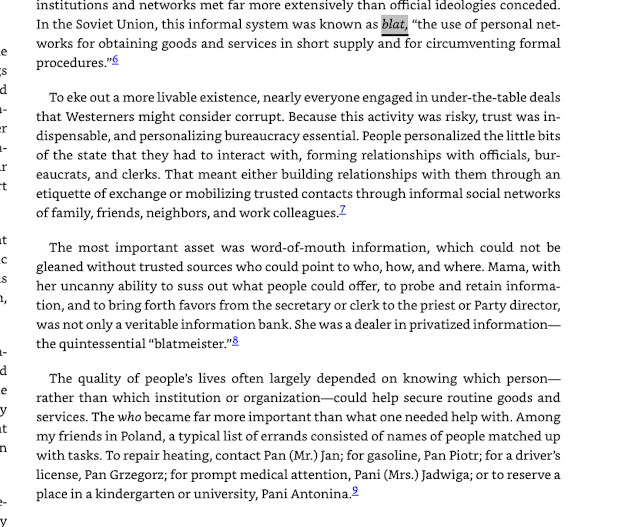
The Jeff Epstein saga isn't a scandal about pedophilia, it's about a Russian word called 'blat,' a Soviet-era word meaning 'the use of personal networks for obtaining goods and services in short supply and for circumventing formal procedures.' It's about a kind of government.
As with the large number of 'blatniks' in the Soviet era who made sure their factories got what they needed outside the formal state procurement process, Epstein greased the wheels for the neoliberal state. His job was governance.
What does that mean? Well it's clear that Epstein was an entrepreneurial broker across multiple public and private bureaucracies, helping organize 'under-the-table' deals among the legal, business, intelligence, and political elites to allow them to escape the rule of law and traditional conflict of interest restrictions. It's statecraft to allow a superclass to systemically escape the formalized rules.
The pedophilia and prostitution were part of it - that is obviously violating the rule of law - but so are the random favors Epstein bestowed. Like Epstein sending Senator Joe Manchin's request for a yacht, a request which came from the First lady of the Virginia Islands, to a random NY financier who might have one. Or working with Joi Ito at MIT and billionaire Reid Hoffman to restructure the Bitcoin Foundation. It's all about matching capital and talent and inputs outside of the restrictions ordinary people are subject to.
This kind of governance is particularly important in Soviet-style states, where everyone knows the rules are fake, where skirting the system IS the system. Epstein and his affiliates thrived because of the weakened institutions of the United States, institutions enfeebled in many cases by the men in his network, like Larry Summers. These men adopted multiple roles - advisor, businessman, academic, board member, regulator - and put on the hat that best maximized their self-interest and the self-interest of their narrow network at that moment.
The old world, where handing someone your business card meant you represented that institution, disappeared in the 1980s. Over the course of the 1990s, neoconservatives, neoliberals, bankers - ultimately Epstein's network - built this new social order. It was one where you couldn't succeed through the formal rules, but if you were let into the networks of trust by blatniks, you could do anything you wanted.
While all the specifics of Epstein's network are not known, and while conspiracy theorists often have crazy views, they have correctly fingered that the world of meritocracy and formalized systems is increasingly a fraud. And that the real government lies elsewhere.
In short, when formal democratic institutions like Congress stop governing, the networks of men like Epstein fill the power vacuum. Epstein built what Roy Cohn always wanted to have, but never achieved, because the then-institutions were too strong for him to break.
Here's a passage from sociologist Janine Wedel's Shadow Elite on how this form of governance works.
This is the best summary of the current geopolitical situation I have seen. Sir Alex Younger was head of MI6 between 2014 and 2020. Really worth watching.
1/ 🧵 Why a Bitcoin reserve alone won’t secure America’s role in the future of money— The United States benefits from what economists call the "exorbitant privilege."🪙As the issuer of the world’s reserve currency, it can borrow and support new spend in its own currency. 💵
To me, the most fascinating aspect of Deepseek is the fact it stemmed from a hedge fund, a mere few months after China "cracked down" on the levels of compensation in the finance industry.
It's also incidentally an important reason why the U.S. will struggle to compete with China.
Let me explain.
First of all, worth mentioning that this was predictably, as for most Chinese initiatives, presented by Western media as a terrible move (2 examples screenshoted below 👇) - "why would China do this to the poor innocent bankers" 😏. As usual they didn't even try to reflect on why China would do this: as we all know, all Chinese initiatives are always completely mindless and "crackdowns" are just what the Communist party does for fun...
The actual reason this was done, I believe, is that China looked at the West - the U.S. in particular - and saw the overbearing importance of the finance industry at the expense of the real economy. And in particular they saw that the country's most brilliant graduates from the very best Ivy League schools went to work for the increasingly parasitic finance industry instead of working on stuff that actually made society move forward.
Bloomberg lamented below that the "crackdown" would "fuel an industry brain drain" and yes, that was precisely the point: China doesn't want those who can most contribute to society to spend their careers building ever more senseless financial derivative products or new ways to trade crypto. It doesn't mean they don't want a finance industry, it does serve a purpose, just not one that becomes such a drain on society, in particular in terms of capturing the country's best talents. China would rather have them working on stuff like... artificial intelligence.
And lo and behold, fast forward a few months, and you suddenly have hedge fund geniuses who found a new calling in AI. Too good a coincidence not to see a correlation there.
This is something that would arguably be very hard for the U.S. to do, where capital is very much in control: an industry that becomes extremely wealthy, even if largely detrimental to broader societal goals, becomes difficult to reform. We're seeing this with finance, defense, big pharma, etc.
It also illustrates that the U.S. and China are at different stages of their development: excessive financialization is a common pattern among late-stage great powers - from the Dutch Republic to the British Empire (but also Venice or Spain) - and a vicious-circle type factor of their decline. Emerging great powers are often more thoughtful and nimble about managing talent flows to achieve technological and industrial primacy.
Looking at this question is also very interesting in the context of the H-1B visa debate in the U.S. It feels like the debate doesn't address the elephant in the room: why claim a shortage of top talent when the country's best minds are funneled to the finance industry? Much more coherent to first thoughtfully allocate talent at home before seeking to brain drain the rest of the world...
Anyhow, yet another example of a Chinese policy that seems bizarre and incomprehensible to the West at first glance but which over the long run (and even short-run as illustrated by Deepseek) helps China develop another strategic advantage in the tech competition. Simply put: you want your best minds building real value, not extracting it from society.
'Man bites dog was a big story once, but the bigger story now, for them, is the cultural import of the attack and who is strengthened and who is weakened by the assorted retellings of the matter."