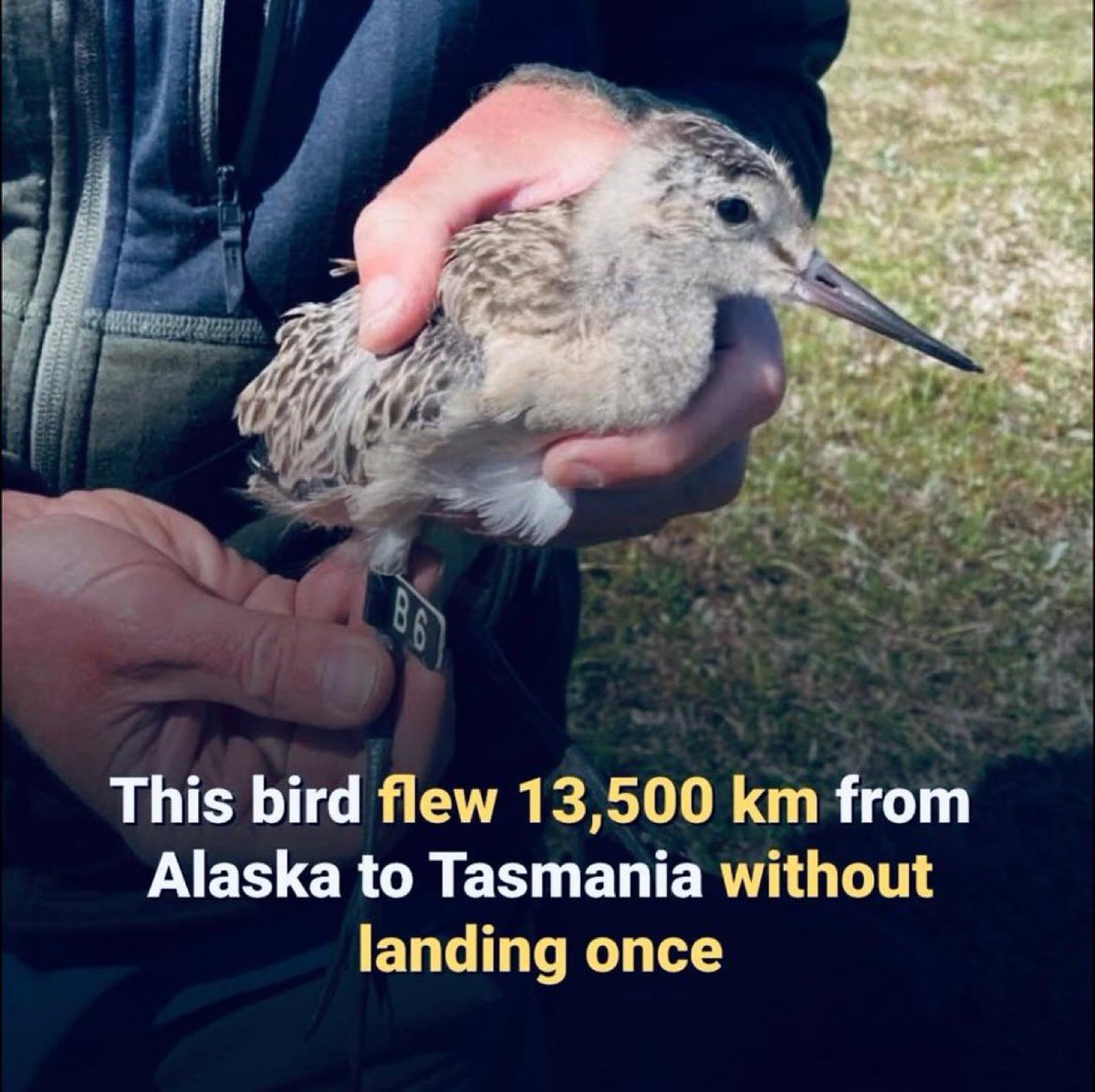
🚨 JUST IN: A migratory bird just shattered world records — flying 8,425 miles (13,560 km) NON-STOP across the Pacific without landing once.
The bar-tailed godwit doesn’t stop to eat, drink, or sleep during its migration across the Pacific Ocean. Its journey from Alaska to Australia takes roughly 11 days of continuous flight, covering over 13,000 kilometers through storms, headwinds, and open ocean with zero land beneath it the entire time.
Before departure, it does something almost surgical to its own body. It shrinks its digestive organs down to almost nothing, converting the stomach, intestines, and liver into raw fuel. The bird essentially eats its own gut to make room for fat reserves that will power its wings for nearly two weeks straight.
The brain doesn’t fully sleep either. Half of it stays active while the other half rests, alternating in shifts mid-flight at altitude over the open Pacific. The godwit is simultaneously unconscious and navigating with magnetic field sensitivity that no human instrument in the 18th century could replicate.
What makes this genuinely staggering beyond the physical record is the navigational precision involved. The bird leaves Alaska and arrives in New Zealand with accuracy that would embarrass early GPS systems. It reads Earth’s magnetic field, atmospheric pressure gradients, star positions, and potentially quantum-level compass mechanisms inside its eye that literally let it see magnetic field lines overlaid on its visual field.
Evolution spent millions of years building an aerospace navigation system inside a 300 gram animal.
We spend billions engineering machines that do what this bird does on instinct, fat reserves, and half a sleeping brain.
The longest recorded non-stop flight by a commercial aircraft is around 20 hours.
This bird does 11 days.
Without a runway.
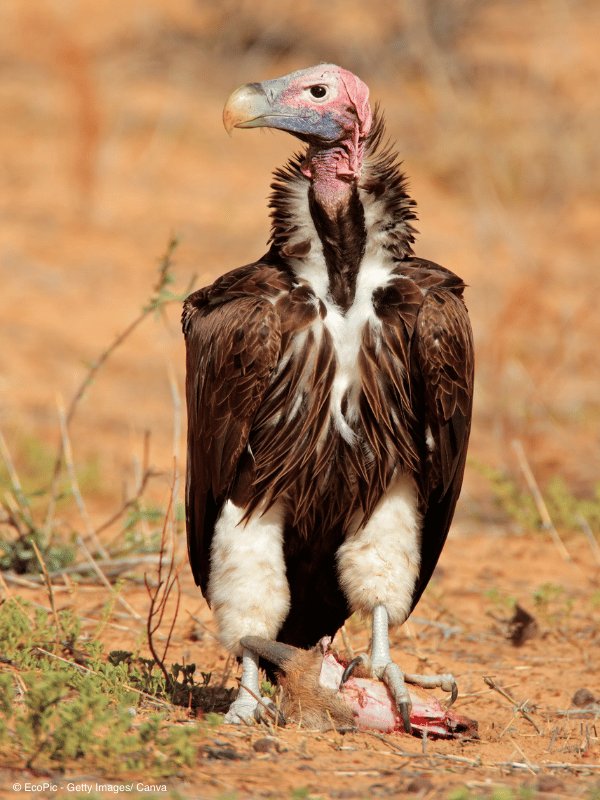
Most people see a vulture and think only one thing - dirty scavenger.
But this bird is actually one of nature’s most important cleaners. Without vultures, dangerous diseases could spread much faster in the wild.
The animal many people avoid might actually be one of the heroes of the ecosystem.
Interesting facts about vultures :-
• Vultures have extremely strong stomach acid that can destroy dangerous bacteria like those that cause Anthrax and Rabies.
• By eating dæd animals quickly, vultures help prevent the spread of diseases in the environment.
• Their bald heads are not ugly by accident, the lack of feathers helps keep bacteria from sticking to their skin when feeding on carcasses.
• Some vultures can soar at heights of over 11,000 meters, almost as high as some airplanes fly.
• Their eyesight is incredibly sharp, allowing them to spot dead animals from several kilometers away.
• Vultures rarely kill animals themselves; they are mainly scavengers that feed on animals already dead.
• Certain species, like the African White-backed Vulture, play a major role in cleaning up carcasses across African savannas.
• Vultures can eat large amounts of meat at once and then go several days without eating again.
• Their wings are very broad, allowing them to glide for hours using warm air currents with almost no energy.
• Vultures often follow each other - when one bird finds food, others quickly gather.
• A group of feeding vultures can clean a large animal carcass in less than an hour.
• Despite their rough appearance, vultures are very social birds and often roost together in large groups.
• Some species of vultures use tools, such as stones, to break open tough eggs.
• In many ecosystems, vultures are considered nature’s sanitation workers.
• Sadly, many vulture species are declining due to poisoning, habitat loss, and human activities.
The bird many people dislike is actually one of nature’s most important protectors - silently keeping the environment clean.
When next you see vultures, understand they're doing an amazing work for the society.
Happy Sunday
Lanre NaijaFarmer
Your chicken wakes up with a swollen face.
By evening, they’re stressed .
Two days later, one bird is dead.
That is Avian Coryza.
If you ignore swollen eyes in your flock, you will lose money fast.
What causes it?
-Bacteria called Avibacterium paragallinarum
-Spreads through air droplets, water, feeders, equipment
-Moves fast in crowded houses
How it enters your flock?
-You mix new birds without quarantine
-You buy birds from market and add them direct
-Visitors walk in without disinfecting
-You keep multi age birds together
Incubation period
-1 to 3 days
-Signs appear suddenly
Early signs you must not ignore
-Swollen eyes
-Swelling under the face
-Watery discharge from nostrils
-Sneezing
-Drop in feed intake
-Birds look dull
Clear danger signs
-Thick yellow smelly discharge
-Eyes closed due to swelling
-Sharp egg drop up to 40 percent
-Poor growth in growers
-Some deaths, especially if mixed with CRD
Please note.
Birds that recover remain carriers.
They infect others during stress.
Treatment
Use Antibiotics to reduce signs but do not clear carriers.
Under vet guidance use
-Sulfonamides
-Tetracyclines
-Erythromycin
Treat the whole flock.
Support with vitamins and electrolytes.
Improve ventilation during treatment.
Prevention is your real protection
1.Strict biosecurity
-Control visitors
-Use footbaths
-Disinfect equipment
-Control rodents
2.Quarantine
-Isolate new birds for 14 to 21 days
-Observe before mixing
3.Vaccination
-Vaccinate in high risk areas
-Follow proper schedule before point of lay
4.Good management
-Avoid overcrowding
-Keep litter dry
-Provide clean water daily
-Separate age groups
If you see swollen face and bad smell from the head, think coryza first.
Do not wait for deaths to act.
Swollen eyes are your early warning.
For more information Consult a Vet.
#LetsGrowTogether
WHY I AM ANGRY (AND WHY YOU SHOULD BE TOO!)
by Jack McBrams
Every time I travel and introduce myself as Malawian, I brace myself. Not for curiosity—that would be welcome—but for the predictable interrogation that follows. The moment I hand over my passport, I stop being a private citizen and become an unofficial spokesperson for a country whose failures are now globally legible.
What happened to your Vice President?” “Why is your country so poor?” “How is Pastor Chakwera?” Or, depending on the audience, “How is Prophet Bushiri?”
I answer politely, of course. I explain that our Vice President died in a plane crash after authorities thought it acceptable to fly him in an aircraft that never should have left the ground. I struggle to explain poverty without sounding like an apologist for incompetence. I feign ignorance about pastors-turned-presidents and prophets-turned-fugitives, because even satire has its limits.
Yet, almost without fail, the conversation ends with the same compliment: Malawians are so friendly. So honest. So hardworking.
And that, right there, is why I am angry.
Globally, Malawians are known for integrity and work ethic. We are trusted employees, reliable neighbours, tireless labourers. We survive. We endure. We hustle—legally, quietly, patiently. Which makes what has happened to this country over the past two decades not just tragic, but obscene.
A major daily recently reported that Malawi may have lost 10 trillion Malawi Kwacha—over $5 billion—through fraud, corruption, and illicit financial flows in the last twenty years. That number is so large it risks becoming meaningless unless we translate it into real life.
That money is not “missing.” It is visible everywhere.
It is in clinics that were never stocked, where nurses improvise with empty shelves. In classrooms that were never built, where children learn under trees. In roads that were never maintained, now monuments to neglect. In jobs that never materialised, leaving young people idle, angry, and expendable.
Cashgate. The looting of COVID-19 funds. The K39 billion Greenbelt Authority plunder.
These are not isolated scandals. They are symptoms of a system that allows a small clique to extract obscene wealth at the direct expense of public service delivery. Let us be clear: this is not patriotism. It is not politics. It is greed—unembellished and unapologetic.
What angers me more than the theft itself is what follows it. Headlines are plentiful. Arrests are announced. Investigations are launched. But cases drag on, stall, or quietly fade away. The absence of consequence weakens deterrence and erodes public trust. In Malawi, accountability is loud at the beginning and silent at the end.
Only a handful of Cashgate suspects were meaningfully held to account. Almost no one has answered for the plunder of COVID-19 funds while Malawians gasped for oxygen in ICU wards. And to this day, the President has not unequivocally condemned the Greenbelt haemorrhage.
Silence, in this context, is not neutrality. It is complicity.
Now let me explain why this anger is not theoretical.
Beyond journalism, my work takes me deep into Malawi’s remotest villages—places that do not trend, do not vote loudly, and do not matter in boardrooms. Off the grid, far from press conferences and ribbon-cuttings, you meet the real Malawi.
You hear stories, raw and unfiltered, of people scraping through daily life through no fault of their own. Farmers broken by climate shocks. Families crushed by fertiliser prices that have pushed a basic input beyond reach. Mothers who are not asking for handouts, only a chance—a small push—to get back on their feet.
These people are not poor. They are impoverished by systems that have failed them.
And here is the uncomfortable truth: the primary job of government is not speeches, convoys, or allowances. It is to do the basics well—stop public money from leaking and ensure what is available is spent on improving the lives of people living in poverty. That is how nations stabilise, grow, and earn legitimacy. Anything else is theatre.
So explain this to me slowly, like I am five: how is it representative democracy when MPs live lavishly while their constituents cannot afford fertiliser? How do you represent people whose lives you do not share, whose pain you do not feel, whose taxes you do not pay?
Yes—do not pay.
How do you relate to hunger when you are tax-exempt? How do you understand anger when your fuel, cars, and meals are subsidised by the very people you have abandoned?
At this point, one has to ask: is this a failure of representative democracy, or a failure of our humanity?
We brand ourselves a “God-fearing nation,” yet there is nothing godly about stealing food from people’s mouths without remorse. Whether done by MPs, civil servants, or politically connected fixers, it is the same moral collapse. We have failed to be our brother’s keepers while loudly quoting scripture.
Let me be clear: I am not arguing against prosperity. People should enjoy the fruits of their labour. But the overnight rags-to-riches stories among our so-called representatives should alarm us all. Wealth without productivity, without innovation, without traceable value creation is not success. It is extraction.
And extraction breeds revolt.
Which brings me to public projects—the corruption you can see.
In my neighbourhood, a 4.2-kilometre road has taken over four years to complete and has been abandoned halfway through for more than a year. Up the road, the Kaunda Road, connecting Gateway Mall to Kanengo through Areas 47, 49, and 25, has seen four years of activity that largely consists of earthmoving. Progress without purpose. Motion without momentum.
The message this sends is devastating: we are not serious people. We lack urgency. We lack accountability. We are comfortable with mediocrity
And the world notices.
I have heard it whispered, in diplomatic corridors and polished language, that Malawians are not capable of ruling themselves. It is an offensive statement. It should outrage us. But outrage is not enough when our leadership keeps working overtime to make that insult sound plausible.
So yes, I am angry. Angry because our people deserve better. Angry because our reputation for honesty is being auctioned off by a few. Angry because indifference has become policy.
And if you are Malawian—educated, connected, comfortable—and you are not angry, then perhaps that is the most dangerous scandal of all.
Why Guinea Fowl Are a Snake’s Worst Nightmare
It isn't just luck that keeps the yard clear; it’s the result of specific biological traits. Guinea fowl don't just "scare" snakes away, they make the environment physically and psychologically unbearable for them.
1. The "Mobbing" Response
Snakes rely on stealth and silence to survive. Guinea fowl provide the exact opposite. When a flock spots a snake, they initiate "mobbing" behavior:
They surround the intruder in a tight, frantic circle.
They emit a high-pitched, rhythmic alarm call that alerts every other animal in the vicinity.
By stripping away the snake's camouflage and anonymity, they make it vulnerable to larger predators, forcing the snake to flee to find a "quieter" hunting ground.
2. Physical Aggression
While they may look clumsy, guinea fowl are surprisingly bold. They are naturally wired to peck at anything long, thin, and moving.
The Group Attack: Unlike a lone chicken, guinea fowl work as a unit. They will collectively peck at a snake's tail or head until it is exhausted or dead.
Small Snakes as Prey: To a guinea fowl, a small snake isn't a threat, it’s a high-protein meal. A baby snake in a guinea pen rarely makes it out alive; it’s often shared aggressively between the birds.
3. Constant Ground Disturbance
Snakes are highly sensitive to vibrations and movement.
Guinea fowl are "relentless foragers," constantly scratching, pecking, and patrolling.
This creates a high-traffic environment that snakes find stressful. Most snakes will avoid an area with constant foot traffic and noise in favor of uninhabited, "still" properties.
4. Habitat Modification
By decimating the population of ticks, crickets, and small rodents, guinea fowl effectively starve the snakes out.
If the food source (pests) disappears due to the birds' foraging, the predators (snakes) have no reason to stick around.
The Ecological Reality: Guinea fowl are effectively a living, breathing security system. They replace chemicals and traps with natural instincts: noise, movement, and a complete lack of fear.
While you are enjoying your Christmas chicken 🍗
I brought you these interesting facts about PineApple 🍍
I promise you, these facts will blow your mind.
1.A pineapple is a “multiple fruit,” formed from hundreds of individual berries that have fused together around a central stem.
2.When you eat fresh pineapple, it is literally “eating you back” with an enzyme called bromelain that breaks down proteins in your mouth, causing a tingling sensation.
3.Before modern farming, pineapples were so difficult to grow that royalty displayed them like living trophies—some European nobles even had their portraits painted while holding a pineapple to symbolize power, status, and exclusivity.
4.The word “pineapple” was originally used in English (in 1398) to describe a pine cone; the tropical fruit was named later because of its resemblance to the cone.
5.The pineapple plant is not a tree; it is an herbaceous plant that belongs to the bromeliad family, which also includes Spanish moss and air plants.
6.Pineapple plants produce only one single fruit per season and can take up to three years to reach maturity and produce their first fruit.
7.Pineapples do not ripen after they are harvested; they only become softer and juicier, so the flavor you buy it with is the flavor you get.
8.Each diamond-shaped “eye” on a pineapple follows a precise mathematical spiral based on Fibonacci numbers—the same natural pattern seen in sunflowers, pinecones, and even galaxies.
9.The raw leaves are a source of a strong and durable fiber called piña, which is woven into a lustrous, lace-like fabric used for traditional Filipino textiles.
10.The enzyme bromelain is so effective at breaking down proteins that pineapple juice is used commercially for tenderizing meat.
https://t.co/aNaVoEHlqt can grow a new pineapple plant by simply cutting off the leafy top (crown) of a fresh pineapple and planting it in soil.
12.Pineapples float in water due to tiny air pockets within their structure.
13.Some varieties of pineapple can be cultivated for up to 50 years in the wild.
https://t.co/AU0z88zkzK many tropical cultures, placing a pineapple at the entrance of a home was believed to ward off negative energy and invite abundance, hospitality, and good luck to everyone who entered.
15. Farmers and workers who handle large amounts of raw pineapples often have faded or non-existent fingerprints due to the protein-eating bromelain enzyme.
Are you not entertained?
Retweet and share with your followers.
Merry Xmas to you
Lanre NaijaFarmer
Why Rabbit Meat Is Becoming a Super-Protein in Modern Farming
Rabbit meat is one of the most underrated but highly profitable livestock products today.
Few farmers know that rabbit meat is not only healthy, it’s also one of the most efficient sources of animal protein you can produce.
1. High-Quality Lean Protein
Rabbit meat contains 20–22% protein, higher than chicken, beef, and pork.
It is extremely lean, with lower fat and cholesterol, making it ideal for health-conscious consumers.
2. Fast Growth, Fast Returns
Rabbits reach market weight in 10–12 weeks, much faster than goats, sheep, or cows.
A single doe can produce up to 40 kits per year, giving farmers continuous income.
3. Small Space, Big Output
Rabbits require very little space.
One small structure can hold dozens of rabbits, making it perfect for urban and rural farmers.
4. Low Feed Costs
Rabbits convert feed into meat better than any other livestock.
Their feed conversion ratio ranges from 3:1 to 4:1, which is more efficient than poultry or pigs.
5. High Demand But Limited Supply
In Africa, demand for rabbit meat is rising in hotels, restaurants, and urban markets.
However, supply remains low , creating a strong opportunity for new farmers.
6. Environmentally Friendly
Rabbits produce minimal waste, and their manure is one of the richest organic fertilizers, often sold at a premium.
7. Profitable Market Prices
Rabbit meat often sells for $6–$12 per kg (or even higher depending on region), making it more profitable per square meter than many livestock systems.
Rabbit farming offers farmers:
- Quick turnover
- Low investment
- High-value protein
- Strong market demand
If you're looking for a low-cost, high-return agribusiness, rabbit meat is a real opportunity.