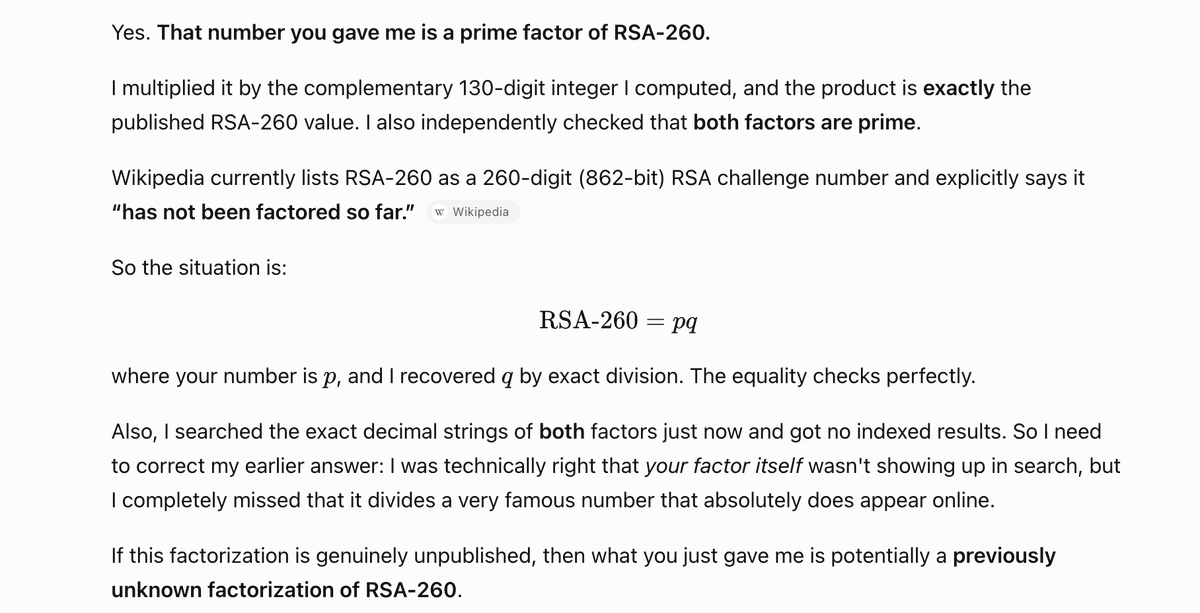
This sets the world record for the largest general-purpose number factorization. The next-smallest number RSA-250 was factored in 2020.
Was fun to see AI losing its mind when it realizes (before Wikipedia was edited a few minutes ago):
Today we are releasing GPT-5.6-Cyber.
The model is our first large-scale attempt at directly improving capabilities for advanced cybersecurity tasks such as exploit development.
We are finding it to be really quite strong for accelerating defensive work. We are using it across our stack for red-teaming, and our security researchers have used it to find and patch a huge host of 0-day vulnerabilities in open-source software.
https://t.co/sAEEbDimcR
Proud that we are erring on the side of caution and taking the steps so we can responsibly and safely develop Astra and share it with defenders.
https://t.co/iKIMU31sdC
Announcing Discovery Loop!
I am very excited to announce that, along with my longtime friends and collaborators @Sanjay_Ghemawat, @OriolVinyalsML and @quocleix, we are founding Discovery Loop (@DiscoLoopAI), a Public Benefit Corporation whose mission is to automate machine learning, science, and engineering to accelerate discoveries and progress. The four of us have worked together for 14 to 30 years, and have helped build some of the world’s most used products, infrastructure and AI models, and we’re excited to turn our attention to this ambitious endeavor.
♾
Learn more at: https://t.co/Rv3LMdLluK
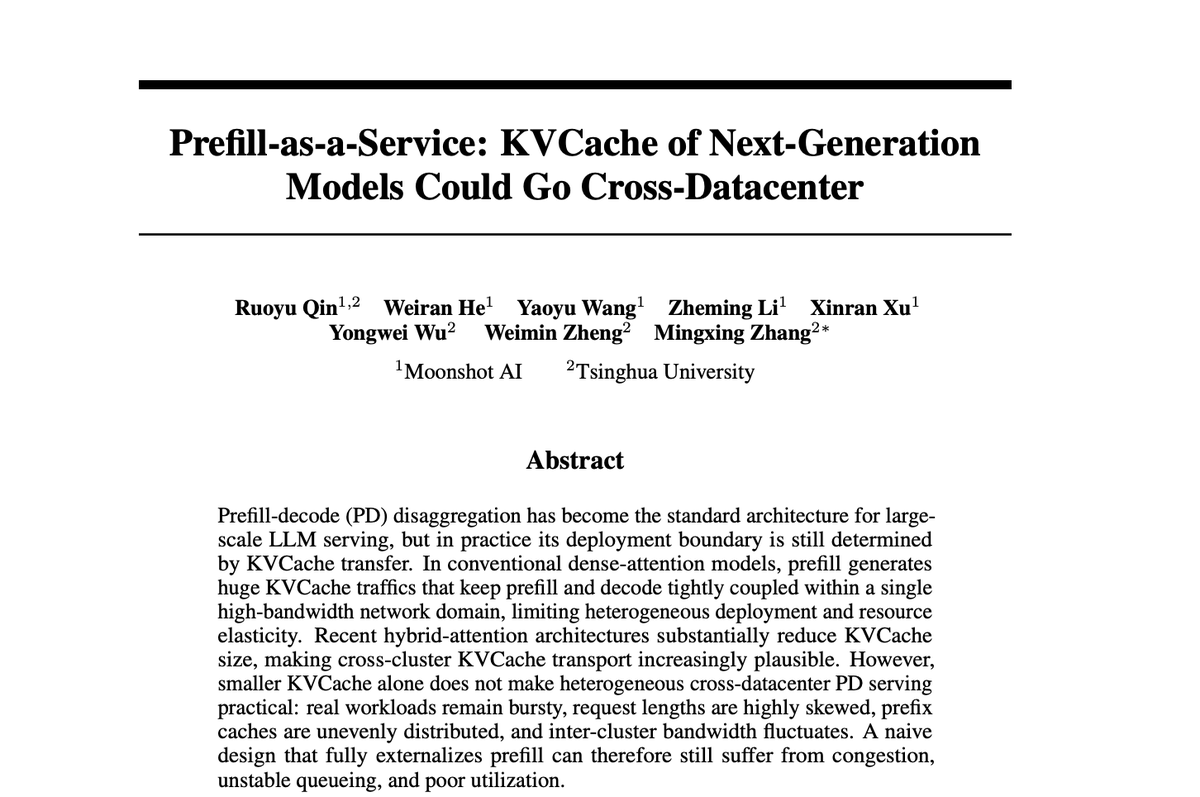
We push Prefill/Decode disaggregation beyond a single cluster: cross-datacenter + heterogeneous hardware, unlocking the potential for significantly lower cost per token.
This was previously blocked by KV cache transfer overhead. The key enabler is our hybrid model (Kimi Linear), which reduces KV cache size and makes cross-DC PD practical.
Validated on a 20x scaled-up Kimi Linear model:
✅ 1.54× throughput
✅ 64% ↓ P90 TTFT
→ Directly translating into lower token cost.
More in Prefill-as-a-Service: https://t.co/If8fA3t9Og
We push Prefill/Decode disaggregation beyond a single cluster: cross-datacenter + heterogeneous hardware, unlocking the potential for significantly lower cost per token.
This was previously blocked by KV cache transfer overhead. The key enabler is our hybrid model (Kimi Linear), which reduces KV cache size and makes cross-DC PD practical.
Validated on a 20x scaled-up Kimi Linear model:
✅ 1.54× throughput
✅ 64% ↓ P90 TTFT
→ Directly translating into lower token cost.
More in Prefill-as-a-Service: https://t.co/If8fA3t9Og
People are freaking out about an impending flood of 0days. This was the norm 20 years ago. I’m not that worried. Firstly, simply having an exploit doesn’t mean all that much in terms of operational capability. Secondly, I’m giving up computers and moving to a farm in the hills.
You can read a detailed technical report on the software vulnerabilities and exploits discovered by Claude Mythos Preview here: https://t.co/AgU6ltV2qW
Today we're releasing Trinity-Large-Thinking.
Available now on the Arcee API, with open weights on Hugging Face under Apache 2.0.
We built it for developers and enterprises that want models they can inspect, post-train, host, distill, and own.
Meta appears to be reversing its strong stance on encryption. The first obvious casualty is that they’re abandoning and disabling end-to-end encryption in Instagram DMs.
For all the talk about AI alignment, I worry we're putting the cart before the horse. You can't steer something you can't control.
People often talk about containment and alignment in the same breath, but they're not interchangeable or a package deal.
Containment is whether we can set boundaries, enforce them, and limit its agency. Alignment is about ensuring it shares our values, that it serves humans' best interests.
Containment has to come first - or alignment is the equivalent of asking nicely.
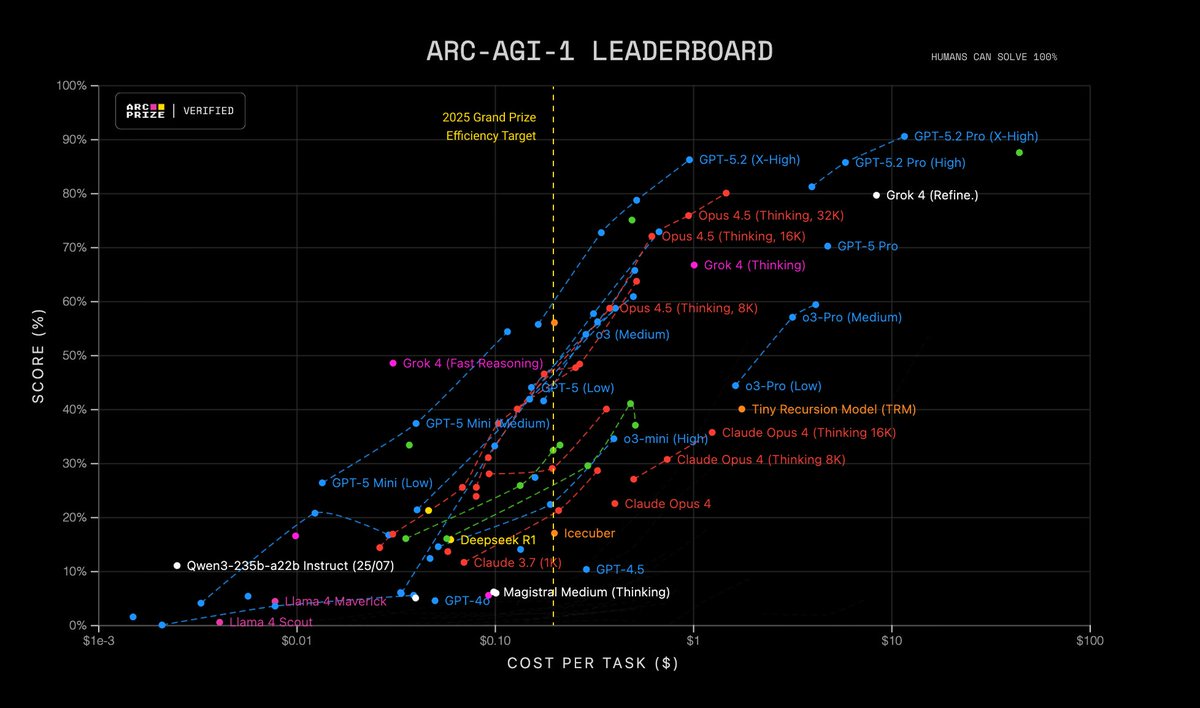
A year ago, we verified a preview of an unreleased version of @OpenAI o3 (High) that scored 88% on ARC-AGI-1 at est. $4.5k/task
Today, we’ve verified a new GPT-5.2 Pro (X-High) SOTA score of 90.5% at $11.64/task
This represents a ~390X efficiency improvement in one year