After working in the YouTube content space, I realised how hard it is to get stats for multiple channels in one place.
So I built Crosstats.
To track channels, compare competitors, score performance — all in one dashboard.
Free to start → https://t.co/7mzPVmuOsS
#YouTube #YouTubeAnalytics #ContentCreator #YouTubeGrowth #BuildInPublic
What I feel is happening isn’t AI sabotage, but future planning to restrict other nations from achieving AGI.
A lot of these companies are on the verge of AGI. Once they get there, they may try to prevent others from reaching it.
One route is restricting chip access. Another could be coming together and forming a treaty of sorts—similar to the NPT—to limit AGI development by other nations.
BREAKING: OpenAI recursive self-improvement researcher warns there is a 70% chance of “human extinction” in 3 years unless there is a coordinated slowdown between labs.
I resigned from Anthropic today. I spent the last three years doing pretraining research at both OpenAI and Anthropic. Neither company is acting responsibly. They are racing straight to self-improving superintelligence and gambling with our lives. More thoughts below.
One of the things I wanted to do while learning AI through @100xSchool Bootcamp1.0 was actually build something instead of just consuming theory.
So I built Ramayana AI.
It's a RAG-powered application that retrieves relevant passages from the Ramayana and uses Qwen3-4B to answer questions based on them.
Did all the cleaning and chunking the text → embeddings → retrieval → context → LLM → deploying the whole thing on Hugging Face.
Also got to learn, Prompt Engineering for the first time.
It’s now live:
https://t.co/bnHC6QLMU5
@rishabh10x@100xDevs@100xSchool - would love to hear what you think.
@RishabhPal8931 Thanks bro!
wanted to build something in the creator space, and since I have a background in cloud, I thought it would be a good project to experiment with.
Most of the architecture was actually vibe coded, but I learned a lot while putting the whole thing together.
After working in the YouTube content space, I realised how hard it is to get stats for multiple channels in one place.
So I built Crosstats.
To track channels, compare competitors, score performance — all in one dashboard.
Free to start → https://t.co/7mzPVmuOsS
#YouTube #YouTubeAnalytics #ContentCreator #YouTubeGrowth #BuildInPublic
I created an AI bot by giving it access to Ramayana.
You can actually ask it questions about the Ramayana, its characters and their specialities.
Deployed it publicly, and you can try it here 👇
https://t.co/bnHC6QLMU5
I'm thinking of making a video showing how I built it from scratch to a working application.
Soon. 🚀
#AI @WorldOfRamayana #Ramayana
I recently decided to build something instead of just watching theory on AI.
So started building a RAG project using Ramayana.
It sounded simple at first. It wasn't. 😅
(Sharing resources in the end.)
So far, I've learned:
→ RAG starts way before the LLM. I had to preprocess the PDFs, clean the text, and structure the Ramayana.
→ Created chunks with proper metadata, which later helped the system identify where an answer came from.
→ Embeddings ≠ LLMs. Understanding what embeddings actually represent and why embedding models are different from generative models was a big learning.
→ Spent much time exploring Hugging Face models, and learned more about fine-tuned vs base models, quantization, and why a 3B/7B model isn't simply “better” or “worse.”
→ Context size finally clicked. It directly affects how much information the model can work with at once.
→ Prompt engineering is much more than “write a better prompt.” With RAG, the goal is to make the LLM reliably use retrieved context and produce grounded answers.
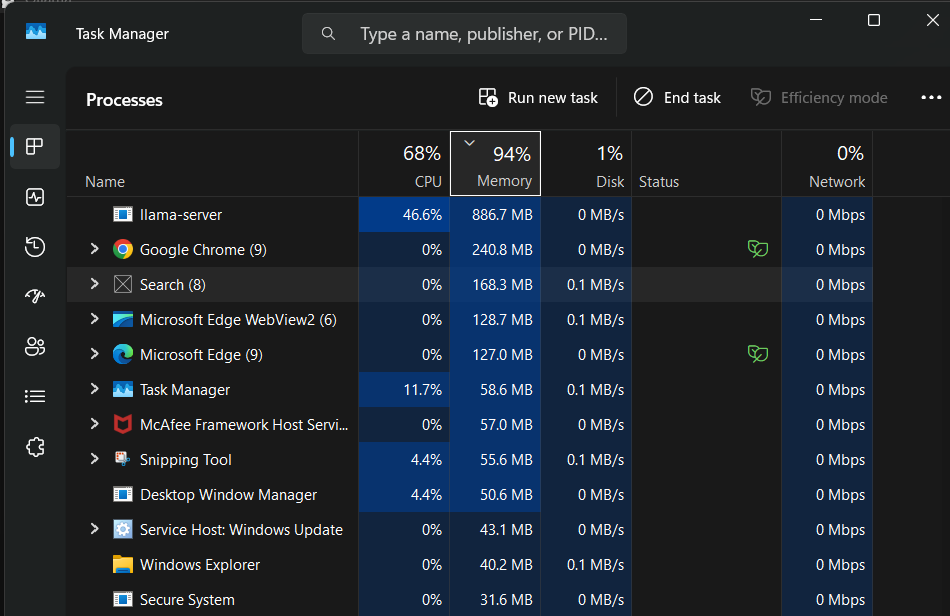
And somewhere along the way, I also learned why AI has made RAM suddenly feel like a luxury. 💀
A huge shoutout to @mrdbourke for his RAG implementation video. It was one of those resources that actually showed what was happening under the hood.
I'm still early in this project.
The next challenge I'm exploring:
How do you design the retrieval + prompt pipeline so an LLM consistently produces reliable answers from the retrieved source material?
If you're working with RAG, LLMs, embeddings, or AI engineering, I'd love to hear what you'd do differently.
I'll be sharing more as I build. 🚀
Tutorial on Simple RAG Pipeline Setup: https://t.co/sT9EHHfCTv
@Snowflake@Alibaba_Qwen
Depth-aware light injection in TypeGPU
I got a 448x448 monocular depth model down to ~8 ms on my M4 Pro across ~250 dispatches, which is fast enough to use in realtime :D
Since the inference is written directly in TypeGPU, I can just feed the depth buffer straight into the lighting pass. It never has to leave the GPU or go through any extra synchronization/interop step
Inference, lighting and draw all go through the same command encoder.
I can finally build my own apps without worrying about expiring tokens, API limits, or burning money on side projects.
Used Ollama , deployed open sourced Qwen Model locally and used it to buold a simple todo app.
No Expensive AI subscription.
No API bill.
No token limit hanging over my head.
Just an LLM running on my own laptop.
I jonestly did not realize local AI had bevome this accessible.
And this is just my first experiment.
Now I am thinking about creating a project using RAG.
Thanks to @ollama and @Alibaba_Qwen.
#LocalAI #LLM