Recently, my girlfriend and I were distant. I used @CassetteAi to create beats and wrote her a song. She loved it! Thanks, Cassetteai, for helping us reconnect! 🎶❤️ #LoveThroughMusic#CassetteAi
I did not notice, but somehow I managed to contribute more than 1000 commits last year, along with lots of hustle in life. But yeah, last year was fun and fruitful. Hoping for this year to bring more surprises, including more fun and learning.
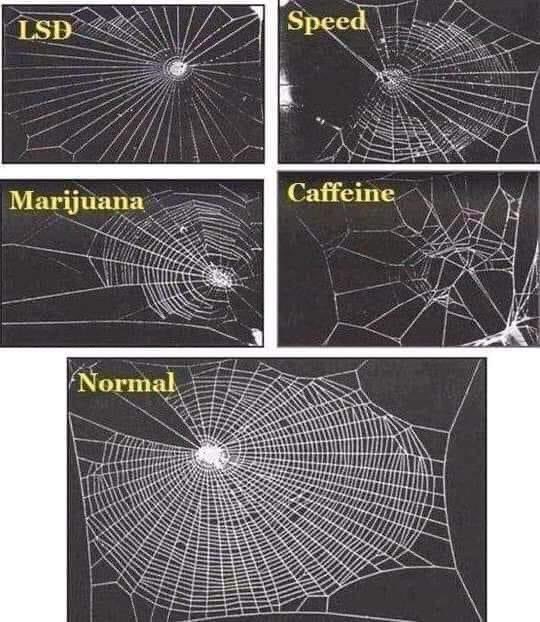
In 1995, a group of scientists conducted a study on the effects of various drugs on spiders, specifically focusing on the way they weave their webs. This research aimed to explore the impact of psychoactive substances on the behavior and motor skills of these arachnids
The initial motivation for the study was a request from a zoologist colleague to shift the time when garden spiders build their webs from between 2:00 a.m. and 5:00 a.m., which was apparently a source of annoyance. The scientists tested spiders with a range of psychoactive drugs, including amphetamine, mescaline, strychnine, LSD, and caffeine, and found that the drugs affect the size and shape of the web rather than the time it is built.
At small doses of caffeine (10 µg/spider), the webs were smaller; the radii were uneven, but the regularity of the circles was unaffected. At higher doses (100 µg/spider), the webs were even smaller, and the design became irregular and fragmented. The scientists also discovered that caffeine has a significant effect on spiders, which is reflected in the construction of their webs.
The study revealed that nearly every drug yielded the same effects, in slightly varying degrees of non-functionality. Spiders dosed with sleeping drugs became "very drowsy," skipped spinning the longest, most challenging radial threads (those on the outer corners of the frame), and left huge gaps in their webs; Benzedrine caused the spiders to spin a spiral "that zig-zagged like an unsteady walker" and induced the inability to locate precise spots within the web; marijuana made the insects omit altogether the inner part of the web; scopolamine, which has hallucinogenic effects in humans, destroyed the spiders' sense of direction altogether.
Overall, this research provided valuable insights into the impact of drugs on spiders and their web-building behavior. While the exact analogy between the effects of drugs on spiders and humans is still uncertain, the study showcased the importance of understanding the effects of psychoactive substances on various organisms.