Strategic Communicator at the Ministry of Interior and National Administration. Passionate about building connections and navigating complex dialogues.
Universal Healthcare, through the Social Health Authority (SHA), empowers youth, especially those from low-income backgrounds by removing the burden of medical costs and ensuring access to quality care.
It also creates new opportunities for young people in community health, telemedicine, health tech and wellness innovation.
We are deeply committed to not just opening doors of opportunity for our youth, but also walking with them, nurturing their talents, instilling values and guiding them to become visionary, responsible leaders who will champion the cause of empowerment for generations to come.
While we envision a brighter and more prosperous tomorrow, we must be willing to invest effort, dedication and action today because the future we desire will only be built through the deliberate choices and hard work we commit to in the present.
President @WilliamsRuto's administration has placed strategic focus on key pillars aimed at transforming the nation, namely: Agriculture, the Micro, Small, and Medium Enterprise (MSME) economy, Affordable Housing and Settlement, Universal Healthcare, the Digital Superhighway and Creative Economy, as well as Environment and Climate Action.
These priority areas are springboards of opportunity for the youth.
By aligning their skills, creativity and drive with these priorities, the youth stand to benefit and become central architects of Kenya's transformation.
Jagoro mongirore e migao mar arita Dr. Raymond Omollo oromo gi rawere mawuok e aluora mar Nam Lolwe e boma ma Kisumu kamane gitwak ewi chenro mag sirkal. Dr. Omollo bende ojiwo rawere mondo kik tii kodgi marach gi josiasa.
#RamogiTV
For as long as villages have existed in Kenya, there has always been someone the community turned to in times of conflict, crisis, or celebration, a figure of wisdom, trust, and service. Whether called likuru, Jodong’ gweng’, Mukasa, Athuri a ituura, or simply Mzee wa Kijiji, the Village Elder has been the backbone of Kenya’s grassroots governance. Yet, for decades, their role, while critical,has remained unofficial and unrecognized.
That is, until now.
The Government of Kenya, through the Ministry of Interior and National Administration, has finally taken a bold and overdue step to honour this vital institution. The Draft National Government Village Administration Policy is a landmark initiative that seeks to formalize the place of Village Administrative Elders in Kenya’s governance structure. This is more than policy, it is a historic restoration of dignity.
As Cabinet Secretary Hon. Kipchumba Murkomen aptly put it, the policy represents a “transformative milestone in our journey towards devolved governance.” He sees it as a tool to “bridge the gap between the people and government,” anchoring service delivery at the grassroots while promoting inclusivity, unity, and sustainable growth. For a country whose Constitution (Article 6(3)) mandates access to services in every corner of the Republic, the formal recognition of the village as the lowest unit of administration is not just constitutional, it’s moral.
But it is not just about structure. It’s about people. Real people.
Village Elders have for years volunteered their time to resolve disputes, mobilize communities, collect data, and report threats to peace and security, all without pay or formal support. In many ways, they have served as the invisible spine of Kenya’s internal security and social cohesion. As Principal Secretary Dr. Raymond Omollo observed, “Village Elders wield huge influence in community representation and decision-making. They provide the fabric that holds society together.” His words carry weight, not just as an administrative declaration, but as a tribute to their quiet sacrifices.
The policy outlines a clear vision: to build a structured, accountable, and well-facilitated Village Administration system. It proposes the mapping and gazettement of villages, introduces eligibility criteria for elders, and assigns them well-defined roles,from maintaining incident registers and promoting peace to acting as liaisons with government agencies. Just as important, it provides for their training, facilitation, and oversight.
Critically, this policy doesn’t arrive from an ivory tower. It has been shaped by voices from across Kenya, through years of consultations with stakeholders, including community members, chiefs, lawmakers, and development partners. It is a people-driven framework, anchored in values of public participation, dignity, and inclusion.
Of course, challenges remain. Implementation will require resources, coordination with county governments, and continued civic education to ensure all citizens understand the policy’s intent and impact. But with committed leadership from the Ministry, strong community networks, and support from stakeholders, the policy has every chance of success.
This is more than policy reform. It’s an act of justice.
For the old man who wakes up at dawn to mediate a land dispute. For the elderly woman who keeps peace in her homestead. For the quiet warriors who have held the social fabric together even as systems failed them.
This is their moment.
Finally, the village has a seat at the table.
𝐈𝐏𝐎𝐀: 𝐂𝐡𝐚𝐦𝐩𝐢��𝐧𝐢𝐧𝐠 𝐀𝐜𝐜𝐨𝐮𝐧𝐭𝐚𝐛𝐢𝐥𝐢𝐭𝐲 𝐢𝐧 𝐏𝐨𝐥𝐢𝐜𝐢𝐧𝐠
In a nation where trust in law enforcement is crucial to peace, justice, and democratic governance, the Independent Policing Oversight Authority (IPOA) stands as a guardian of public interest. Established under the IPOA Act CAP 86 Laws of Kenya, this independent institution was born out of a national desire for a professional, transparent, and accountable police service. Its roots are embedded in Article 244 of the Constitution, which envisions a disciplined police force that serves the people with integrity.
From its headquarters in Nairobi, IPOA has extended its presence across nine regional offices in Mombasa, Kisumu, Nakuru, Eldoret, Meru, Kakamega, Garissa, Nyeri, and Nairobi, bringing its oversight mandate closer to the people. Through its broad reach and sharp focus, IPOA ensures that the National Police Service (NPS) remains answerable to the citizens it is meant to protect.
As the authority transitions into the Financial Year 2024/2025, it carries forward the momentum of its Second Strategic Plan (2019-2024). Despite the transition of its board, IPOA remains anchored on four key strategic pillars: enhancing police accountability, fostering stakeholder cooperation, strengthening research and information systems, and building institutional capacity.
Central to IPOA’s work is the commitment to ensure that every citizen’s concern about police conduct is taken seriously. Each complaint it receives represents a call for fairness, transparency, or justice. Through thorough inquiries and investigations, IPOA seeks to ensure that no abuse of power goes unchecked and that the voices of the public are heard and acted upon.
Beyond investigations, IPOA’s oversight extends to police environments and operational conduct. It evaluates police premises and detention facilities to ensure they uphold human rights standards and maintain dignity in treatment. Additionally, it monitors police operations to ensure that officers carry out their duties lawfully and with respect for the rights of the public.
Recognizing the need for alignment within the criminal justice system, IPOA will continue harmonizing legal mandates between itself, the Directorate of Criminal Investigations (DCI), and the Internal Affairs Unit (IAU). It will also follow up on complaints previously referred to IAU, ensuring no case falls through the cracks.
In its long-term vision, IPOA is also looking to the future of policing. By developing oversight modules for inclusion in police training curricula, the Authority is embedding accountability into the DNA of new officers. Moreover, it is addressing emerging areas like oversight of the National Forensic Laboratory and tracking the adoption of the BETA priority plan and the recommendations of the Maraga Taskforce within the service.
In a rapidly evolving security environment, IPOA is not merely reacting—it is shaping the future. With every complaint handled, every investigation conducted, and every forum organized, it brings the police closer to the people. IPOA is a reminder that accountability is not a burden but a beacon—one that lights the path to a more just, peaceful, and secure Kenya.
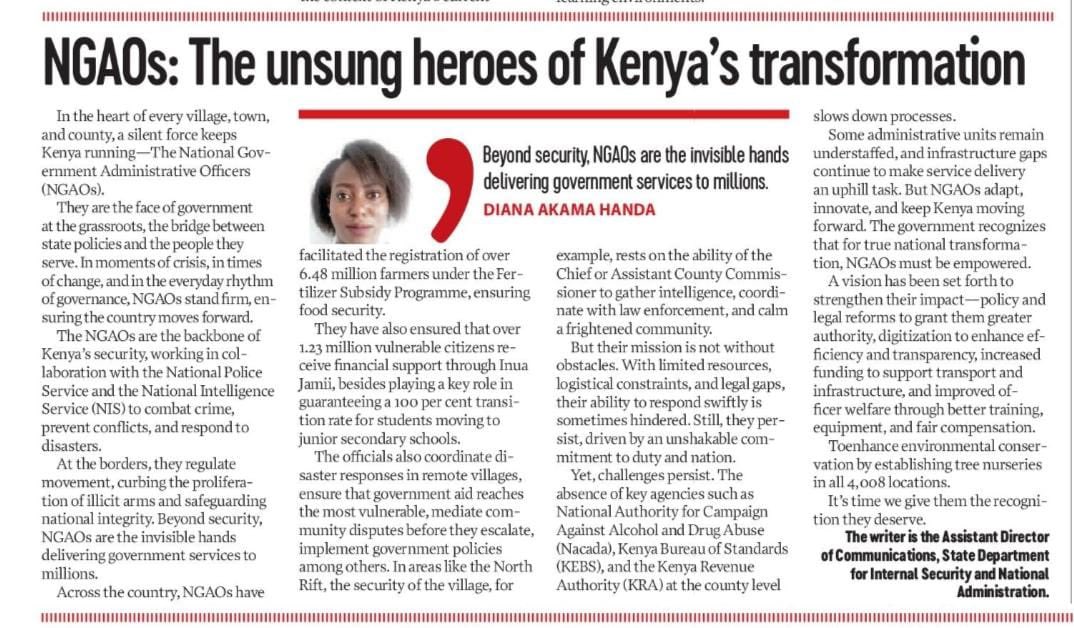
𝐍𝐆𝐀𝐎𝐬: 𝐓𝐡𝐞 𝐔𝐧𝐬𝐮𝐧𝐠 𝐇𝐞𝐫𝐨𝐞𝐬 𝐨𝐟 𝐊𝐞𝐧𝐲𝐚’𝐬 𝐓𝐫𝐚𝐧𝐬𝐟𝐨𝐫𝐦𝐚𝐭𝐢𝐨𝐧
In the heart of every village, town, and county, a silent force keeps Kenya running, The National Government Administrative Officers (NGAOs). They are the face of government at the grassroots, the bridge between state policies and the people they serve. In moments of crisis, in times of change, and in the everyday rhythm of governance, NGAOs stand firm, ensuring the country moves forward.
From the early hours of the morning, an Assistant County Commissioner in the North Rift begins his day, responding to an overnight bandit attack. The security of an entire village rests on his ability to gather intelligence, coordinate with law enforcement, and calm a frightened community. His presence reassures, his actions restore order. Similar scenes unfold across the country, NGAOs are the backbone of Kenya’s security, working in collaboration with the National Police Service to combat crime, prevent conflicts, and respond to disasters. At the borders, they regulate movement, curbing the proliferation of illicit arms and safeguarding national integrity.
But their mission is not without obstacles. With limited resources, logistical constraints, and legal gaps, their ability to respond swiftly is sometimes hindered. Still, they persist, driven by an unshakable commitment to duty and nation.
Beyond security, NGAOs are the invisible hands delivering government services to millions. In a small town in Kericho, a farmer stands in line to register for subsidized fertilizer. A few months ago, he struggled with skyrocketing prices.
Today, thanks to NGAOs, he can afford inputs that will boost his yield and secure his family’s future. Across the country, NGAOs have facilitated the registration of over 6.48 million farmers under the Fertilizer Subsidy Programme, ensuring food security. They have ensured that over 1.23 million vulnerable citizens receive financial support through Inua Jamii. They have played a crucial role in guaranteeing a 100% transition rate for students moving to junior secondary schools.
Yet, challenges persist. The absence of key agencies such as NACADA, KEBS, and KRA at the county level slows down processes. Some administrative units remain understaffed, and infrastructure gaps continue to make service delivery an uphill task. But NGAOs adapt, innovate, and keep Kenya moving forward.
The Kenya Kwanza administration recognizes that for true national transformation, NGAOs must be empowered. A vision has been set forth to strengthen their impact—policy and legal reforms to grant them greater authority, digitization to enhance efficiency and transparency, increased funding to support transport and infrastructure, and improved officer welfare through better training, equipment, and fair compensation. Plans are underway to systematically expand administrative units, strengthen grassroots public participation through initiatives like Nyumba Kumi and County Accountability Forums, and enhance environmental conservation by establishing tree nurseries in all 4,008 locations.
Imagine a Kenya without NGAOs. Who would coordinate disaster responses in remote villages? Who would ensure that government aid reaches the most vulnerable? Who would mediate community disputes before they escalate? Without NGAOs, policies would remain mere documents, and governance would become distant and impersonal.
They are the problem-solvers. The implementers. The silent hands guiding Kenya’s development.
As Kenya Kwanza moves forward with its ambitious vision, NGAOs must be recognized, empowered, and equipped with the necessary resources. Their success is Kenya’s success.
Strengthening this institution is not an option, it is the surest way to achieve sustainable development, security, and national prosperity.
It’s time we give them the recognition they deserve.
The collaboration between the Border Management Secretariat @BmsKenya and the International Organization for Migration @IOMKenya continues to play a pivotal role in strengthening Kenya’s 🇰🇪 border security and governance.
This partnership has significantly contributed to key initiatives, including the training of 395 frontline border officers in collaboration with the Kenya School of Government @KSGKenya and the successful hosting of the first ever National Border Management Conference.
Leveraging on these achievements, the Principal Secretary for Internal Security and National Administration and Chair of the Border Control and Operations Coordination Committee (BCOCC), Dr. Raymond Omollo @ray_omollo alongside IOM Chief of Mission, Ms. Sharon Dimanche @DimancheSh, officially flagged off land cruiser vehicles donated by IOM to support border security operations between Nairobi and Nadapal, Turkana County.
Protecting our Children from Drugs and Alcohol as they Return to School
As the new school year begins, it is a crucial time for parents, teachers, and communities to stay vigilant about the dangers of drugs and alcohol.
To safeguard our children, we are actively enforcing the 300-meter rule, which bans the operation of bars and alcohol outlets within 300 meters of basic education institutions.
Guided by the Alcoholic Drinks Control Act, this policy is designed to create safer learning environments by limiting students’ exposure to alcohol and its associated risks.
Together with the Ministry of Education @EduMinKenya, National Government Administrative Officers @ngaosKE, @NACADAKenya, County licensing authorities, and the Bars, Hotels, and Liquor Traders Association (BAHLITA), we are collaborating to ensure compliance and that schools remain secure spaces for education and positive growth.
Access the guidelines here: https://t.co/FlHlleVdg1
@MOH_Kenya@TSC_KE
Jitihada za kuimarisha usalama kaskazini mwa Bonde la Ufa, ambapo usalama na wizi wa mifugo ulikidhiri, na kutatiza elimu, zaendelea kufaulu.
Tunamuangazia Grace Kibowen ambaye alifuzu mwaka wa 2023 kutokana na amani iliyoleta udhabiti na nafasi ya kipekee aliyohitaji kufaulu katika masomo yake, kwa familia yake na pia kuboresha maisha ya jamii yake. Shujaa wa kweli.
@ngaosKE@NPSOfficial_KE