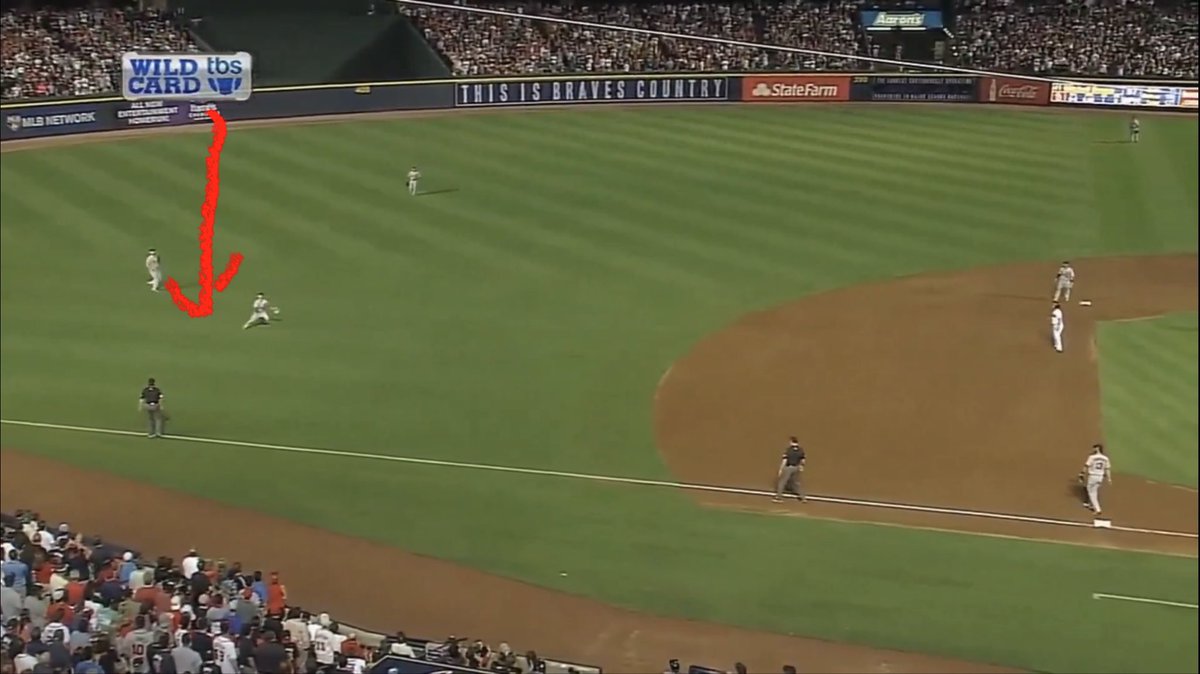
@GarrettWebste13@MaseDenver@MLBReplays_ There is nothing in the rule book that says it’s an automatic call. It’s the umpires judgment. He felt he was helping the Braves by making the call there, I contend he wasn’t. There is no way the defender was established and looking to make a trick dp. Holbrook thought he was.
@Mike_Grant603@_greatgoose@MLBReplays_ The infield fly is subjective, if in the umpires judgment, he feels that not calling it will result in a trick double or triple play. The rule is up to the ump to call - he felt he was helping the Braves by making it, apparently. I don’t think the cards were attempting that.
@GarrettWebste13@MaseDenver@MLBReplays_ I don’t think that is the only question. The question is did the call help prevent a trick double play. It’s entirely the umpires discretion. I don’t see anyway Sam Holbrook went to the clubhouse thinking “I really saved the Braves from a dp right there.” That’s the question.
@GarrettWebste13@MaseDenver@MLBReplays_ The question at hand is there is the subjective element to the rule. There is a judgement side to it. I don’t agree with Holbrooks interpretation of events. I don’t think he aided the Braves runners by calling the infield fly rule here.
https://t.co/EUeXfbARxL
@Mike_Grant603@_greatgoose@MLBReplays_ I have a problem with the application of the rule. There is a subjective side to it. There’s a reason two mlb lifers in the booth said “you can’t make that call there” “no way”. The letter is there - the correct application is not.
https://t.co/EUeXfbARxL
@Mike_Grant603@_greatgoose@MLBReplays_ From out here - they should have “played it out”. The rule is written to prevent trick dp’s. The cards were not deking the Braves here. Bad D got bailed. Just make all flyouts inf flies. Why make the LF catch it? Stand in proximity and call it in the air. The letter applies.
@GarrettWebste13@MaseDenver@MLBReplays_ Why not have all pop ups be inf flys? If a left fielder stands in proximity to where a ball could land - why make him catch it? Call it in the air. The letter of the rule applies.
@GarrettWebste13@MaseDenver@MLBReplays_ From there? No. The reason the rule exists is to prevent the trick double play. This was clearly not that. Bad D was bailed out by a poor application of the rule.
@Mike_Grant603@EnduranceEgo@MLBReplays_ The “right call” can be argued by letter - the “right call” cannot be argued by intent. The rule is to prevent turning cheap dp’s. No way that was what the cards were doing on this play. Wrong application.
@Mike_Grant603@_greatgoose@MLBReplays_ That doesn’t matter, but the purpose of the rule does. There’s no way the Cards were trying to turn a cheap double play in left. Even if the letter is right, the purpose was not.
@TF_BSUfan@MLBReplays_ It’s arguable. The purpose of the rule was not in play. Ump threw his hand up, but the context mattered. There is no way the Cards were trying to execute a cheap dp out there. Their bad D got bailed.
@GarrettWebste13@MaseDenver@MLBReplays_ The rule exists to prevent turning cheap double/triple plays. The rule was not correctly enforced. Cards were not prevented from turning a cheap double play. They got bailed out.
@GarrettWebste13@MLBReplays_ The purpose of the rule was not correctly enforced. There is no way he was trying to deceive the runner. Ordinary effort is debatable. Letter can be argued correct - intent is completely wrong. Cards bad D got bailed out.