Met a guy making $1.6 million a year.
Three days ago he was at a Meta conference. Told me he saw the best AI talk of his life.
Boris Cherny was on stage. Showed how the Anthropic team actually uses Claude day to day.
Boris deleted his IDE eight months ago. Now he codes from his phone.
I watched it last night. Had to pause it twice.
Not because it was hard. Because I realized I've been using Claude like a toy.
He sent me the recording. It was never published.
Posting it below.
New blackboard lecture w @reinerpope
How do chips actually work – starting with basic logic gates, and working up to why GPUs, TPUs, FPGAs, and the human brain each look the way they do.
0:00:00 – Building a multiply-accumulate from logic gates
0:16:20 – Muxes and the cost of data movement
0:25:59 – How systolic arrays work
0:39:00 – Clock cycles and pipeline registers
0:51:40 – FPGAs vs ASICs
1:03:14 – Cache vs scratchpad
1:07:16 – Why CPU cores are much bigger than GPU cores
1:11:49 – Brains vs chips
1:15:22 – A GPU is just a bunch of tiny TPUs
Look up Dwarkesh Podcast on YouTube/Spotify/etc to watch. Enjoy!
As an AI Engineer. Please learn:
- Harness engineering, not just prompt engineering
- Prompt caching vs. semantic caching tradeoffs
- KV cache management at scale
- Speculative decoding vs quantization
- Structured output failures & fallback chains
- Evals (LLM-as-judge + human evals)
- Cost attribution per feature, not just per model
- Agent guardrails & loop budgets
- LLM observability as a first-class discipline
- Model routing & graceful fallback logic
- Knowing when to fine-tune vs. in-context learning
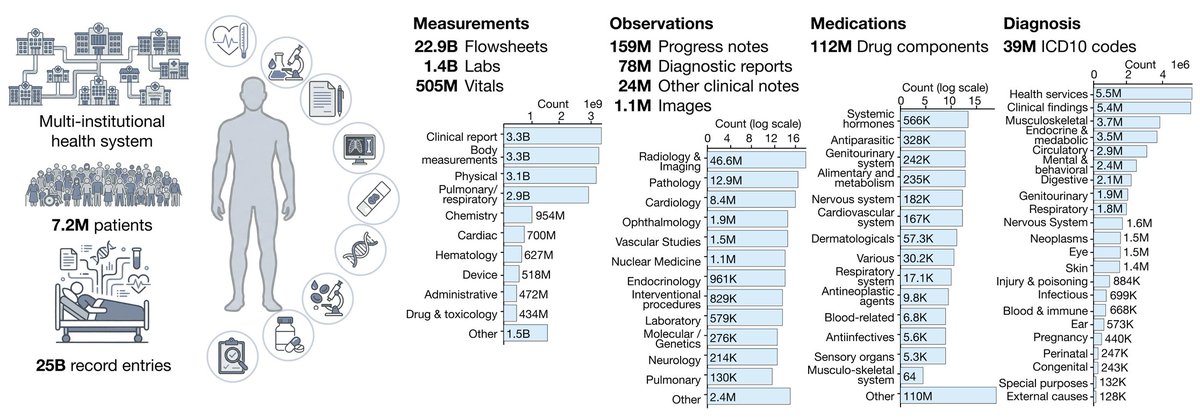
APOLLO: a multimodal temporal foundation model that learns to represent a patient’s entire medical journey in a single computational space.
By learning from millions of care trajectories, Apollo sees the future of each patient from their past.
Trained and evaluated on 25 billion medical records from 7.2 million patients, spanning 33 years of care across 28 clinical modalities and 12 major specialties. Labs, vitals, clinical notes, diagnostic reports, pathology and hematology images, medications, and diagnoses, all fed into a single model.
From @AI4Pathology et al.
https://t.co/EL1iWzS6Bo
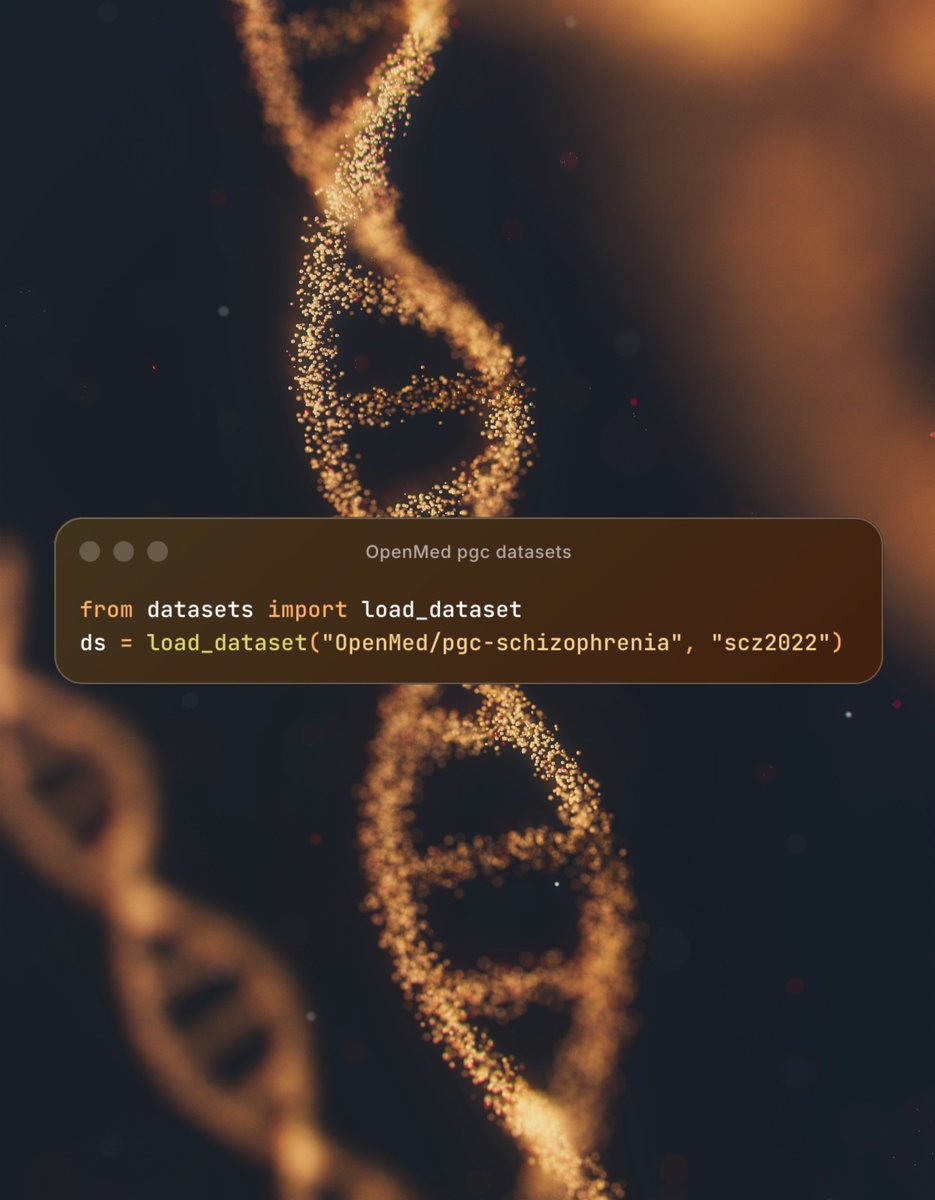
1B rows of psychiatric genetics data, open on HuggingFace, two lines of Python to load. The kind of dataset that used to require years of institutional access is now a pip install away.
We spent 40 years and billions of dollars building GUIs so humans wouldn't have to use terminals. The best interface in 2026 is a terminal again. Except the old terminal required you to learn the machine's language. This one learned yours.
14/ Speed of generation is a solved problem.
Quality of verification is the open one.
Everyone is building better builders. Almost nobody is building the adversary.
Build the adversary.
8/ Then: do four rounds of this. Build, critique, fix, critique again.
These tasks take an hour sometimes. Way slower than accepting and shipping.
The difference in quality isn't incremental. It's a different category of output.
13/ The entire discourse right now is about speed. Ship faster. Generate more. Parallelize agents. 10x output.
But the best teams I see aren't the fastest. They're the ones that figured out how to make AI critique its own work before anything ships.
7/ Deploy to staging. Run end to end. Not just the function you touched. The whole flow. Check the logs.
Then go even further. Pretend you're a user. Try the product. Try weird inputs. Try the path nobody would think of.
Report what you find.
6/ Here's what the adversary does in practice.
Same prompt. I tell the agent: once you're done building, switch roles. You are now a skeptical senior engineer. Run unit tests. Check for duplication. Look for missed edge cases.
Then go further.
5/ So I started thinking about every AI coding task as two layers:
The builder: the agent that writes the code. The adversary: the agent that tries to break it.
Most people only have the builder.
4/ This is getting worse, not better.
The faster you generate code, the more verification you need and the less time you have to do it.
I've been calling this comprehension debt. The gap between the rate code is produced and the rate humans can understand it.
3/ But there's a second question almost nobody asks systematically:
Is the code actually good?
Not "does it run." Not "does the function return the right type."
Is it maintainable. Does it handle edge cases. Is it duplicating logic that exists elsewhere. Will it break something three weeks from now.
1/ The bottleneck in AI coding isn't generation. It's verification.
Almost nobody builds for this. And I think it's going to be the thing that separates teams that build lasting products from teams that drown in their own output.
Thread.
2/ Watch how most people code with AI right now:
Describe what you want. Agent writes it. Accept all. Ship. If something breaks, paste the error back in.
The whole workflow answers one question: can AI produce the code?
In 2026 the answer is yes. Overwhelmingly yes.