Today, after seven years of work, The Law of the Sublime is out in the world.
When I started this book, I had an ambitious plan. I would go down the Amazon, find chimpanzees in the wilds of Africa, and cross the Gobi Desert, then write about those experiences of awe.
Then, on a hot August afternoon in 2018, I had a stroke while driving in Los Angeles. A blood clot cut off oxygen to my brain, and within seconds I lost consciousness. When I woke up in the hospital, I learned how close I had come to the point of no return. My left hand was frozen into a claw, and I could barely feel my left leg, but something strange happened.
On the ambulance ride home, I looked out at the people on the street, and for a moment I felt I could be inside their bodies and hear their thoughts. It was marvelous and weird, and I knew it was time to write this book.
I couldn't type, so I wrote every page by hand, dictated it, printed it out, and edited it all over again. I couldn't take the long hikes that had carried me through my six previous books. Then one afternoon I woke from a nap in my backyard to find a grasshopper inches from my face, and I understood that this small backyard would have to be my Amazon jungle. The lizards, the hummingbirds, the insects became my teachers.
My limits turned out to be a blessing. They forced me to find the Sublime in the simplest things, and that is what this book is about.
Most of us live inside a circle: an everyday consciousness shaped by culture, convention, and, more and more, technology. That circle keeps shrinking, and we grow bored and restless. Just outside it is the Sublime, a realm that is frightening and exciting at once, pulling us out of our comfort zones and opening us to a much wider reality. The book maps 12 points outside that circle, and each one is a different face of the Sublime.
Inside, you'll find stories of near-death encounters, astonishing discoveries, and radical changes of consciousness, along with exercises and meditations so you can feel the Sublime yourself, not just read about it.
The Sublime doesn't require travel or exotic adventures. It only requires a new pair of eyes for the reality all around you.
The Law of the Sublime is available now in hardcover, ebook, and audiobook.
Thank you for your support of my work. I hope you enjoy reading this book, and I look forward to hearing your feedback.
With gratitude,
Robert Greene
Sometimes, the greatest thing you fit give a young person no be money. Na opportunity.
Look at wetin happen when Baba entered Bae U’s world.
A man of his age and experience sat down with a young man whose style dey completely different from wetin he is used to.
Baba no just sit there looking serious.
He matched the energy, played along and showed Nigerians another side of himself.
And who helped make that connection happen?
CharlyBoy.
Fada believed in the young people behind that show enough to pull Baba into their space.
That one get lesson inside.
To the older generation: don’t only tell young people to succeed.
Give them room.
Open doors. Recommend them.
Trust them with opportunities.
To the younger generation: don’t wait for somebody to hand you a future.
Build something worth believing in.
When opportunity comes, be ready.
Because sometimes, all a young person needs is one person with influence to say:
“I believe in what you are doing. Go ahead.”
And sometimes, all an older person needs is the willingness to say:
“Let me enter your world and see what you are building.”
When generations support each other, everybody gets to grow.
Na so legacy suppose work.
When you look at the price Dangote refinery wants to list in 🇳🇬 stock market, the valuation is at about $48 billion . That price means you are paying a heavy premium for optimism
@Rufyb, I agree with your assessment and would add a little context.
The 4.43% headline is an improvement, but it remains well below what Nigeria requires. Tilewa Adebajo's growth arithmetic is useful here. The economy needs sustained real growth of 8–10% annually to support a population approaching 250 million, or roughly 50 million households.
With population growing at about 2.5%, the current rate leaves output per person rising by less than 2% a year. At that pace, income per head would take more than three decades to double. We should all pause to imagine what that means. A young person entering the labour market this year would be approaching the end of a working life before average income per head has doubled, and that is the human content of the arithmetic.
The composition is equally important. Telecommunications grew by 10.4% and finance and insurance by 9.3%, but neither absorbs labour on the scale Nigeria needs. Trade grew by only 2.4%, while food, beverage, and tobacco manufacturing expanded by 2.8%, despite these activities being where much of the employment is concentrated. These are the sectors where most households actually earn, so weakness there is felt in homes long before it appears in a quarterly table. Cement's 12.8% growth points to stronger construction activity, but not yet to a broad manufacturing recovery.
There is always some noise around headline GDP numbers, and my senior colleagues and the more cautious economists among us will have more to add in the coming days. One distinction, though, is worth making now, and it concerns oil. The 7.3% figure represents the real growth of the oil sector in value-added terms, not the increase in barrels produced.
Our @TheAnalystNG, working off the @NBS_Nigeria figures, put production at an average of 1.72mbpd in the quarter, up from 1.68mbpd a year earlier, an increase of about 2.4%. The more encouraging figure is the 43.9% growth in oil refining, although its effect on jobs and household incomes remains limited for now.
The price effect also deserves attention. Nominal GDP rose by 18.43%, while real output grew by 4.43% and prices, as measured by the GDP deflator, increased by 13.4%. Much of the expansion in nominal GDP therefore reflected higher prices rather than additional output, which is very much how it has felt to households this year.
I would also treat some of the Q-onQ movements carefully. Electricity, gas and steam rose by 286.60% in real terms and water supply by 84.58%, while real estate declined by 44.61% in nominal terms and accommodation and food services fell by 60.08% in real terms.
Movements of that size are more likely to reflect seasonality and estimation effects in a rebased series than changes of the same magnitude in underlying economic activity. That is not a criticism of the Bureau, which is working through a rebasing, but it is a reason to lean on the year-on-year picture for now.
@proshare's review of the Q2 GDP numbers provides further context:
https://t.co/r5bLAyOX8G via @ecopoliticsNG
Please take the time to read it. I expect our Chief Economist @TeslimShittabey will have more to say on the numbers, particularly as Nigeria enters a pre-election year, a point @PaulAlaje also drew attention to yesterday on his @ARISEtv interview.
The improvement should be acknowledged, but not celebrated too quickly. The headline numbers still need to be tested against employment, household incomes, inflation and independently observable activity.
Growth counts when it is visible in wages, in market prices and in what a family can afford at the end of the month.
Nigeria needs growth that is sustained, employment-intensive and broad-based enough to raise living standards faster than the population expands. This quarter is a step forward, and I would rather we read it as encouragement to do much more than as evidence that enough is being done.
'FA
cc: @FinMinNigeria@cenbank@Ayoteriba@BJRewane@mudashiru_yusuf@Rotankwot@officialNESG@NGRPresident@nbccng@FDC_ltd@RTCAdvisory@webtvnigeria@DangoteGroup@cibnigeria@cisnigeria@TheAnalystNG@BBoason@nsia_nigeria
FGN leans toward external borrowings
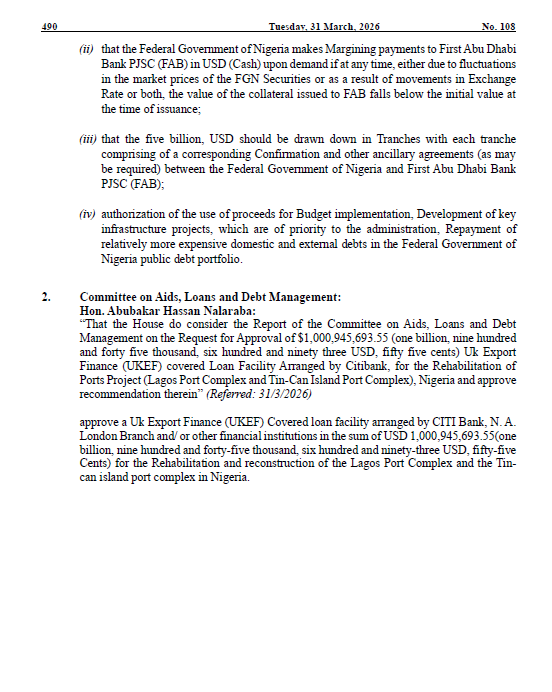
FGN plans two external borrowings: a $1.0 billion UK Export Finance (UKEF) covered loan facility needed for the rehabilitation of the Lagos and Tin Can Island ports, and a $5.0 billion debt swap deal with First Abu Dhabi Bank (FAB). The details of the swap include the following
A few details on the debt swap deal
1. Total return swap: the deal will be a total return swap transaction, with FGN naira bonds provided as collateral. The value of the collateral was set at 133.3% of the actual amount drawn.
2. Margin call: If at any point the worth of the FGN bonds used as collateral falls below their original valuation in the deal, the government would be required to make an immediate top-up payment in US dollars (cash) to FAB upon demand.
3. The fund will be drawn by Nigeria in tranches, with each tranche comprising a corresponding confirmation and other ancillary agreements between the parties involved.
4. Transaction cost: the first tranche will be at SOFR+395bps, and subsequent tranches will be at SOFR+400bps.
5. Transaction period: is 6 years.
6. The proceeds from the deal are for budget funding, infrastructure developments, and repayment of relatively more expensive domestic and external debts.
This is not new to the African space, as both Angola and Senegal have done Total return swaps in the past
I have seen a few write-ups that believe that the swaps arrangement is cheaper than regular Eurobond borrowings. The argument is flawed, as the TOTAL RETURN swap structure of the transaction means that Nigeria will pay (1) transaction cost, which is about 7.6% - 7.7% (SOFR +395/400bps) and (2) all the coupons from the FGN naira bonds provided as collateral.
By my calculations, the effective interest rate will settle at around 15.3% per year (see the table attached), assuming the naira remains stable over the 6-year period. That’s clearly expensive.
Too many stringent rules for Nigeria. What if something goes wrong
- If bond spreads widen for any reason, a margin call is placed on Nigeria. For example, Angola’s margin call in 2025 was $200bn on its swap with JPMorgan. By my estimate, if the interest rate increases by 200bps, Nigeria will have a margin call of $466 million.
- If the naira depreciates, the USD-equivalent value of those naira bonds falls, which could trigger the margin call clause. By my estimate, if the naira depreciates by an average of 10% annual over the transaction period, Nigeria will need to provide an additional margin of $326 million. I know that the outlook for Naira is expected to remain largely positive over the near term, but there is a need for caution.
The other day, we celebrated a credit rating upgrade by the international credit agency, S&P. The events over the past few days just explains how the government (across all arms and tiers) make one step forward and two steps backwards.
A country does not become a $1 trillion economy simply because oil prices rise or because GDP numbers look bigger on paper.
A trillion-dollar economy is built when millions of people can safely learn, work, move, invest, build companies, transport goods, and plan for the future with confidence.
Industrial economies are built on efficient movement:
of people
of goods
of raw materials
of labour
of capital
Insecurity disrupts all of them.
The substance of the article below is right on point. However, the framing needs to be sharpened further to locate what is missing in the triumphalism that seems to follow such upgrades.
Tilewa Adebayo makes this point clearly when he said that “Nigeria’s move from B− to B (Stable) is positive, but it is not investment grade. It remains in the speculative / non-investment-grade (“junk”) category”.
At 'B', Nigeria sits in what S&P classifies as "highly speculative" territory, two notches above the CCC tier and five notches below the lowest investment-grade rating of 'BBB-'. The Bloomberg news we referenced in the article below captured this in its reporting by noting the upgrade placed Nigeria "five levels below investment grade", which is the standard counting convention
Therefore, in reading the ladder properly, we must note that from B, the path to BBB requires five single-notch upgrades. The sequence runs B to B+, then B+ to BB-, then BB- to BB, then BB to BB+, then BB+ to BBB-. Each is one notch on the S&P long-term scale, and the boundary crossing into investment grade is the fifth step rather than a separate destination beyond the ladder. Most sovereign upgrade events move a single notch at a time.
The African comparison deepens the point materially. Per Samira Mensah, Managing Director of Africa Research and Analytics at S&P Global Ratings, only four African sovereigns currently hold investment-grade ratings on the S&P scale, comprising Mauritius (BBB-), Botswana (BBB after the October 2025 downgrade from BBB+), Morocco (BBB-), and St Helena, which is a British overseas territory.
The harder fact, drawn from the historical record summarised in the African Union's AfCRA brief and corroborated by the OECD Africa Capital Markets Report 2025, is that no African sovereign has ever climbed from speculative-grade to investment-grade through reform-driven upgrades.
The four sovereigns currently at investment grade were rated at that level from initial assignment. Nigeria's prospective path is therefore historically unprecedented on the continent, not merely long.
The cost-of-capital prize is therefore substantial. S&P's own published commentary cites Morocco issuing Eurobonds in 2025 at approximately 250 basis points lower than Benin or Côte d'Ivoire in the BB-range, despite all three being African issuers tapping the same global investor pool. The full spread between a B-rated sovereign and a BBB- rated sovereign in normal market conditions is typically 400 to 600 basis points across the Eurobond curve, widening in periods of stress.
For Nigeria, sustained compression of that premium is the quantifiable measure of reform success, with each successive single-notch upgrade plausibly delivering an incremental 80 to 150 basis points of issuance saving on long-dated paper.
On pace, S&P typically reassesses sovereigns every twelve months and moves single notches when positive trajectories hold. Five notches would imply at least five to seven years of unbroken progression, and the historical African record cautions against assuming linearity.
Commodity cycles, security events, and fiscal slippage have repeatedly stalled or reversed upgrade cycles for peer sovereigns, including South Africa, Namibia, and Tunisia, all three of which previously held investment grade and have since lost it.
We should now learn how to calibrate outcomes, not celebrate inevitables.
READ THE INITIAL ANALYSIS>>> https://t.co/F9W2dxbvi7 via @proshare
S&P lifted Nigeria’s credit rating for the first time since 2012, citing higher oil prices and the country’s improved capacity to refine and export crude https://t.co/MUN3ZSRepu
Late yesterday, the S&P Global Ratings announced what some folks had anticipated. Nigeria’s credit rating was upgraded by one notch to B (five levels below investment grade), the first upgrade since 2012. According to S&P, the considerations for the credit rating upgrade were:
✑ Higher oil prices
✑ Improved capacity to refine and export crude
✑ The decision to liberalise the exchange rate
This is a big win.
I have seen, in some places, the frustration over the gap between macro wins and micro pains. The honest answer is that the average Nigerian on the roadside cannot connect this progress to their well-being today. They will only feel it through a longer transmission chain that has not yet finished playing out.
A credit upgrade essentially signals to the global market that Nigeria is a less risky borrower, allowing the federal government and major Nigerian corporates to borrow at cheaper rates abroad. The bread-seller in Mushin does not borrow from JP Morgan or from the international debt market, so the immediate effect on her bottom line is zero.
Where it eventually shows up for her is in three indirect channels:
✑ First, cheaper sovereign borrowing means the FG can enter the international debt market and borrow at a lower rate to refinance some of its costly debt. This will result in lower debt service spend and, in theory, provide more fiscal room for roads, power, security, etc.
✑ Second, lower country-risk attracts FDI and portfolio inflows, which strengthens the Naira (we might see an extended stability in the FX market. Naira is still likely to remain a darling). The imported inflation will also slow, and this is the channel where the Mushin trader would feel it the fastest.
✑ Coys can refinance their debt or raise capital for expansion. A business expansion opens the door to hiring, which means higher income in the economy.
However, all of these still depend entirely on whether the reforms continue and whether the fiscal headroom is actually deployed productively rather than consumed (I've been hearing news of how APC Governors have been cornering funds for the Presidential campaign. Toor).
By the way, my family members and I in the equities market will smile at this development.
This experience was disappointing and honestly worrying. Emergency response is not something any city should take lightly. In critical moments, every second matters. A functional and reliable emergency system saves lives, reduces traffic chaos, and gives people confidence that help will come when needed.
Lagos is growing fast, and our emergency response system must grow with it. We need faster response times, better coordination, more equipment, and more accountability.
We can do better. And we should.
#accident #lagosnigeria #emergencies
Three kinds of Nigerians dominate the Internet.
- People with smartphones but no discipline. They do not see anything beyond their nose; they spread rumours and panic.
- People who use smartphones with judgment. They verify facts. They add context. They raise the quality of conversation.
- People who know exactly what they are doing but spread hate, intolerance, and disinformation.
A smartphone gives every one of us a voice, but character decides how that voice is used.
Date - 04/02/2026
CBN NFEM rate - N1,358.28/$
Customs FX rate - N1,451.63/$
Parallel Market Rate - N1440/$
In a clean system, the Customs FX rate should track the official window, perhaps with a small lag not overshoot the parallel market.
Yet here, Customs is:
+6.9% above NFEM
₦12 above parallel
That’s not accidental. It appears to be deliberate and here is why it is a concern to me.
When Customs prices FX above both NFEM and the parallel market, it’s quietly admitting two things:
- It doesn’t trust the official rate to hold and,
- Importers are sourcing or will ultimately source FX at worse-than-NFEM prices
So Customs hedges. Revenue is protected. Importers carry the risk.
The implication?
1. The introduction or reintroduction of multiple FX regime. Call it a third FX regime. Even if unintentionally, we now have:
- NFEM for some transactions
- Parallel market for others
- Customs FX rate as a third, punitive benchmark.
This undermines the entire narrative of FX unification.
2. Imported inflation pressure is back. A higher Customs rate means:
- Higher landed costs
- Higher VAT base
- Higher working capital needs
Even if parallel FX softens, prices won’t adjust downward, because Customs has already locked in a higher cost base. This is inflationary especially for manufacturing inputs, FMCG
and Capital goods.
3. And finally, it sends a credibility signal problem. FX policy is not just about rates, it’s about who believes which rate.
When a core government agency prices FX above the market, it tells investors and traders: The state itself does not fully believe the official FX narrative.
Which leaves us with the question - If government agencies don’t believe the official rate, why should the market?
Cc @proshare@OlufemiAwoyemi@cenbank
Dear Yinka,
You raised valid points and laid them out well. We believe the real damage is deeper. Your analysis is a major concern for anyone tracking the daily FX rates, which we publish. The Customs rate premium is indeed a credibility issue. When revenue agency prices rise above the market, it's essentially publishing its own FX stress test in real time, which signals something different from what the monetary authority is signalling.
As you have noted, the imported inflation lock-in is severe. But the critical issue it signals is one of coordination failure. When different arms of government operate with incompatible exchange rate assumptions, it shows a fragmented policy environment. This is precisely how multiple FX regimes begin before official announcement, if at all we learn anything from history. Our narrative of FX unification is critically undermined.
This is also a form of state-enforced price discrimination and a hidden tax that fragments the market. It taxes domestic manufacturers that must import inelastic inputs, while more demand-elastic finished consumer imports may simply evade the port, find ways around it, or pass the cost directly to consumers, thereby worsening inflation without protecting local industry. This distorts the import substitution incentives.
The government, through its should-be trade facilitation agency but now revenue-generating agency, is telling the market the rate it believes, which is not the official rate.
We will continue to monitor the situation...
Here's how I got to present my string art to our mummy @NOIweala the DG of World trade Organization at my prestigious Universities 45th convocation ceremony lecture.
Mama said and I quote, "Please tell your own story and let it be a story of success" this is me telling mine❤️
@cenbank Now at @FirstBankngr and beyond we go into 2026 lighter, cleaner and better prepared for the recapitalisation era and serious growth.
Bad loans cleared + strong income engine + long term thinking = real value creation 💪🏾🏦🐘 …. F.Ote💲