Respected @nsitharaman ji and @FinMinIndia,
Suggestion 3 of 3 for strengthening India's capital markets:
Securities Transaction Tax (STT) should be abolished.
STT was introduced as a simplified transaction tax to facilitate easier collection of taxes from capital market transactions. However, over time, it has effectively become an additional layer of taxation alongside other market-related levies.
A simplification measure should not evolve into permanent duplication.
In addition to brokerage, investors already bear multiple statutory and regulatory charges including exchange transaction charges, GST on transaction-related charges, SEBI turnover fees, stamp duty and STT.
Unlike income tax, STT is payable irrespective of whether an investor makes a profit or a loss. The investor pays the tax simply for participating in the market.
Capital markets play a vital role in channeling household savings into productive enterprises, supporting entrepreneurship, generating employment and strengthening India's economic growth. Transaction costs and multiple layers of taxation discourage participation, particularly among long-term retail investors.
India's equity markets have matured significantly since the introduction of STT. The time has come to review its original purpose and reconsider its continued relevance.
Abolishing STT would simplify market taxation, improve capital market efficiency and encourage greater participation in India's growth story.
Respectfully submitted.
Respected @nsitharaman ji and @FinMinIndia,
Suggestion 2 of 3 for strengthening India's capital markets:
Dividend income on listed equities should not be subjected to double taxation.
A business can raise capital in only two ways: debt or equity.
When a company raises debt, the interest paid to lenders is treated as a business expense and deducted before tax. The lender may then pay tax on the interest received.
However, when a company raises equity capital, dividends are paid out of profits that have already suffered corporate tax. The shareholder is then taxed again on the same stream of income.
More importantly, equity capital bears far greater risk than debt capital. A lender has a contractual right to interest and principal repayment. A shareholder has no such guarantee. Dividends are discretionary, capital is fully at risk, and the shareholder stands last in line if a business fails.
If debt providers receive tax-deductible compensation despite bearing lower risk, there is a strong case for more favourable treatment of equity providers who supply the permanent capital that fuels entrepreneurship, innovation, employment and economic growth.
India needs to encourage long-term risk capital and greater participation in equity markets. Tax policy should reward those who provide patient equity capital to Indian enterprises rather than place them at a relative disadvantage compared to debt capital.
Respectfully submitted.
Respected @nsitharaman ji and @FinMinIndia ,
Suggestion 1 of 3 for strengthening India's capital markets:
Long-term capital gains tax on listed equities should be abolished.
A long-term shareholder is not a speculator but a provider of patient risk capital. By investing in and holding businesses, investors help companies expand, create jobs, innovate and contribute to India's economic growth.
India requires enormous amounts of long-term capital to build world class enterprises, infrastructure and global champions. Tax policy should encourage households to move savings from passive assets, including imported stores of value such as gold, into productive businesses that create jobs, generate tax revenues and build national wealth.
The appreciation in a company's value is not created in isolation. During its growth journey, the government already collects corporate tax, GST, income tax from employees, customs duties, stamp duties and numerous other levies. Long-term capital gains are often the final outcome of economic activity that has already generated substantial tax revenues.
Most importantly, tax policy should clearly distinguish between investment and speculation. A long term shareholder is a partner in wealth creation, not merely a participant in market transactions. Tax policy should reward long-term ownership of productive businesses and distinguish it from short-term speculation.
India needs more patient capital, more entrepreneurship and more long term investing. Abolishing long-term capital gains tax on listed equities would be a powerful step in that direction.
Respectfully submitted.
@rishibagree No boss. Unemployed ppl hoping to make a quick buck by flipping it over to the rich at ₹82k .. but nothing wrong with that . Demand supply effort - mkt forces will determine if this was worth the effort !
@_soniashenoy@sandeepjethwani The NPV of ₹40 cr to be received after 20 years at a 6% annual interest rate is approximately ₹12.48 cr. Now this seems like a decent palatable number to work with . Important you clarity as after 20 years , ur now 10 cr will be worth 2.5 maybe . Then, 40 is the new 10!
@_soniashenoy@sandeepjethwani Is 40 cr a must for retirement 20 years out? Only then it makes sense . So not sure what his context is . Would help if you clarify
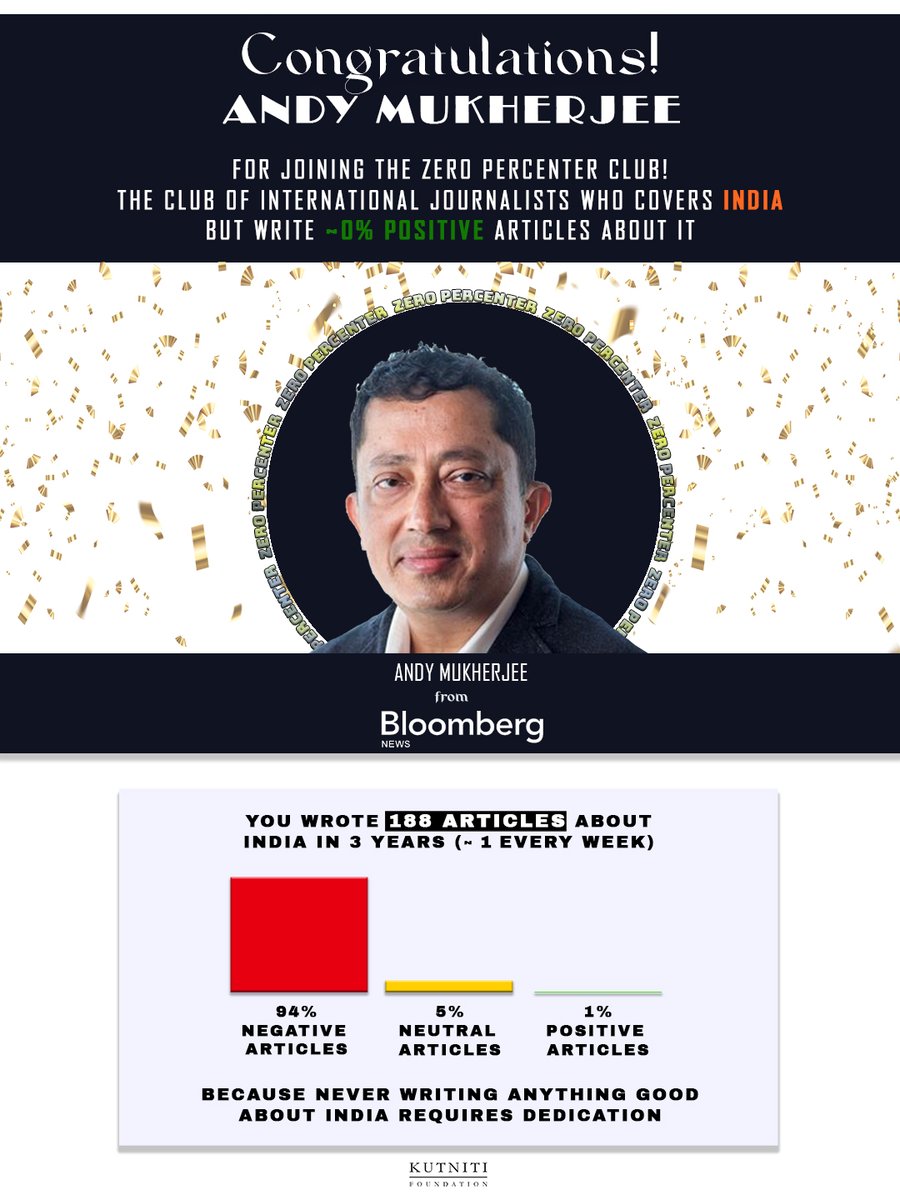
Andy Mukherjee is NOT your traditional anti-India journalist
They write against Indian Society
He writes against Indian Economy
And for Bloomberg, the most critical financial media
🇮🇳 188 ARTICLES about INDIA in 3 years (5 per month!)
🟢95% Negative 🟡4% Neutral 🔴1% Positive
@GitaGopinath@nsitharaman@Harvard@Kennedy_School Plz highlight undue taxation on equities . Especially on FIIs who have 100 options to invest in and India doesn’t seem go fit its risk/reward criteria . Thank
Honourable @PMOIndia and @FinMinIndia
We are losing Foreign Capital of almost $1 Bn a day. Since July 2024, post hike in capital gain tax and STT, we have lost $100 Bn and our markets have become globally unattractive .we need patient risk capital to fund our growth story.
It’s undoing the good work done through various reforms.
A responsive govt like yours has always taken feedback on taxation - GST, Income tax and given relief.
I urge you to reconsider.
On Hanuman Janmotsav, I keep coming back to the idea that Hanuman is a study in contrasts.
Infinite knowledge, yet disarming humility.
Unmatched strength, yet deeply tender and caring.
Capable of conquering worlds by himself, yet choosing to remain most devoted in the bhakti of Lord Ram
Maybe that’s the lesson; true greatness doesn’t shout, it serves.
Jai Bajrang Bali!
This is easily my favorite clip of Bill Ackman
> His fund was down 30%+
> Being sued by Valeant Pharma investors
> Going through divorce with his wife
> Elliot, an activist firm, trying to take over his fund
Here is his advice on how to deal with the tough moments in life
Dear Finance minister and Dear PM, please open your eyes. With current situation Rupee will hit 100= 1 dollar in no time.
If you don't stop FII outflow there will be serious damage to the economy and Indian currency. Remove taxation STT and Captial gains for Foreign institutions and see the inflows resume to our economy
@nsitharaman@nsitharamanoffc@PMOIndia