Amritsar Diaries:
The First Happy Birthday Song
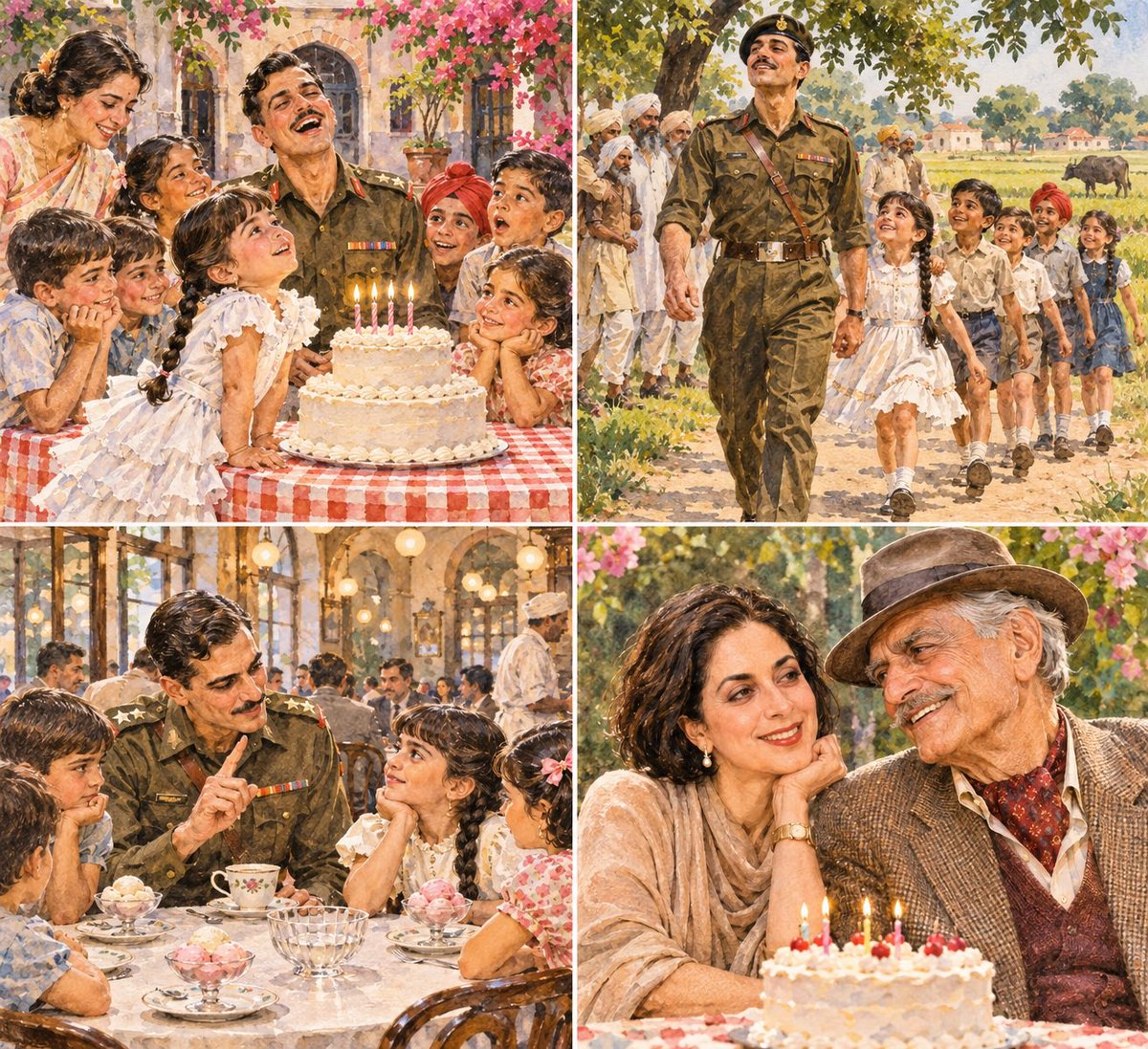
In the small courtyard with the mosaic tiles, an ancient dining table has been pulled out from the drawing room.
It wears a red and white checkered tablecloth.
A little girl stands next to it in her frilly white frock with the can-can. She has a fringe and one huge plait.
It is my birthday. That girl is me.
On the table sits a huge white cake, two tiers of scrumptious vanilla. The checkered cloth and the cake leave a luminescence in my eyes.
Seven children from Galli Number 3 have been granted the honour of an invitation. Brahma and Baby had to be there. They were necessary evils.
Their eyes, as big as saucers at the sight of the cake, made me feel like Snow White among the seven dwarfs.
Mom lights four candles. I am asked to blow.
But it is more than the blowing. It is the booming voice singing "Happy Birthday to You", the first time I have ever heard the song.
It comes from a very handsome man, my uncle, my dad's younger brother, my favourite Chacha ji. A strapping young army officer.
He was the first one who ever sang the birthday song for me.
I waited all year for the summer vacations, when he would walk in and call out, "Meri Barah Mann ki Dhobin, kahan hai tu?"
I would run into his lap and he would bounce me up and down.
"Oh, you have got so heavy. We need to exercise more."
He tried teaching me to swim by throwing me into the pool. I screamed, "Save me!"
He said, "No. You have to learn to be brave."
But I always remained a sinker. In that department, I failed him completely.
He seemed to me very old. I would not sleep till he told me stories about the 1971 war.
And Diwali was another matter. Every patakha made me run away, and he would call me back.
"Bas, fauji ki beti dar gayi? Ladai wich aise patakhe kitne hote hain, pata hai tujhe? Be brave."
He took us on his bike to fancy coffee houses, where children from a small town like Amritsar got their first lesson in etiquette.
"Don't slouch. Sit up."
When the ice cream came, we were not to pounce on it. We waited, salivating, till everyone's had arrived.
Then one gentle scoop, a taste, and "Mm, thank you."
He taught us how to use a fork and spoon, and that the water in the finger bowl is not for drinking.
A spoon tinkling against the teacup, or a slurp, earned a frown.
Every summer he took us to the village, in his uniform, and we marched up behind him like little soldiers.
The peasants were awestruck by the fauji.
Once, I knitted him a red skivvy sweater, my first ever. He wore it happily, just to make me happy.
He looked so much like Rajesh Khanna, and the red matched the red of his cheeks.
Once he brought home a music system, and that was how English music stepped into our lives.
Trying to get me out of bed in the morning, he sang, "Chal yaar dhakka maar, band hai motor car."
As I grew older, he handed me his staff college books and asked me to check whether he remembered all the details. I felt so big, teacher and student reversed.
As a young woman, when I lost my puppy fat, he said, "Why are your collarbones showing? Eat a little more."
Even now, the first thing he asks is, "Are you exercising? Are you meditating?"
And I answer yes.
And to this day, a noisy stir of the teaspoon wakes Chacha ji up in me.
As he approaches eighty, he still plays tennis and golf, and meditates regularly. The discipline of the army officer has never left him.
He is immensely proud of our family heritage and the glowing skin that runs in it. I find that a little quirky now. But then, that is Chacha ji.
Now his 80th birthday approaches. I will miss the day itself, but later in the week we will celebrate with a little party of our own.
I want to feed him the cake and sing him the happy birthday song.
And perhaps, somewhere in that booming voice, I will hear it once again,
"Chal yaar dhakka maar, band hai motor car."
@GoutamGhosal3 Thank you. Why don’t you become a member of our music group? You are a source of immense knowledge. Minimal
Messaging if at all. Just keeping it to the weekend for a limited time.
Music Diaries 🎶
Zindagi Hai Kya, Sun Meri Jaan — Maya (1961)
Salil Chowdhury was iconic. Here is a lesser-known gem from his compositions.
Salil da was always different. His music often reminds me of hill music. His little instrumental interludes were a delight. In Zindagi Hai Kya, those tinkling bells remind me of the ice cream vendors of my childhood, pushing their carts through the streets.
Salil da made the ice cream cart into a song!
Dev Anand poses as an ice cream vendor to visit the locality where Mala Sinha lives. In the film, he is a rich man hiding among the poor, selling ice cream from a cart to keep up the pretence.
There is an interesting anecdote about the song. Salil Chowdhury and Rafi Sahib apparently had reservations about the word ice cream in the lyrics. Majrooh insisted on keeping it. It stayed, and the song turned out to be a gem.
Hidden behind the more famous numbers of Maya, it nevertheless carried a charm of its own.
Zindagi Hai Kya, Sun Meri Jaan.
The philosophy of life, from an ice cream seller!
Happy 101st birthday, Salil da. The bells still ring. 🎶
Film: Maya (1961) Singer: Mohammed Rafi Music: Salil Chowdhury Lyrics: Majrooh Sultanpuri On screen: Dev Anand
https://t.co/57cPFcO2e5
This week, meet someone special stepping into the Amritsar Diaries universe tonight.
A fauji makes a grand entry!
And what an entry it promises to be! 🎖️