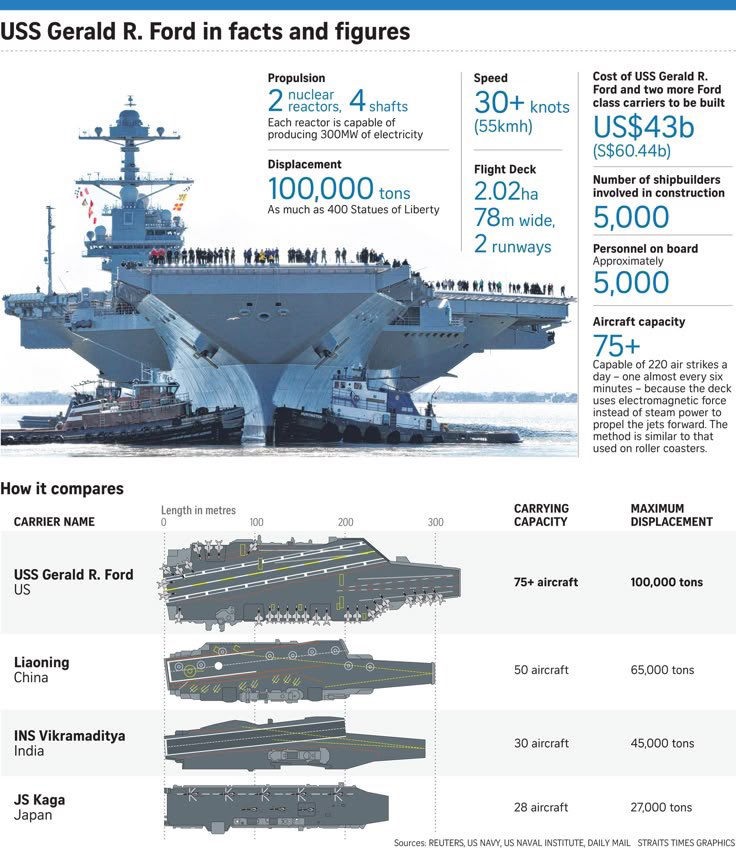
The USS Gerald R. Ford is not parked near Iran. It is parked off Israel. And nobody is asking the only question that matters: why.
The $13.3 billion crown jewel of the US Navy, the largest warship ever constructed, just positioned itself off Haifa. Not in the Arabian Sea where the Lincoln sits 850 kilometers from Iranian shores loaded for offensive operations. Not in the Gulf where strike range is optimal. Off Israel. Defending Israel.
This is not redundancy. This is architecture.
Two carriers. Two missions. Two entirely different strategic functions. The Lincoln is the sword, positioned to launch strike packages into Iranian airspace within hours of an order. The Ford is the shield, its Aegis missile defense systems creating an umbrella over Israeli population centers against the retaliation that follows the first Tomahawk.
America just split its carrier doctrine into offense and defense simultaneously. That has not happened since the Pacific theater in 1945.
But the positioning reveals something deeper than tactics. When Iran retaliates, and every wargame says Iran retaliates, its missiles and drones fly toward Israel. They will fly through the same airspace where a US carrier strike group is now stationed. Every Iranian missile aimed at Tel Aviv or Haifa must traverse the Ford’s defensive envelope. Shooting at Israel means shooting at, around, and through an American carrier group.
Iran cannot retaliate against Israel without engaging American naval assets. The Ford’s position makes that physically impossible. The carrier is not defending Israel as a favor. It is positioned so that any Iranian response to American strikes automatically becomes an attack on American forces, triggering the full unrestrained weight of US military response without a single additional political decision required.
This is escalation insurance written in steel and seawater. If the campaign goes longer than planned, if munitions run thin in 7 to 10 days, if allies hesitate, the Ford’s position ensures that Iranian retaliation does the political work Washington cannot do alone: it transforms a limited American strike into an act of self-defense that no ally can refuse to support.
You do not park a $13.3 billion carrier where the enemy’s return fire will hit it unless you want the enemy’s return fire to hit it.
The Ford is not there to prevent escalation. The Ford is there to guarantee that if escalation comes, it comes on terms that make American restraint politically impossible and allied participation politically unavoidable. https://t.co/BrzGRrU3VW
𝗕𝗔𝗞𝗜𝗧 𝗡𝗔𝗚𝗕𝗨𝗕𝗨𝗡𝗬𝗜 𝗔𝗡𝗚 𝗦𝗨𝗣𝗣𝗢𝗥𝗧𝗘𝗥𝗦 𝗡𝗜 𝗦𝗔𝗥𝗔 𝗗𝗨𝗧𝗘𝗥𝗧𝗘 𝗦𝗔 𝗥𝗨𝗟𝗜𝗡𝗚 𝗡𝗚 𝗦𝗨𝗣𝗥𝗘𝗠𝗘 𝗖𝗢𝗨𝗥𝗧?
Do they even understand the SC ruling at kung ano ang implications nito sa future impeachment against Sara Duterte?
Let's discuss in detail:
====================
1️⃣ - TWO MODES OF IMPEACHMENT
Unahin muna nating i-discuss in bullets ang two modes of impeachment through the House of Representatives para maintindihan ang ruling ng SC.
🔹 FIRST MODE (ARTICLE XI, SECTION 3[2]-[3])
--- Properly verified impeachment complaint
--- Filed by a House member or private citizen na may House endorsement
--- May constitutional timelines. Dapat mailagay sa Order of Business within 10 session days
--- Ire-refer sa Committee on Justice for evaluation
🔹 SECOND MODE (ARTICLE XI, SECTION 3[4])
--- Verified complaint o resolution of impeachment
--- May pirma ng at least one-third (1/3) ng lahat ng House members
--- Automatic na ini-initiate ang impeachment
--- Puwedeng diretso nang i-transmit sa Senate
====================
2️⃣ - MGA IMPEACHMENT COMPLAINTS LABAN KAY SARA DUTERTE AT MODE OF IMPEACHMENT NA GINAMIT
1. December 2, 2024 (First Mode of Impeachment) – Filed by private citizens, with endorsement of a House member.
Grounds: Betrayal of public trust, graft and corruption, alleged misuse of confidential funds
2. December 4, 2024 (First Mode of Impeachment) – Filed by members of the House of Representatives, including party-list lawmakers.
Grounds: Betrayal of public trust arising from alleged irregularities in confidential and intelligence funds
3. December 19, 2024 (First Mode of Impeachment) – Filed by private citizens (religious, legal, and civil society groups), with House endorsement.
Grounds: Betrayal of public trust and other alleged constitutional violations
4. February 5, 2025 (Second Mode of Impeachment) – Filed by more than one-third of all members of the House of Representatives.
Grounds: Graft and corruption, betrayal of public trust, and other alleged high crimes
====================
3️⃣ - ANG PAG-KUWESTIYON SA 4TH IMPEACHMENT COMPLAINT AT ANG RULING NG SUPREME COURT
Noong umusad ang 4th impeachment complaint dahil nilagdaan ito ng at least one-third (1/3) ng mga miyembro ng House of Representatives at na-transmit na sa Senado...
Ang kampo ni Sara Duterte ay kinuwestiyon ang constitutionality nito sa Supreme Court.
Noong July 25, 2025, nag desisyon ang Korte Suprema na unconstitutional ang 4th impeachment complaint dahil sa mga sumusunod:
--- Nilabag ang one-year bar sa ilalim ng Article XI, Section 3(5) ng Konstitusyon
--- Itinuturing nang “initiated” ang impeachment dahil sa mga naunang impeachment complaints
--- Nabigo ang House na sundin ang mandatory constitutional timelines, partikular ang requirement na mailagay ang mga naunang complaints sa Order of Business within 10 session days
--- Bawal na sa ilalim ng Konstitusyon ang anumang kasunod na impeachment complaint sa loob ng one-year period, anumang mode ang ginamit o gaano man karami ang endorsements
====================
4️⃣ - MOTION FOR RECONSIDERATION NG HOUSE OF REPRESENTATIVES
Matapos ideklarang unconstitutional ang 4th impeachment complaint, ang House of Representatives ay nag-file ng Motion for Reconsideration sa Supreme Court.
Sabi ng House na hindi pa raw “initiated” ang mga naunang impeachment complaints at mali raw ang interpretation ng SC ng “session days,” at hindi dapat makialam ang SC sa impeachment bilang isang kapangyarihang nakalaan lamang sa lehislatura.
====================
5️⃣ - FINAL RULING NG SUPREME COURT (Jan. 29, 2026)
The Supreme Court, by a unanimous vote of all participating justices, denied with finality the Motion for Reconsideration filed by the House of Representatives.
In-affirm ng Korte ang July 25, 2025 decision nito, na nagsasabing unconstitutional ang 4th impeachment complaint na na-transmit sa Senate noong February 5, 2025.
Inulit ng Supreme Court na ang complaint ay barred ng one-year rule sa ilalim ng Article XI, Section 3(5) ng Konstitusyon.
Ayon sa Korte, ang mga naunang impeachment complaints ay sapat na para maituring na “initiated” ang impeachment, kaya na-trigger na ang one-year bar.
====================
6️⃣ - KAILAN NGA BA NAG-UMPISA ANG ONE-YEAR BAR?
Hindi sinabi ng Supreme Court na ang one-year bar ay nagsisimula sa mismong pag-file lang ng unang impeachment complaint.
Ang sinabi lang, ang one-year bar ay nagsisimula kapag ang impeachment ay "deemed initiated".
Ito ay nangyari noong hindi nasunod ng House ang mandatory constitutional timelines.
What is clear is that, according to the Supreme Court, the one-year bar was already in effect on February 5, 2025 -- the day the 4th impeachment complaint was filed.
Kaya nga ito naging unconstitutional.
Kaya, the safest date na lang na tingnan natin ay ang February 5, 2025. One year after this date, on February 6, 2026, pwede nang mag-file ng panibagong impeachment complaint against Sara Duterte.
====================
7️⃣ - AGAIN, BAKIT NAGDIRIWANG ANG MGA SUPPORTERS NI SARA WHEN PAPUNTA PA LANG TAYO SA EXCITING PART? 😂
The ONE-YEAR BAR will expire on Feb. 6, 2026. Pwede nang mag-file ng bagong impeachment complaint against Sara Duterte.
Remember, ang 4th impeachment complaint ay na-void dahil sa procedural grounds, hindi dahil mahina o walang basehan ang mga alegasyon laban sa VP. Malala pa naman ang grounds ng impeachment complaint na 'yun.
Ang susunod na impeachment complaint ay posibleng mas malakas at mas matibay kaysa sa 4th impeachment complaint last year dahil puwede nang isama ang mga bagong ebidensya at testimonya ni Ramil Madriaga.
Hindi naman abswelto si Sara Duterte. Na-delay lang ng one year ang impeachment nya because of technical issues.
I guess it's Divine intervention na hindi natuloy dahil mukhang aayusin talaga ngayon ang impeachment laban sa kanya at mukhang mas malakas ang ibedensya.
Kaya ba she denied knowing Ramil Madriaga when the pieces of evidence show otherwise?
Moral lesson: Ugaliing magbasa bago mag-celebrate. BUBBLE = BURST YET AGAIN. 😂
-----------
Basahin ang celebratory comments ng fans club ni Sara sa comments section ng SC post:
https://t.co/8V3NYTCezM
"Parang bawal yumaman. Lahat naka-stuck sa Pelepens - bulok na PDAX, GCash, at sobrang taas na feeder fund management fees (ang kakapal ng mukha, pass-through na nga yung feeder fund tapos may management fee pa)." - anon
Your credit card rewards exist because someone else is paying 25% APR. Cap that at 10% and the points don’t survive.
I spent years working inside fintech and card programs. That interest margin is the invisible buffer that makes rewards, lounges, and credits pencil out.
Capping credit card APRs at 10% sounds like an obvious consumer win. Cards charge 20 to 30%, many consumers revolve balances, and the system feels punitive.
But credit card economics are not just about interest rates. They are a cross-subsidized system where revolvers subsidize transactors, rewards rely on behavioral inefficiency, and risk-based pricing subsidizes access.
Remove one leg of that stool and the system does not become fairer; it rebalances. And the costs show up where consumers notice most.
Lets look at how this would impact 3 programs
1. AMEX Platinum
A 10% credit card APR cap would not make your card cheaper or better. You would still have access, but you would almost certainly get less value for the same or higher price.
The Platinum brand survives because its customers are affluent, pay in full, and tolerate high annual fees. What quietly supports that ecosystem is portfolio-level profitability, which allows AMEX to tolerate loss, overuse, and inefficiency in premium benefits.
When that margin shrinks, the cost shows up directly in your (lesser) benefits.
In a world where:
- Rewards economics tighten
- Devaluations become more likely
- Flexibility is reduced
Points become a liability to the issuer, and liabilities get repriced.
So what this likely means for you as a Platinum cardholder:
- Lounges do not expand to fix crowding. Instead, access tightens or amenities are reduced.
- Statement credits become harder to use, more fragmented, or less generous.
- Annual fees go up
- New approvals become more selective, even for high earners.
Your card still works, but the value proposition shifts. Platinum becomes more explicitly pay-to-play, with fewer hidden subsidies propping up premium perks.
You pay the same or more, and you get a little less in return.
Which is why some people are already warning that points devaluations become more likely in this environment (like @BowTiedBull this morning saying "Dump ALL your credit card points. All of them.")
2. Bilt Card
This program is the canary in the coal mine for what to expect.
Bilt’s super popular rent rewards worked because Wells Fargo was willing to subsidize them. The card offered 1 point per dollar on rent with no fees because Wells Fargo paid Bilt roughly 0.8 percent (80 bps) of each rent payment to fund rewards... despite earning little or no interchange on those transactions.
But that is some actuarial level math with a number of variables at risk that proved wrong/ unsustainable.
Wells Fargo was getting hosed $10 million a month on the program, so they exited the partnership years before the original end date and forced Bilt to restructure its rewards with a different bank
What does that teach us?
- When interest and interchange margins shrink, banks stop tolerating loss-leading reward programs.
- Interest income does not fund every reward directly, but it provides the buffer that allows experiments like Bilt to exist at all.
- Remove that buffer and rewards must be paid for explicitly.
Bilt’s shift to a three-tier lineup with annual fees is not an anomaly. It is the direction rewards go when credit stops quietly absorbing losses.
Pay-to-play rewards.
What feels like consumer protection will shows up as fewer perks, pay-to-play rewards, and less room for innovation.
3. Credit One & other Subprime Cards
Now the least glamorous corner.
Subprime cards get criticized for high APRs, annual fees, low limits, minimal rewards. But they exist for a reason.
They serve thin-file borrowers, damaged credit, people shut out of conventional loans, households using cards for liquidity not perks... but they charge high APRs because charge-offs exceed 8-10%, fraud and servicing costs are higher, and credit limits are small while fixed costs remain significant.
A 10% cap makes these products mathematically impossible.
These cards don't become cheaper. They cease to exist.
As @sytaylor noted this morning - "You realize this will push many more customers towards loan sharks?"
The demand for credit doesn't disappear... it migrates to BNPL with opaque effective APRs, chronic overdraft usage, fee-heavy installment loans, and less regulated lenders like loan sharks/ payday loans.
So who WOULD win? Debit-First Fintechs
One of the least discussed consequences: where would reward customers migrate?
I think 1% cashback programs are an obvious winner. Chime, Varo, Current and niche cards like Greenlight and Privacy.
(If you have not worked in a fintech or a bank you probably don't know what the Durbin Amedment is - but the TL;DR is that very large banks (BoA, Wells, JPMC) have capped interchange rates of around 27 bps on debit swipes.
Small banks with < $10B AUM, however, do not - they can earn 1-2% on interchange (avg was 160 bps or so last I checked).
Which is why all of the debit card fintech companies you've heard of are partnered with these smaller banks - they can offer rewards like 1% cashback programs and still have margin sufficient to build a business around.)
In a world where credit rewards shrink, access tightens, and annual fees rise, debit-based fintechs look better by comparison.
But consumers lose: credit protections, payment float, stronger dispute rights, credit-building opportunities.
TL;DR
An APR cap feels like consumer protection.
In practice it reshapes the market in ways that are easy to miss:
- It will shrink access to credit
- Eliminate rewards programs that aren't tied to high annual fees
- Force risk into less regulated channels
- Unintentionally advantages debit over credit
- Help affluent transactors more than vulnerable borrowers
Credit doesn't become cheaper. It becomes scarcer, less flexible, less transparent.
But banks will adapt.
Fintechs will adapt.
Consumers caught in the middle do not get protected.
They get fewer choices, worse products, and priced out.
JAPAN JUST BROKE THE GLOBAL FINANCIAL SYSTEM AND YOU HAVE 30 DAYS
November 18th, 2025. Japan’s 20-year bond yield hit 2.75%. Highest in recorded history. This single number just ended the 30-year era that made your retirement possible.
The math is simple and fatal.
Japan has 263% debt to GDP. $10.2 trillion total. They survived because rates were zero. At 2.75%, debt service explodes from $162 billion to $280 billion over ten years. That’s 38% of total government revenue consumed by interest alone.
No nation in history has sustained this without default or hyperinflation.
But here’s what kills your portfolio first.
Japan holds $3.2 trillion in foreign assets. $1.13 trillion in US Treasuries alone. They bought everything foreign because Japanese bonds paid nothing. Now Japanese bonds pay 2.75%.
After hedging costs, holding US Treasuries loses money for Japanese investors. Repatriation is not optional. It’s mathematical necessity. $500 billion exits global markets in 18 months.
The yen carry trade holds $1.2 trillion in borrowed yen funding global assets. Stocks. Crypto. Emerging markets. Everything. As Japanese rates rise and the yen strengthens, every position goes underwater. Forced liquidation has already begun.
Three certainties nobody can deny.
The rate gap between US and Japanese bonds collapsed from 3.5% to 2.4% in six months. When it hits 2%, Japanese money floods home. US borrowing costs spike 30 to 50 basis points regardless of Fed policy.
December 18th the Bank of Japan meets. 50% probability they hike again. If they do, the yen surges. Every carry trade loses another 6% instantly. Margin calls cascade globally.
Japan cannot print money to escape. Inflation already exceeds target. More printing collapses the yen and imports inflation. They’re trapped between currency crisis and debt crisis.
The anchor holding global rates down for 30 years just broke. Every portfolio built since 1995 assumed Japanese yields stayed near zero forever. That assumption died today.
Position for chaos or become collateral damage. There is no middle ground.
Full Deep Dive Article - https://t.co/J14xVslTlR
Subscribe for daily premium data driven newsletter.
JAPAN JUST KILLED THE GLOBAL MONEY PRINTER AND NOBODY NOTICED
The most dangerous number in finance right now is 1.71%.
That’s Japan’s 10-year bond yield. Highest since 2008. Here’s why your retirement just got obliterated:
For 30 years, Japan printed infinity money at 0% rates and exported it worldwide. $3.4 trillion flowed into US Treasuries, European debt, emerging markets. This invisible bid kept YOUR mortgage cheap, YOUR stocks inflated, YOUR government solvent.
November 10th, 2025: The bid disappeared.
Japan’s yield hit 1.71%. They’re pumping $110 billion stimulus into their economy while debt sits at 263% of GDP. The math just became impossible. At 1.7% rates, Japan pays $27 billion MORE in interest. Every. Single. Year.
Here’s the extinction event nobody sees coming:
Japanese pension funds are pulling $1.1 trillion OUT of US Treasuries right now because keeping money in America LOSES them money after hedging costs. The largest foreign buyer of American debt is becoming a seller.
When Japan stops buying, interest rates don’t stay flat. They explode. US 10-year yields will jump 40 basis points minimum from flow dynamics alone. Your 7% mortgage becomes 8%. Corporate debt refinancing costs spike 60%. Zombie companies holding $3 trillion in junk bonds start defaulting in waves.
The yen carry trade just reversed. $1.2 trillion in borrowed yen funding crypto, stocks, emerging markets must unwind. Every hedge fund, every momentum trade, every leveraged bet built on free Japanese money is getting margin called simultaneously.
This breaks in three places:
Stock valuations were built for 2% bond yields forever. At 3.5% yields, the S&P 500 fair value drops 35%. Emerging market currencies collapse without Japanese capital inflows. Europe’s debt crisis returns because Italy and Spain lose their silent buyer.
December 18th the Bank of Japan meets. 50% chance they hike again. If they do, sell everything not nailed down.
Your 401k doesn’t price this in yet. The Fed can’t stop this. No central bank can.
The world’s biggest piggy bank just cracked open and the money is flowing backwards.
Position accordingly or get destroyed.
Full article here - https://t.co/NAuONH2jlj
Kapag ba pumatay ako ng tao at ako rin ang nagsumbong sa pulis, di na ba ako suspect? Haha bwisit na gobyerno na to, parehas kayong admin na pinakinabangan si Zaldy Co as bagman niyo. Wala po tayong for winner tonight. #KadilimanvsKasamaan
When the powerful die, it suddenly becomes vulgar to weigh a life by its merits. We’re reminded of the smallest good deed. Lectured to forget the bad.
What the powerful fear most is a taste of their own medicine. To be treated with a cold, casual disregard.
So, the political operators backing these accounts really decided the script was to blame the Marcos-Duterte admin on people who never voted for this 😂😂
These operators charge multimillion peso fees. For that??
Why is everyone suddenly ganging up on Slater Young as if he single-handedly flooded Cebu?
You all had years to oppose Monterrazas, but you didn’t stop that development. Now that Cebu was underwater, everyone is acting woke and outraged.
I don’t even care about Slater Young or his greed and ambition; but why do people think this disaster started with him? It didn’t.
Cebu’s flood problem has been years in the making, thanks to government neglect of the environment, greedy developers, corrupt DPWH officials, etc.
Why scapegoat one man when the entire system is rotten?
If you really want accountability, don’t just attack one person who is prominent on social media.
Look into the corrupt government officials and the DPWH engineers, the proponents of those flood control projects who made at least 20% kickbacks, and those who issued permits that shouldn’t have been signed in the first place.
These people made hundreds of millions in S.O.P.s and kickbacks while ordinary Cebuanos watched their homes and cars drown in the flood.
In my dealings with a few executives at the PSE, the impression I got was that they consider the retail investors as secondary participants who are lucky to be invited to the party.
The PSE is oriented to cater to foreign funds and the vested interests of the local elite.
Remember all the politicians that were investigated as part of the PDAF scam?
Nobody in jail. Revilla didn’t even pay back the money he (non-illegally?) stole.
Janet Napoles got convicted.
Lowly Janet Napoles.
The “mastermind”.
See the playbook?
Wala akong Bicam insertions.Wala sa unprogrammed funds.PERIOD.
HINDI AKO PUMIRMA sa Bicam,at bumoto ng NO sa kontrobersyal na 2025 budget.
WAG MANIWALA SA FAKE NEWS AT MALING INFO.
Lahat ng iminungkahi kong amyenda sa budget ay dumaan sa tamang proseso at inaprubahan ng Sen!







![imtheatan's tweet photo. 𝗕𝗔𝗞𝗜𝗧 𝗡𝗔𝗚𝗕𝗨𝗕𝗨𝗡𝗬𝗜 𝗔𝗡𝗚 𝗦𝗨𝗣𝗣𝗢𝗥𝗧𝗘𝗥𝗦 𝗡𝗜 𝗦𝗔𝗥𝗔 𝗗𝗨𝗧𝗘𝗥𝗧𝗘 𝗦𝗔 𝗥𝗨𝗟𝗜𝗡𝗚 𝗡𝗚 𝗦𝗨𝗣𝗥𝗘𝗠𝗘 𝗖𝗢𝗨𝗥𝗧?
Do they even understand the SC ruling at kung ano ang implications nito sa future impeachment against Sara Duterte?
Let's discuss in detail:
====================
1️⃣ - TWO MODES OF IMPEACHMENT
Unahin muna nating i-discuss in bullets ang two modes of impeachment through the House of Representatives para maintindihan ang ruling ng SC.
🔹 FIRST MODE (ARTICLE XI, SECTION 3[2]-[3])
--- Properly verified impeachment complaint
--- Filed by a House member or private citizen na may House endorsement
--- May constitutional timelines. Dapat mailagay sa Order of Business within 10 session days
--- Ire-refer sa Committee on Justice for evaluation
🔹 SECOND MODE (ARTICLE XI, SECTION 3[4])
--- Verified complaint o resolution of impeachment
--- May pirma ng at least one-third (1/3) ng lahat ng House members
--- Automatic na ini-initiate ang impeachment
--- Puwedeng diretso nang i-transmit sa Senate
====================
2️⃣ - MGA IMPEACHMENT COMPLAINTS LABAN KAY SARA DUTERTE AT MODE OF IMPEACHMENT NA GINAMIT
1. December 2, 2024 (First Mode of Impeachment) – Filed by private citizens, with endorsement of a House member.
Grounds: Betrayal of public trust, graft and corruption, alleged misuse of confidential funds
2. December 4, 2024 (First Mode of Impeachment) – Filed by members of the House of Representatives, including party-list lawmakers.
Grounds: Betrayal of public trust arising from alleged irregularities in confidential and intelligence funds
3. December 19, 2024 (First Mode of Impeachment) – Filed by private citizens (religious, legal, and civil society groups), with House endorsement.
Grounds: Betrayal of public trust and other alleged constitutional violations
4. February 5, 2025 (Second Mode of Impeachment) – Filed by more than one-third of all members of the House of Representatives.
Grounds: Graft and corruption, betrayal of public trust, and other alleged high crimes
====================
3️⃣ - ANG PAG-KUWESTIYON SA 4TH IMPEACHMENT COMPLAINT AT ANG RULING NG SUPREME COURT
Noong umusad ang 4th impeachment complaint dahil nilagdaan ito ng at least one-third (1/3) ng mga miyembro ng House of Representatives at na-transmit na sa Senado...
Ang kampo ni Sara Duterte ay kinuwestiyon ang constitutionality nito sa Supreme Court.
Noong July 25, 2025, nag desisyon ang Korte Suprema na unconstitutional ang 4th impeachment complaint dahil sa mga sumusunod:
--- Nilabag ang one-year bar sa ilalim ng Article XI, Section 3(5) ng Konstitusyon
--- Itinuturing nang “initiated” ang impeachment dahil sa mga naunang impeachment complaints
--- Nabigo ang House na sundin ang mandatory constitutional timelines, partikular ang requirement na mailagay ang mga naunang complaints sa Order of Business within 10 session days
--- Bawal na sa ilalim ng Konstitusyon ang anumang kasunod na impeachment complaint sa loob ng one-year period, anumang mode ang ginamit o gaano man karami ang endorsements
====================
4️⃣ - MOTION FOR RECONSIDERATION NG HOUSE OF REPRESENTATIVES
Matapos ideklarang unconstitutional ang 4th impeachment complaint, ang House of Representatives ay nag-file ng Motion for Reconsideration sa Supreme Court.
Sabi ng House na hindi pa raw “initiated” ang mga naunang impeachment complaints at mali raw ang interpretation ng SC ng “session days,” at hindi dapat makialam ang SC sa impeachment bilang isang kapangyarihang nakalaan lamang sa lehislatura.
====================
5️⃣ - FINAL RULING NG SUPREME COURT (Jan. 29, 2026)
The Supreme Court, by a unanimous vote of all participating justices, denied with finality the Motion for Reconsideration filed by the House of Representatives.
In-affirm ng Korte ang July 25, 2025 decision nito, na nagsasabing unconstitutional ang 4th impeachment complaint na na-transmit sa Senate noong February 5, 2025.
Inulit ng Supreme Court na ang complaint ay barred ng one-year rule sa ilalim ng Article XI, Section 3(5) ng Konstitusyon.
Ayon sa Korte, ang mga naunang impeachment complaints ay sapat na para maituring na “initiated” ang impeachment, kaya na-trigger na ang one-year bar.
====================
6️⃣ - KAILAN NGA BA NAG-UMPISA ANG ONE-YEAR BAR?
Hindi sinabi ng Supreme Court na ang one-year bar ay nagsisimula sa mismong pag-file lang ng unang impeachment complaint.
Ang sinabi lang, ang one-year bar ay nagsisimula kapag ang impeachment ay "deemed initiated".
Ito ay nangyari noong hindi nasunod ng House ang mandatory constitutional timelines.
What is clear is that, according to the Supreme Court, the one-year bar was already in effect on February 5, 2025 -- the day the 4th impeachment complaint was filed.
Kaya nga ito naging unconstitutional.
Kaya, the safest date na lang na tingnan natin ay ang February 5, 2025. One year after this date, on February 6, 2026, pwede nang mag-file ng panibagong impeachment complaint against Sara Duterte.
====================
7️⃣ - AGAIN, BAKIT NAGDIRIWANG ANG MGA SUPPORTERS NI SARA WHEN PAPUNTA PA LANG TAYO SA EXCITING PART? 😂
The ONE-YEAR BAR will expire on Feb. 6, 2026. Pwede nang mag-file ng bagong impeachment complaint against Sara Duterte.
Remember, ang 4th impeachment complaint ay na-void dahil sa procedural grounds, hindi dahil mahina o walang basehan ang mga alegasyon laban sa VP. Malala pa naman ang grounds ng impeachment complaint na 'yun.
Ang susunod na impeachment complaint ay posibleng mas malakas at mas matibay kaysa sa 4th impeachment complaint last year dahil puwede nang isama ang mga bagong ebidensya at testimonya ni Ramil Madriaga.
Hindi naman abswelto si Sara Duterte. Na-delay lang ng one year ang impeachment nya because of technical issues.
I guess it's Divine intervention na hindi natuloy dahil mukhang aayusin talaga ngayon ang impeachment laban sa kanya at mukhang mas malakas ang ibedensya.
Kaya ba she denied knowing Ramil Madriaga when the pieces of evidence show otherwise?
Moral lesson: Ugaliing magbasa bago mag-celebrate. BUBBLE = BURST YET AGAIN. 😂
-----------
Basahin ang celebratory comments ng fans club ni Sara sa comments section ng SC post:
https://t.co/8V3NYTCezM](https://pbs.twimg.com/media/G_0rQxYaYAAkd8s.jpg)